Exhausted Ballots
Another common criticism of RCV is how it handles ballots that do not include preferences for all candidates.
 For example, suppose a group is planning a vacation and asks everyone to rank their preferred destinations. You might list your top choices without bothering to rank every place you would be willing to visit. You may have preferences beyond your top choices, or you may be indifferent. For example, you might list Playa del Carmen as your preferred destination but leave Cancun and Hawaii unranked. You have expressed a preference for Playa del Carmen, but no preference between Cancun and Hawaii.
Ranked ballots work the same way. If a ballot does not express a preference between the remaining candidates, there is no information about which candidate the voter would prefer. How unranked candidates are handled depends on the voting method. In Instant Runoff Voting, a ballot becomes exhausted when none of its ranked candidates remain in the race. This effect can be seen in the following example.
The Wilderness
Returning to the wilderness example, suppose there is one Forester candidate (the Bear) and two Feline candidates (the Lion and the Tiger).



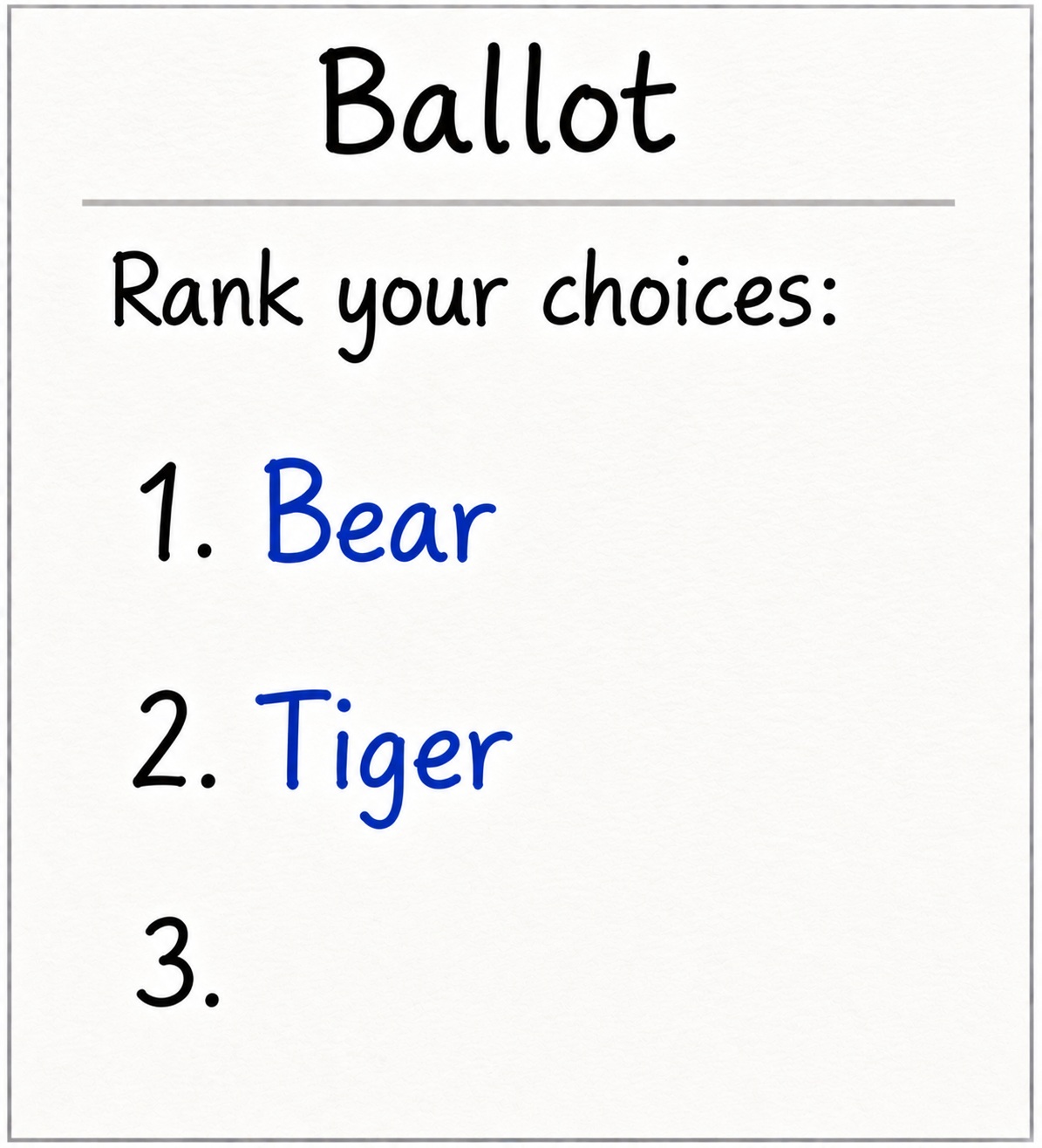
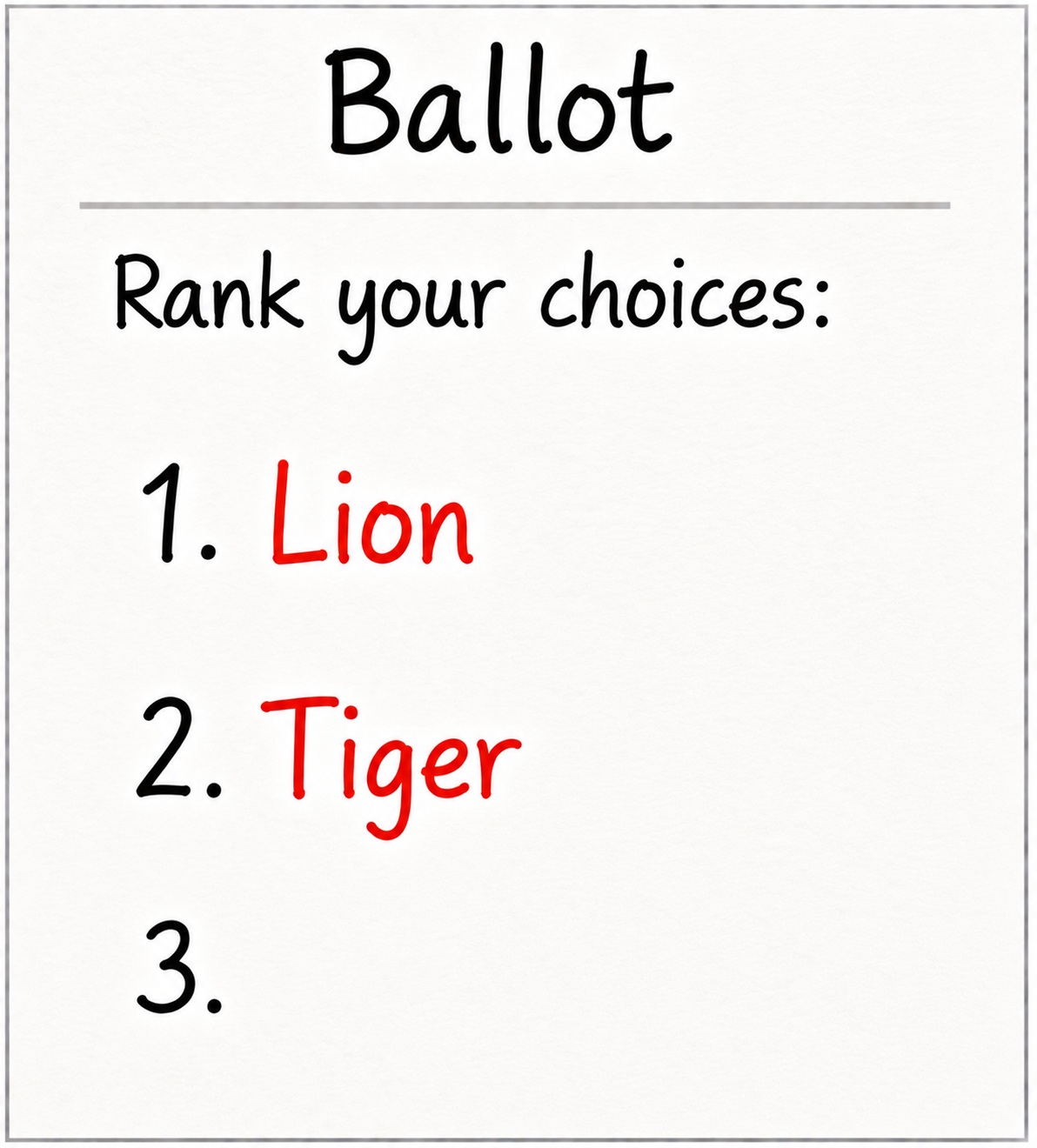
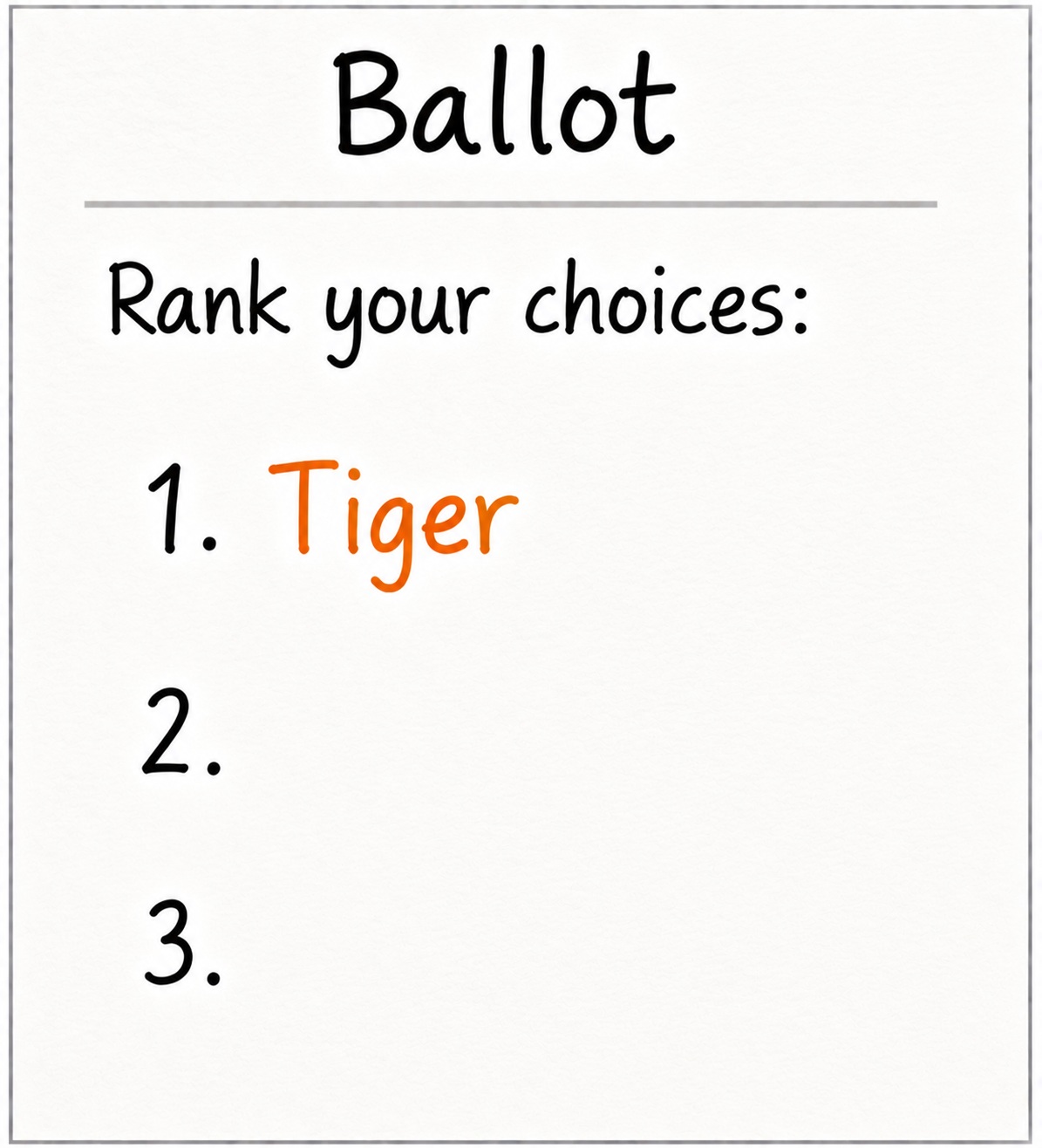
- The Foresters prefer the Bear, but list the Tiger second because they don't like the Lion.
- The Savannah Group prefers the Lion, and also lists the Tiger second because they do not like the Bear.
- The Jungle Group only votes for the Tiger and provides no information about whether they have any preference between the Bear and the Lion.
Instant Runoff Voting
Now, suppose Instant Runoff Voting (IRV) is used. We start by comparing the first-choice preferences:
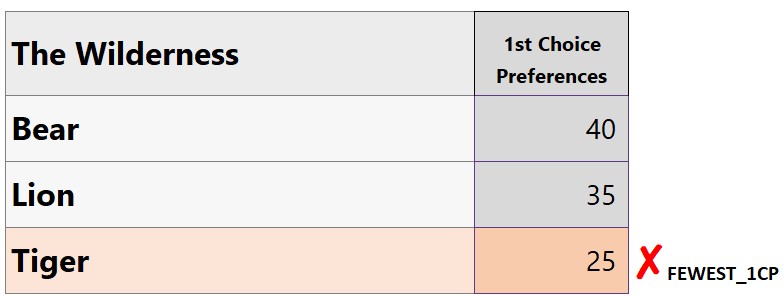
The Tiger with the fewest first-choice preferences is eliminated. The 25 ballots with the Tiger ranked first do not rank either remaining candidate, so they do not continue. The process continues between the Bear and the Lion:
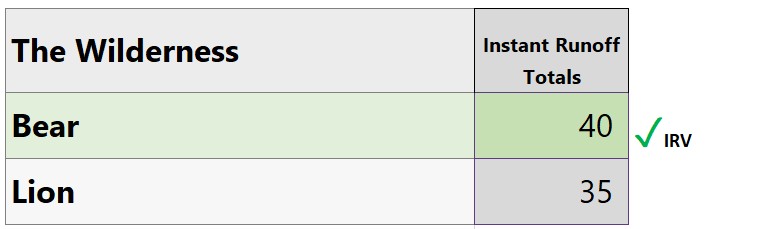
And the Bear wins with a majority of the final votes, but not with a majority of the total votes. Members of the Feline community may be outraged by these results, because Feline candidates combined for more total votes than the Bear. They may call Ranked Choice Voting a partisan plot by Foresters to rig elections, and argue that the Felines as a whole were disenfranchised by having their ballots thrown in the garbage or set on fire.
It may be that the Jungle Group did not fully understand the ballot. Or it may be that they simply chose not to express a preference between the Lion and the Bear. It is impossible to know whether they would have shown up if the race had been only between the Lion and the Bear, or if there had been a runoff election.
Critics of IRV would describe the Lion as a spoiler candidate. If the Lion had not run, the Savannah Group indicated they would have supported the Tiger over the Bear to reach their best achievable outcome. This gives the Felines an incentive not to run the Lion, because doing so could cause the Bear to win instead of the Tiger.
Head-to-Head Record
Now consider how the same example would play out using Head-to-Head Record. The results would be:
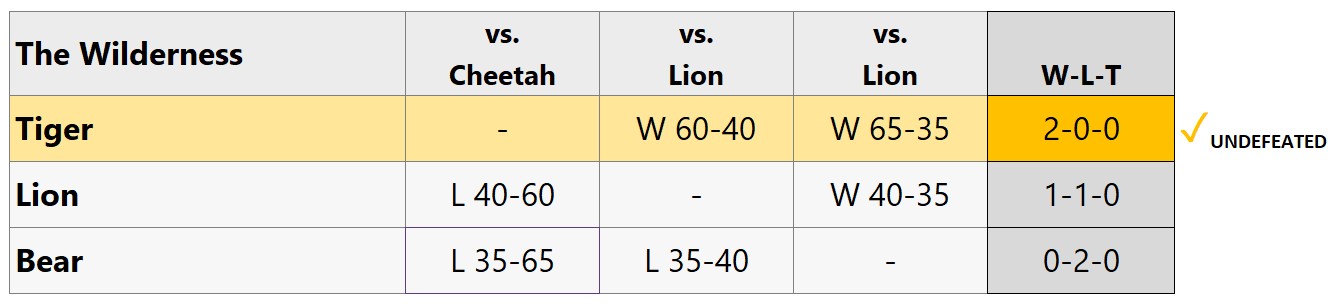
And the Tiger would win as the undefeated Head-to-Head winner, even though the Tiger was the first candidate eliminated under Instant Runoff Voting. Recall that under IRV, the Savannah Group was incentivized not even to run the Lion because making the Lion their first-choice preference allowed the Bear to win. Advocates of Head-to-Head systems would argue this is a strength over IRV because a candidate can run without their supporters being penalized for making their candidate their first-choice preference simply because their coalition allies exhaust their ballots before expressing a secondary preference for their candidate.
Exhausted ballots are not the result of a mistake in counting, but of voters choosing not to express preferences among all of the candidates. This could be because voters are indifferent, or because they simply choose not to list them in their order of preference.
Comments
This site does not manage comment accounts. Comment data is handled by a third-party discussion service.