Head-to-Head Cycle Resolutions
When a preference cycle occurs, there must be a predefined method for determining the winner. The simplest approach would be to rank candidates first by head-to-head record, then by first-choice preferences, then lower rankings if necessary. Such a system would be a perfectly valid cycle-resolution method, and most voters could easily understand this type of tiebreaker.
Mathematicians, however, have developed other cycle-resolution methods with different mathematical properties. While the mechanics of these methods are more complicated, they are designed to satisfy criteria that researchers consider desirable. This article explains the simple Head-to-Head then First Choice Preferences approach, a closely related variation that uses Worst Loss Differential instead of first-choice preferences, and two widely known methods: Ranked Pairs and Schulze.
The details of Ranked Pairs and Schulze are not required reading for the remainder of this site. It is simply an optional look at how some commonly discussed head-to-head methods resolve cycles.
Rail Corridor Commissioner
We return to the down-ballot Rail Corridor Commissioner example from the previous article.



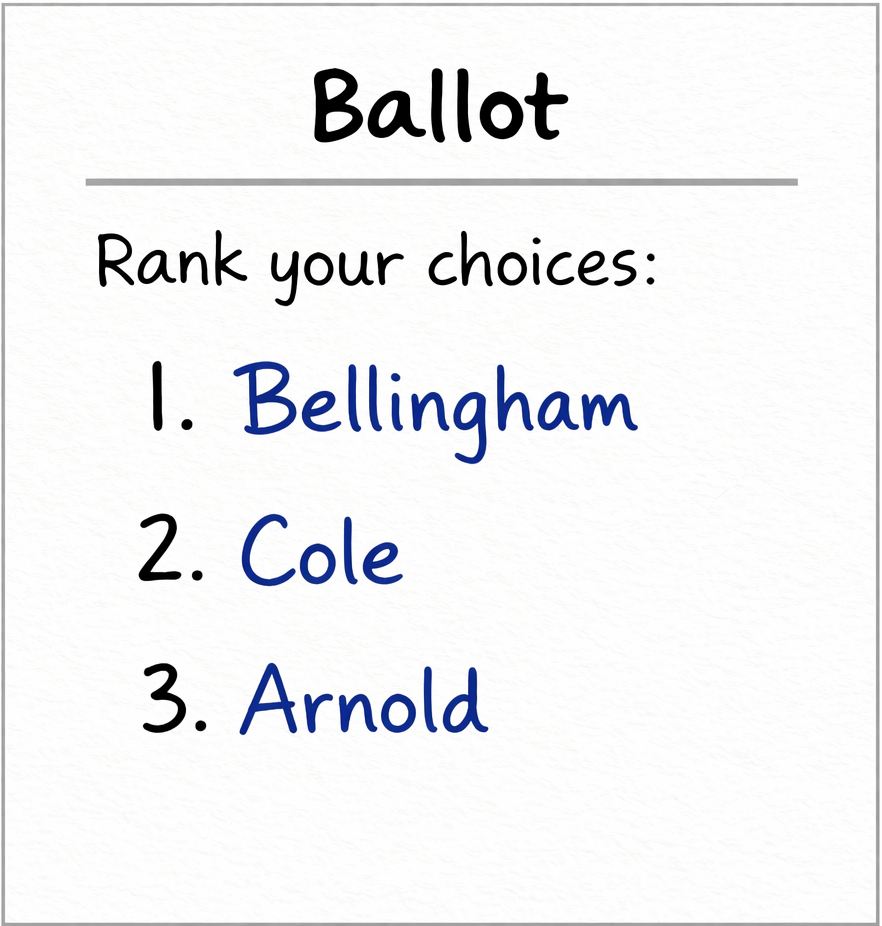
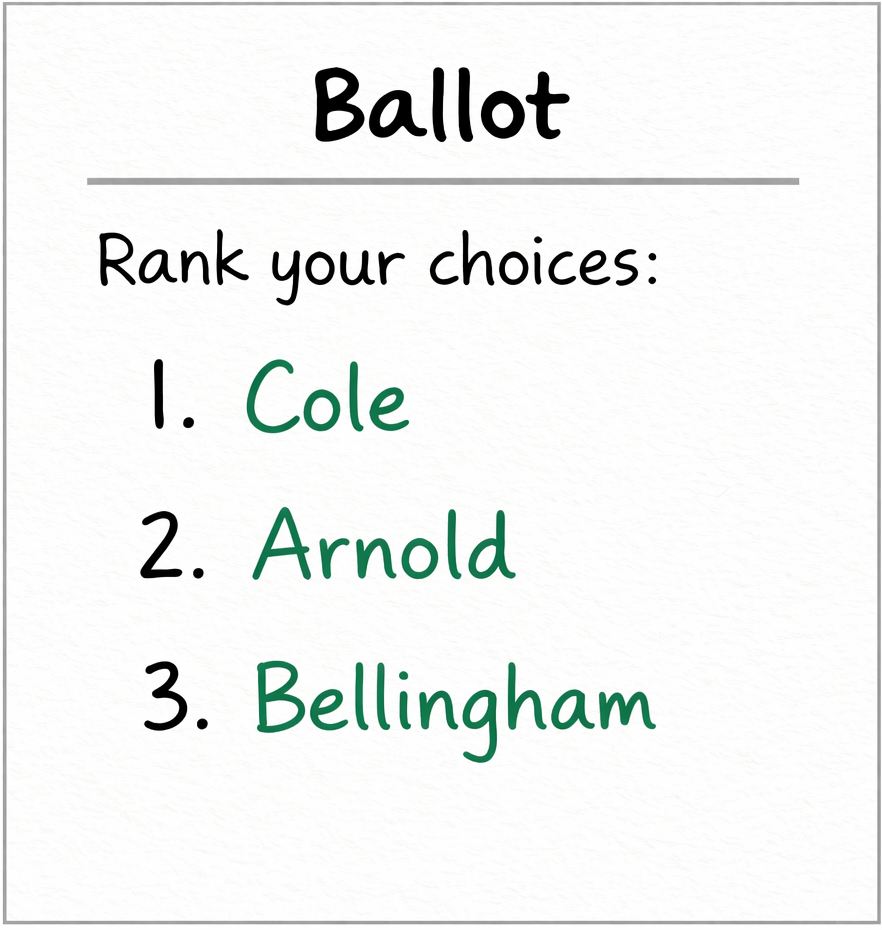
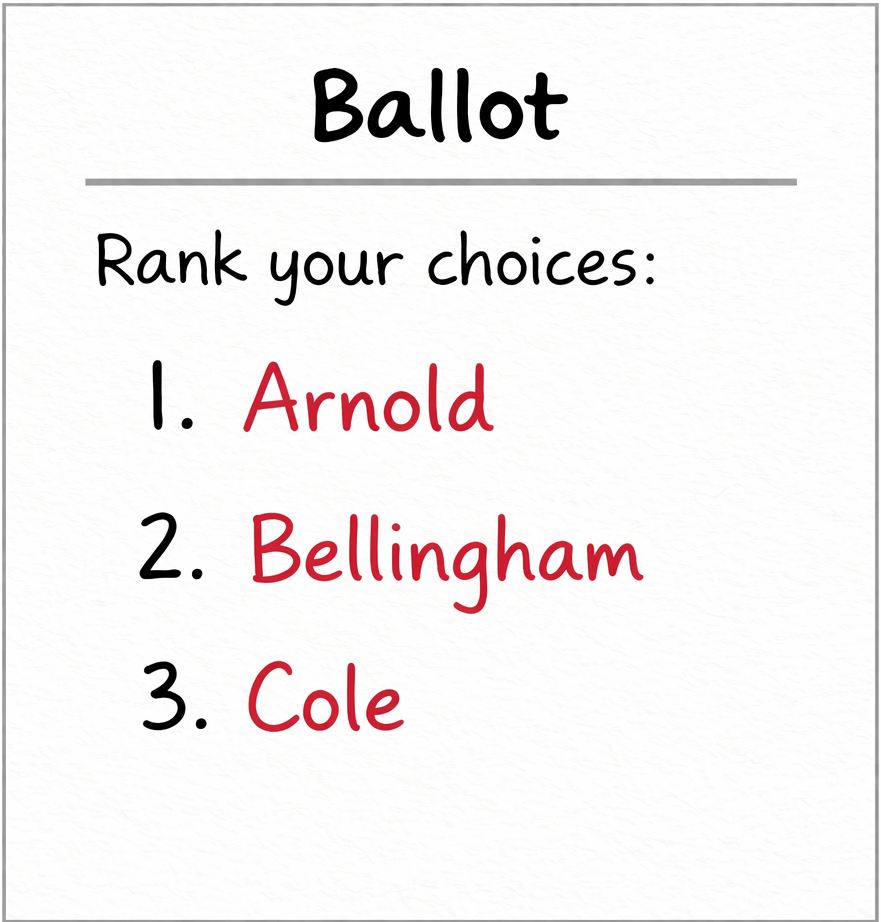
The voters submitted the following ranked ballots:
Head-to-Head, then First Choice Preferences
The simplest way to resolve a preference cycle is to sort candidates first by head-to-head record, and then by first-choice preferences. Applying this method gives:
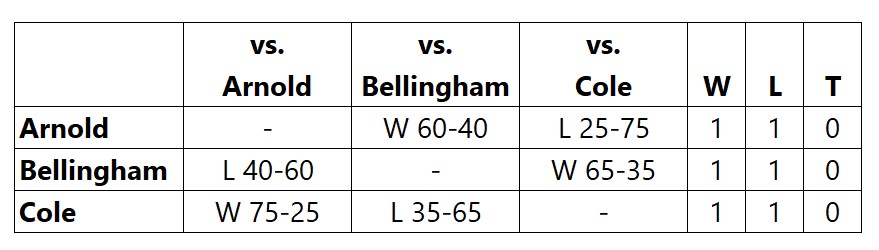
This immediately produces the ordering Bellingham > Cole > Arnold, making Bellingham the winner. The advantage of this method is its simplicity. It produces a legitimate winner that most voters can understand in about 30 seconds. The trade-off is that it does not satisfy many of the mathematical properties that voting theorists have spent decades developing.
Head-to-Head, then Worst Loss Differential
Another simple method of resolving preference cycles is to sort candidates first by head-to-head record, and then by worst loss differential. Worst Loss Differential measures only a candidate's largest head-to-head defeat. When candidates have the same head-to-head record, the candidate whose worst defeat is smallest ranks ahead of candidates whose worst defeat is larger. Applying this method gives:

This also produces the ordering Bellingham > Cole > Arnold, making Bellingham the winner. This method also produces a legitimate winner that most voters can understand quickly. The advantage of this method is that it is more resistant to strategic burial, the primary criticism of head-to-head elections. Resistance against strategic burial is discussed in more detail here.
Ranked Pairs
Ranked Pairs uses the same head-to-head results, but resolves the preference cycle differently. Instead of using first-choice preferences as a tiebreaker, the matchups, or "pairs," are sorted by margin of victory, or "ranked" from strongest to weakest. Starting from the top of the list, victories are “locked” if they do not create a cycle, or skipped if they do.
This creates a cyclical result with no head-to-head undefeated candidate. To apply Ranked Pairs, we first list the winning matchups and their margins of victory:

Next, the matchups are sorted from strongest victory to weakest victory:

Finally, the pairs are locked or skipped depending on whether they create a cycle or not.

In this example, "Arnold defeats Bellingham" is skipped because "Bellingham defeats Cole" and "Cole defeats Arnold" have already been locked. Adding "Arnold defeats Bellingham" would complete a cycle. The remaining locked pairs are:

This leaves "Cole defeats Arnold" and "Bellingham defeats Cole", producing a Ranked Pairs ordering of Bellingham > Cole > Arnold, making Bellingham the final winner under Ranked Pairs.
Schulze
The Schulze method also begins with the same head-to-head matchups, but it approaches cycles differently. Instead of locking victories one at a time, Schulze compares candidates using "beat paths" and "strongest path strength". This works as follows:
- If a candidate defeats another candidate directly, this is considered a direct beat path. The path strength is the number of votes received by the winner in that head-to-head matchup.
- If a candidate can reach another candidate through a chain of victories, that chain creates an indirect path. The strength of the indirect path is determined by its weakest link.
- If a candidate loses to another candidate, and cannot reach that candidate through a chain of victories, then the path strength is 0.
- For each pair of candidates, Schulze uses the strongest available path, whether that path is direct or indirect.
A candidate may lose directly to another candidate, but still have a stronger path through an indirect route. A ranking based on strongest path strengths can then be used to determine the winner.
We will describe this using the same Rail Corridor Commissioner example. First, list the head-to-head victories and calculate direct path strength:
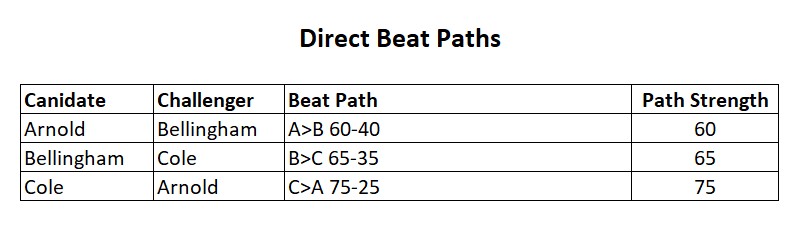
Then, find the strongest paths between candidates, which can be direct or indirect. The path strength of an indirect path is determined by the weakest link in that path:
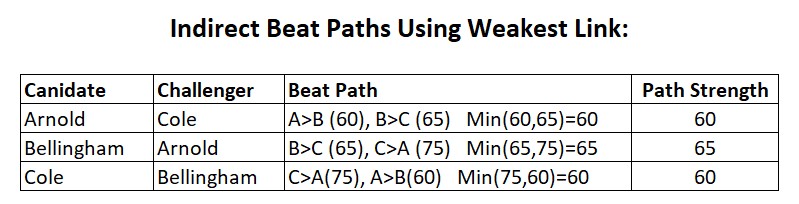
Comparing the strongest path strengths in each direction produces the following pairwise results:
Note that while "Arnold defeats Bellingham" in a direct head-to-head matchup, "Bellingham defeats Arnold" based on strongest beat path strength. The resulting Schulze ordering is Bellingham > Cole > Arnold. So under the Schulze method, Bellingham is the winner.
A Larger Example
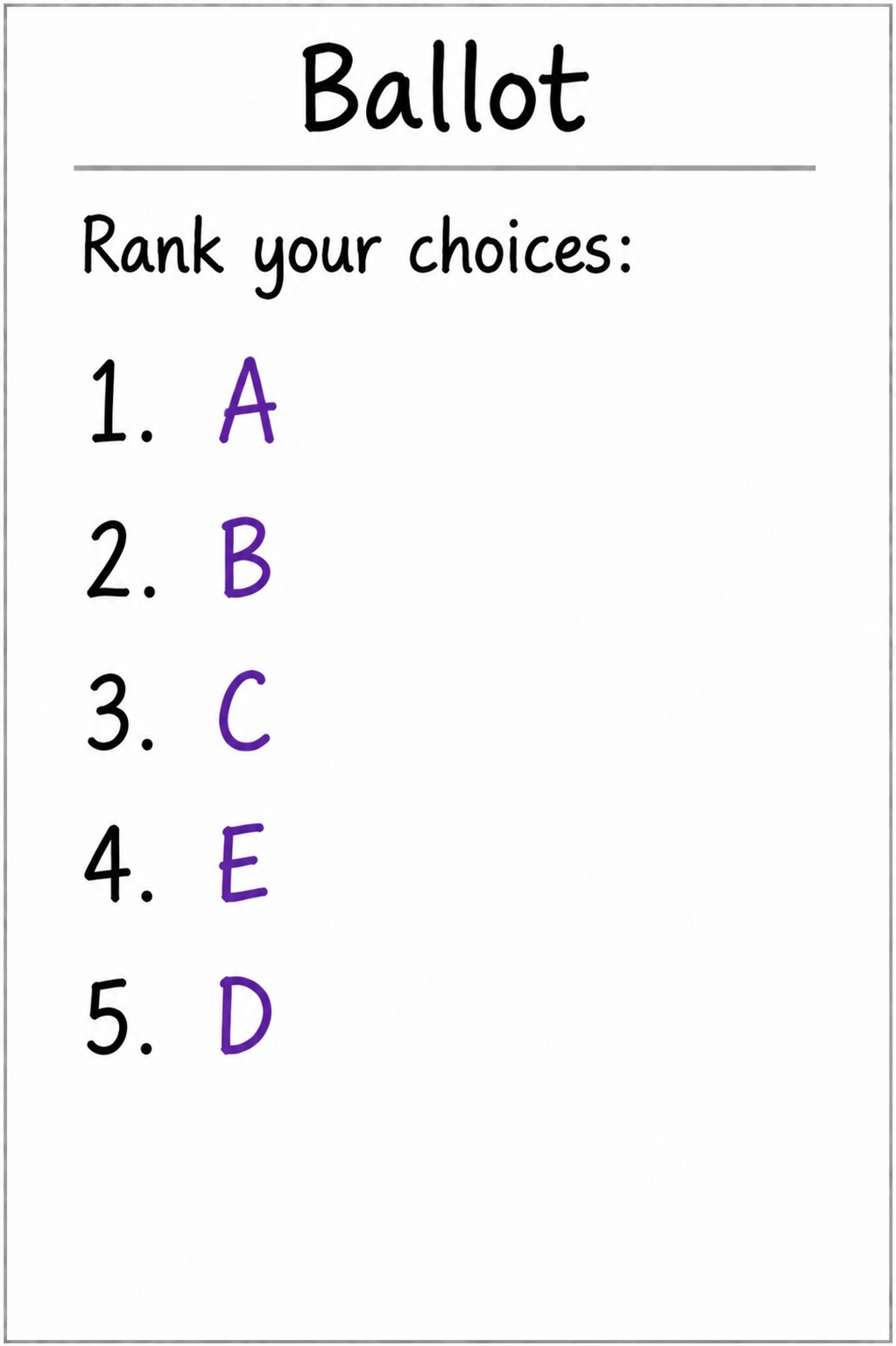
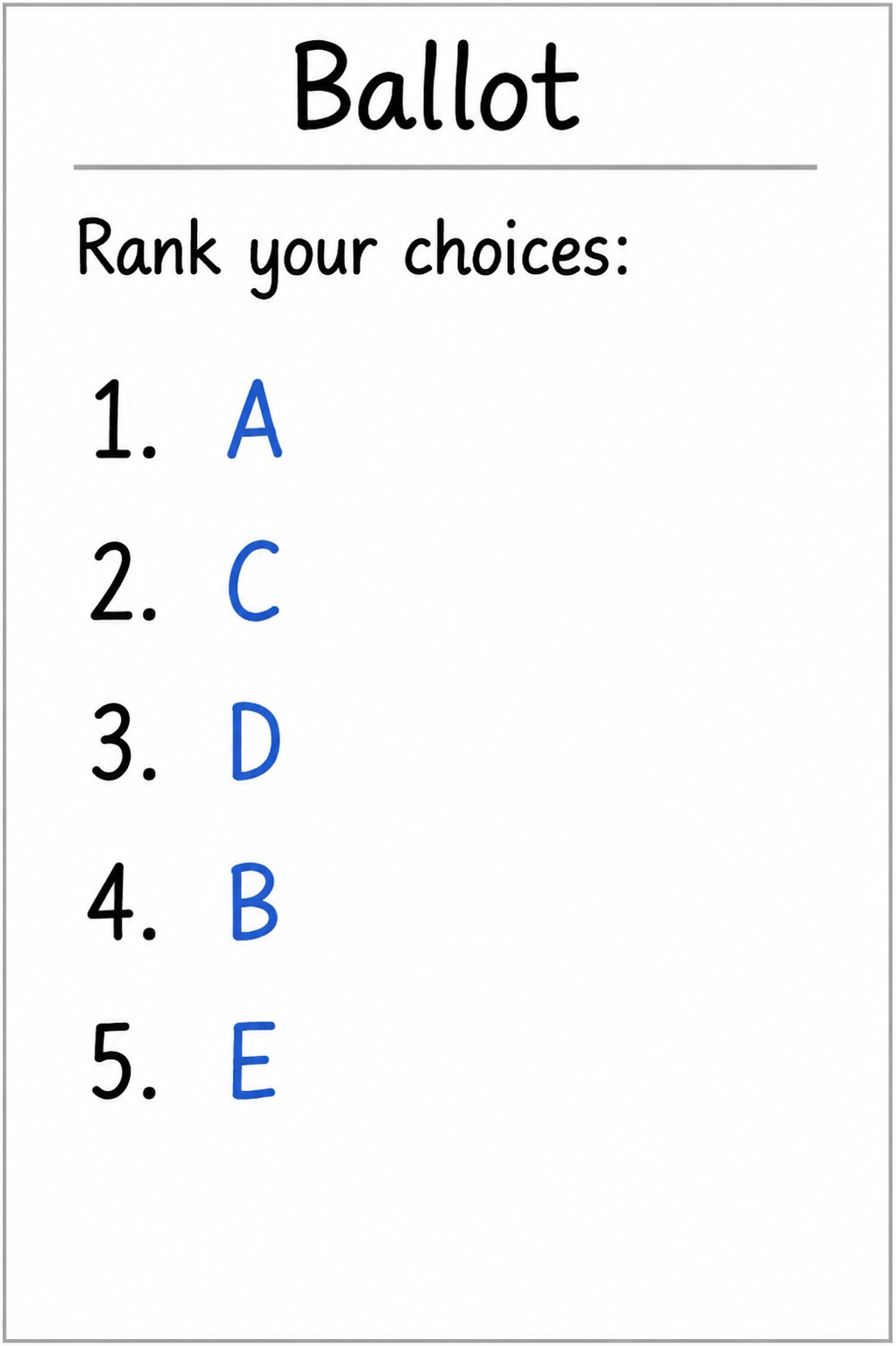
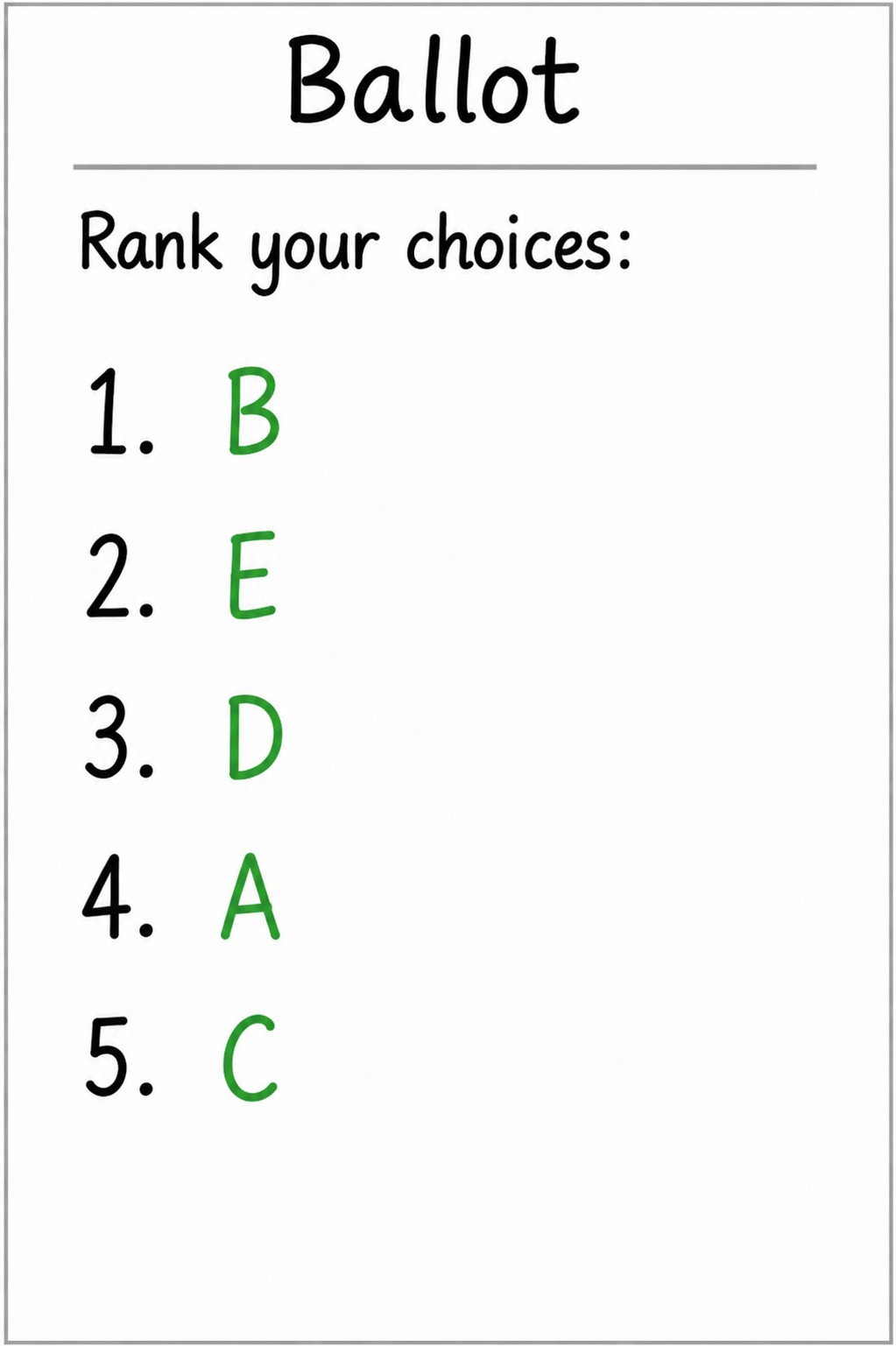
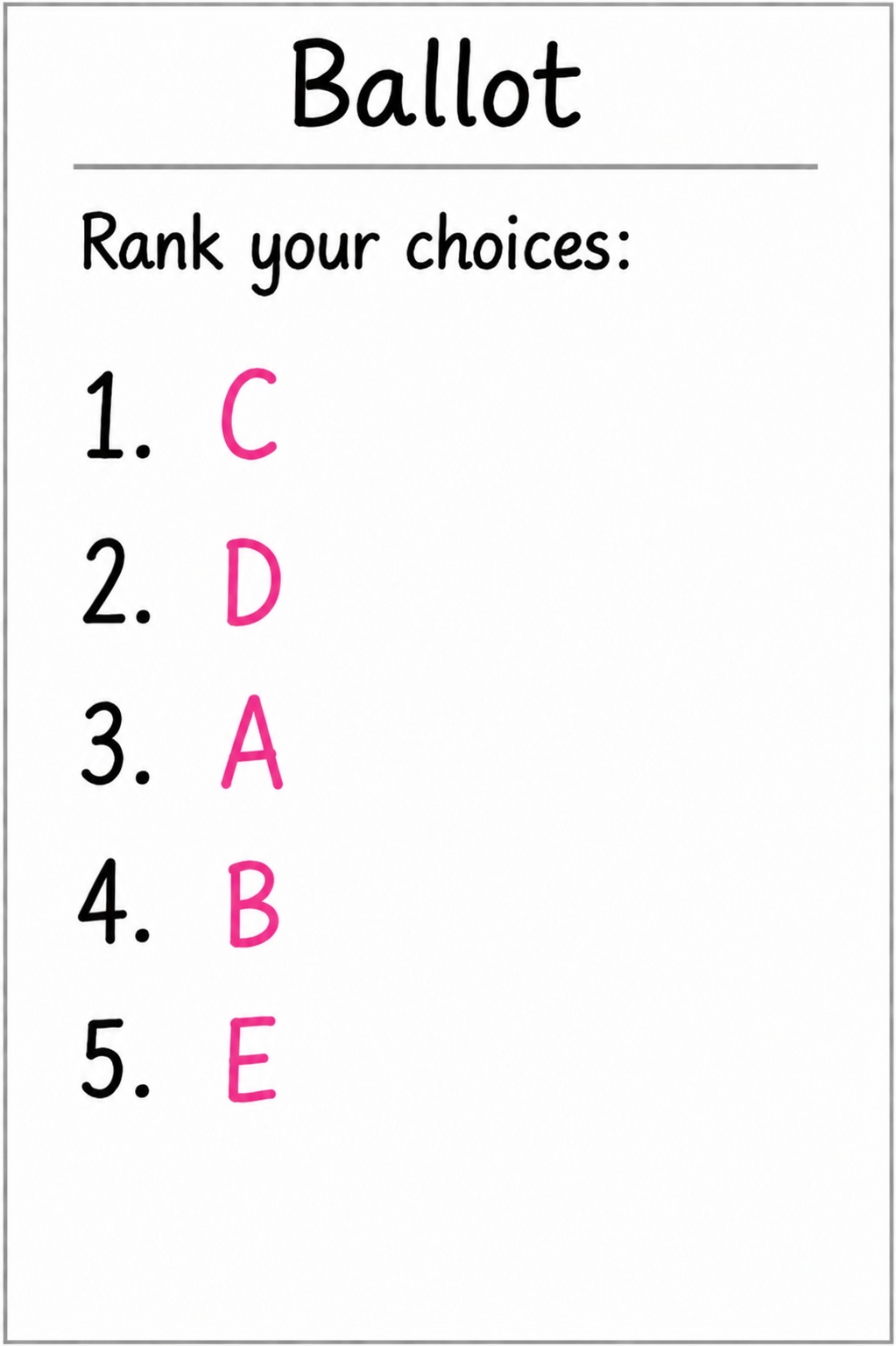
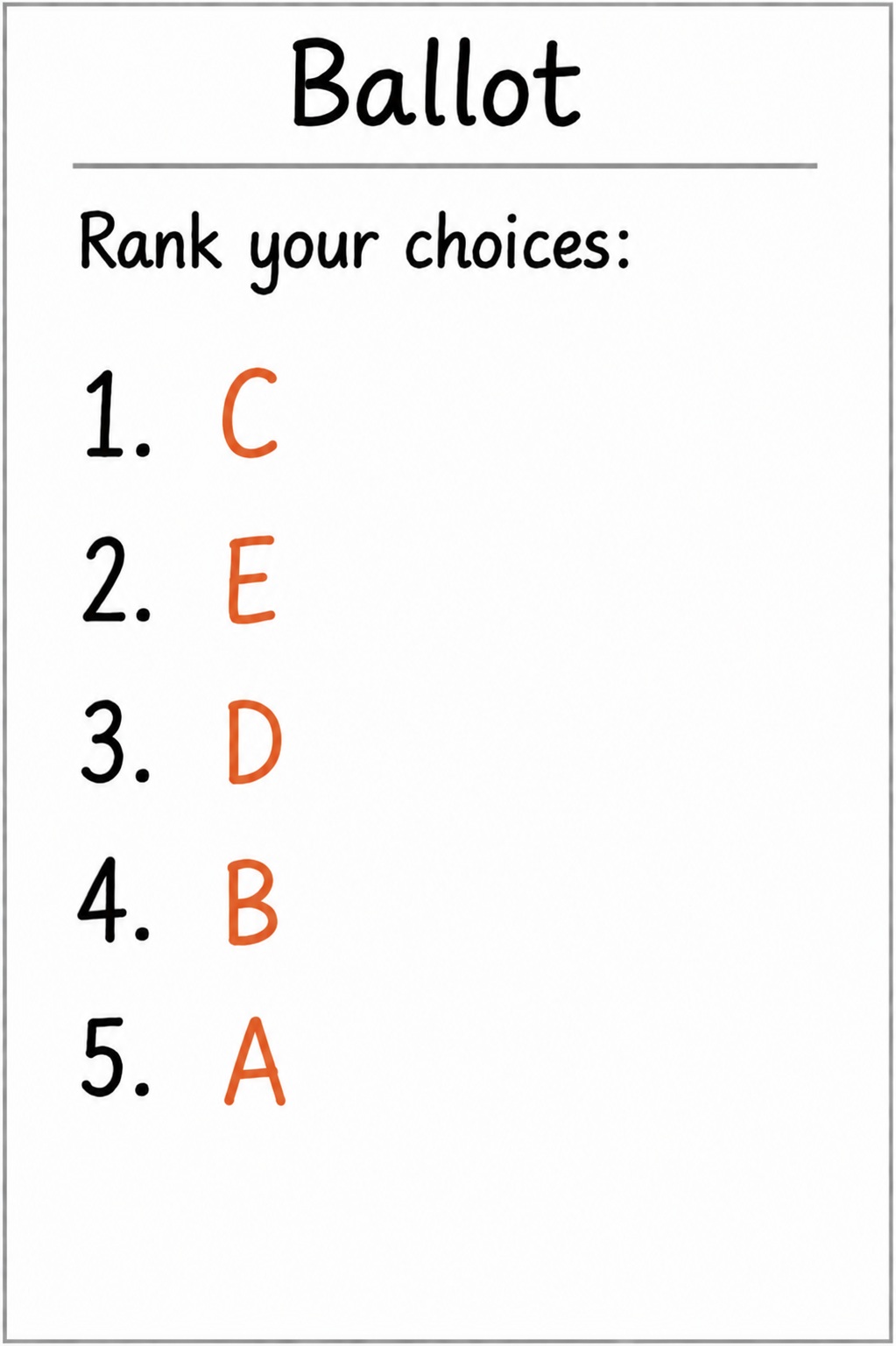
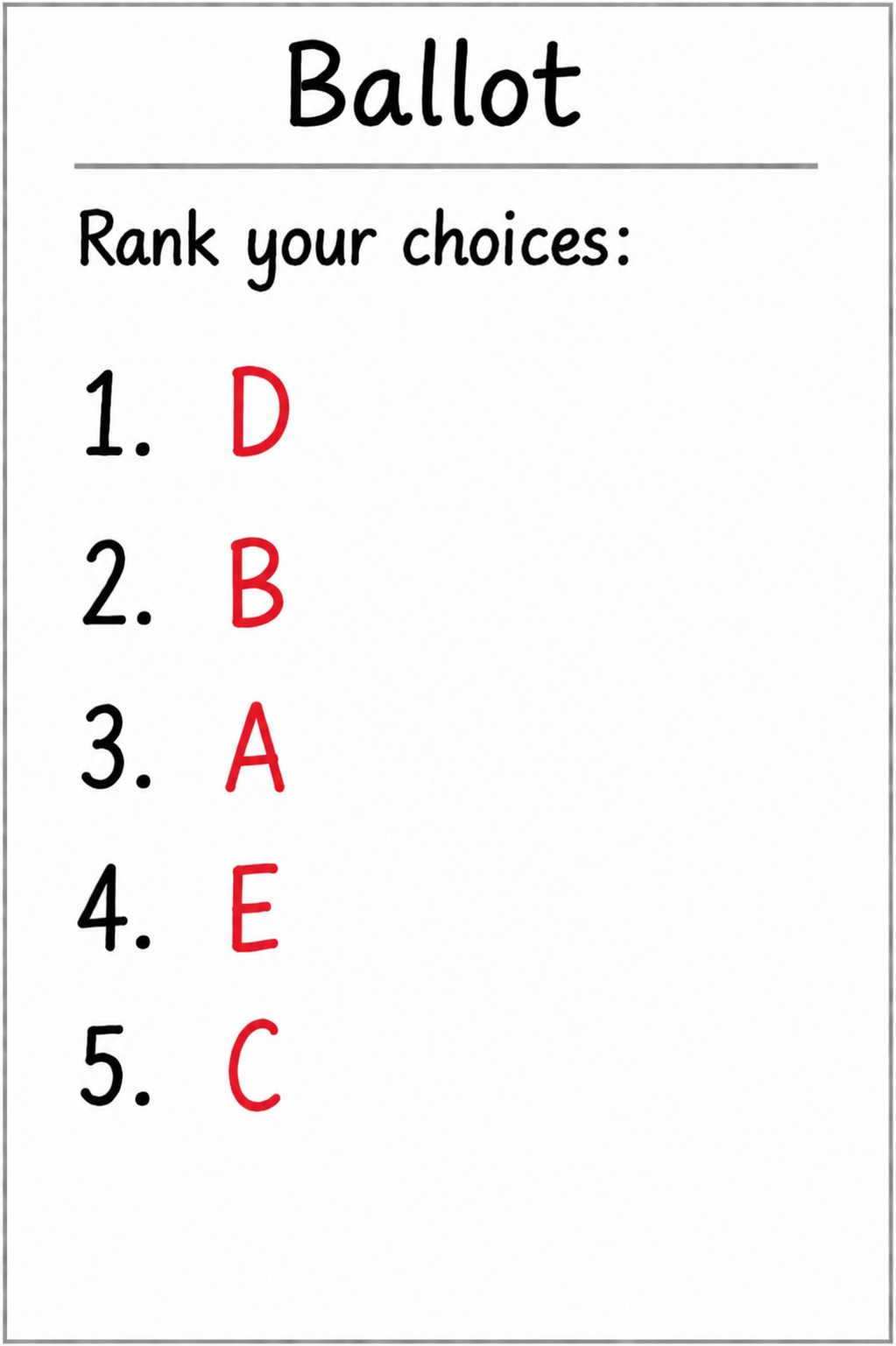
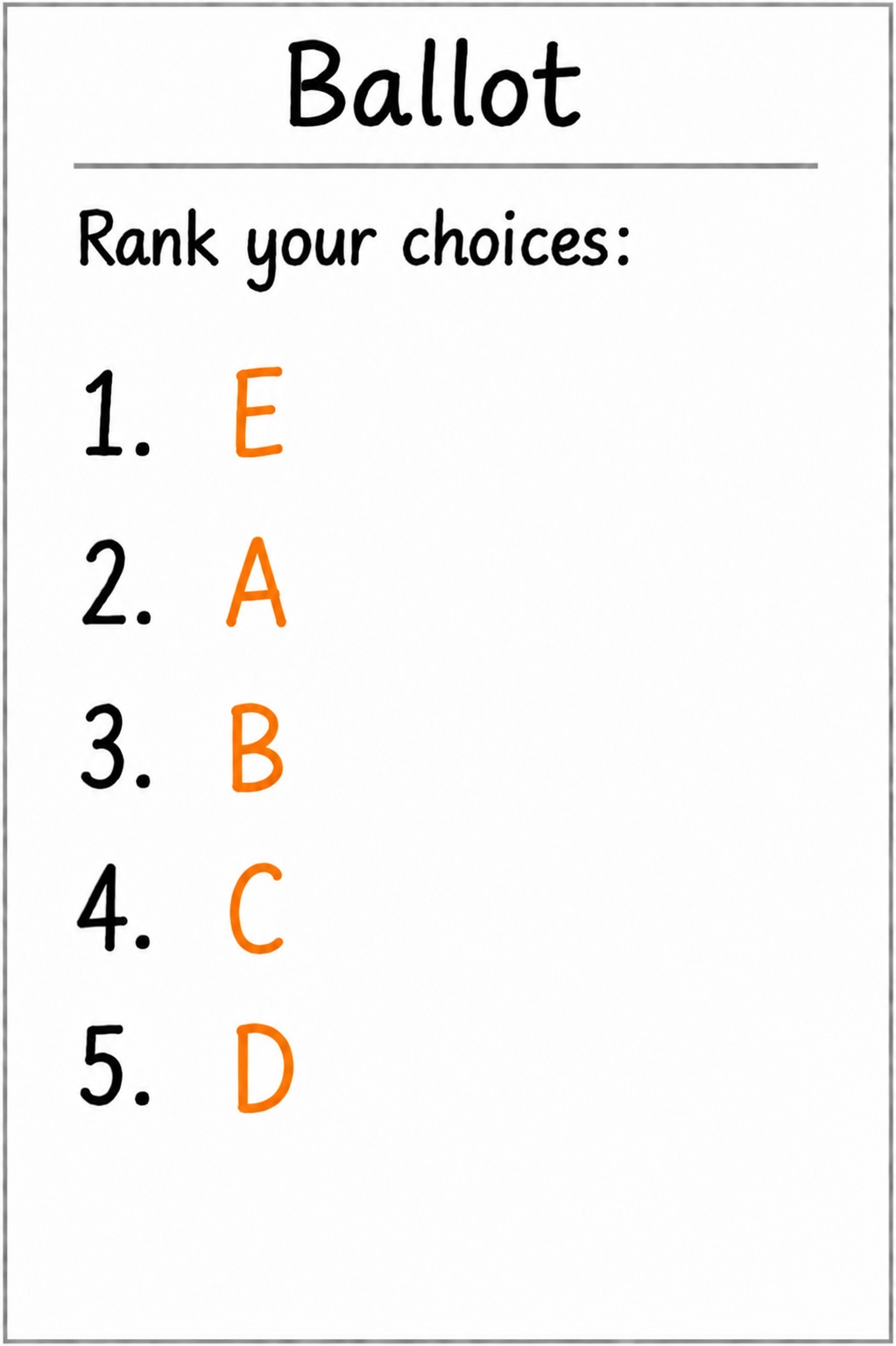
While all cycle resolution methods produce the exact same winner when an undefeated head-to-head candidate exists, they do not always produce the same winner when one does not. The next example is intentionally unusual and is designed to demonstrate how different methods can diverge. For this example, instead of candidate names we will use letters:





75 voters fill out the ballots as follows:
Head-to-Head, then First Choice Preferences
Applying the same method, we sort candidates first by head-to-head record, and then by first-choice preferences:
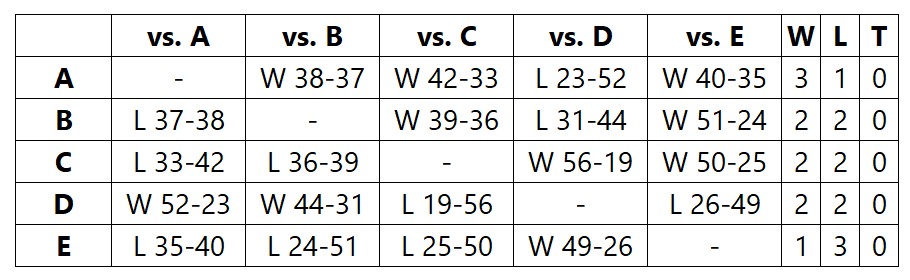
This immediately produces the ordering A > C > B > D > E. Candidate A finishes with the best overall head-to-head record at 3-1. Note that candidate C has more first choice preferences than A, but this method values head-to-head record over first choice preferences. Also note that there is no head-to-head undefeated candidate, as every candidate in the set defeats at least one other candidate in the set.
Head-to-Head, then Worst Loss Differential
We now look at sorting candidates first by head-to-head record, and then by worst loss differential:
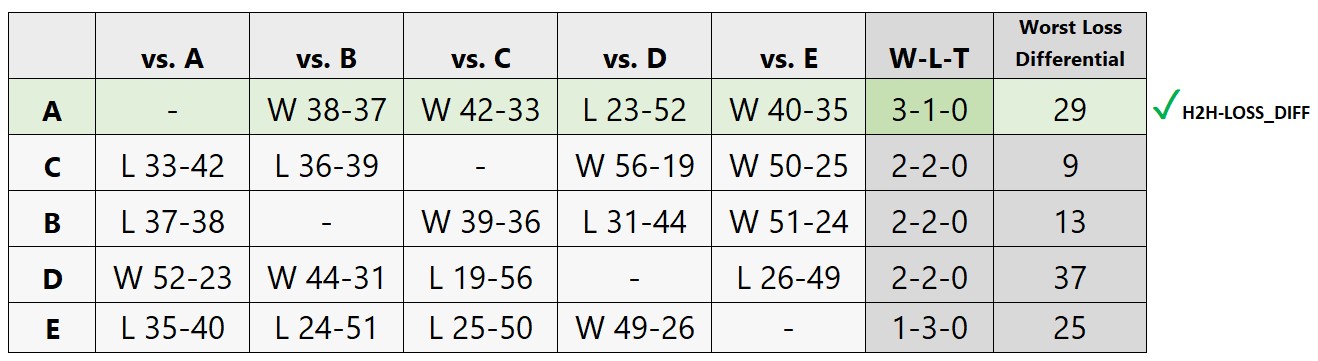
Again we have the ordering A > C > B > D > E. Candidate A finishes with the best overall head-to-head record at 3-1. Although Candidates B, C, and E have substantially smaller worst losses than Candidate A, this method still ranks A first because overall head-to-head record takes precedence over Worst Loss Differential.
Ranked Pairs
We now apply Ranked Pairs to the same ballots. First, extract the winning matchups and their victory margins:
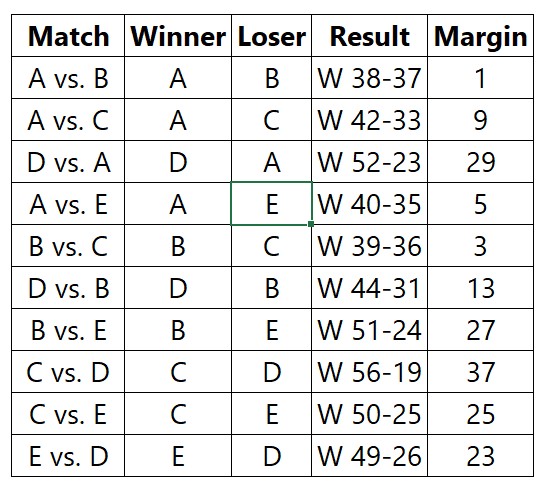
Next, sort the victories from strongest to weakest:
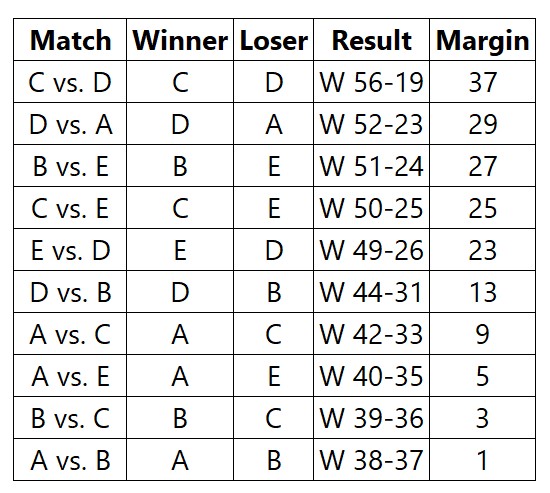
The victories are then locked from the top down, skipping any matchup that would create a cycle.
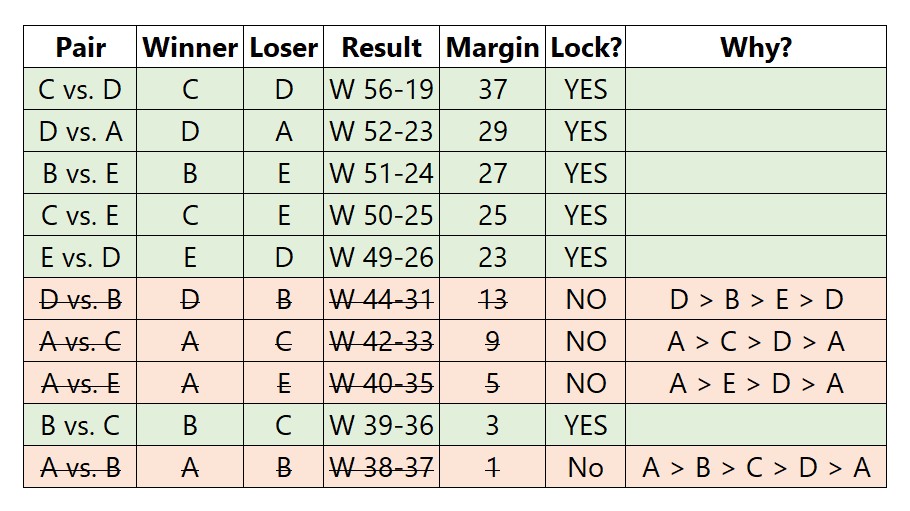
The final locked ordering becomes:
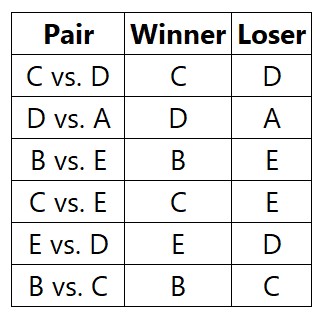
This produces the ordering B > C > E > D > A. Under Ranked Pairs, Candidate B becomes the winner.
Schulze
We now apply the Schulze method to the same ballots. First, list the direct head-to-head victories between candidates and calculate direct path strength:
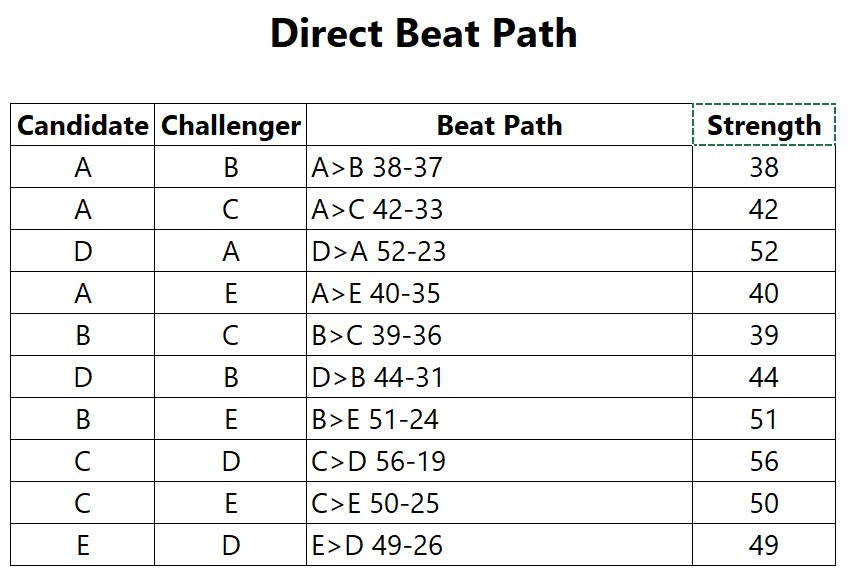
Next, examine the indirect paths connecting candidates and determine the strongest path strength between each pair of candidates:
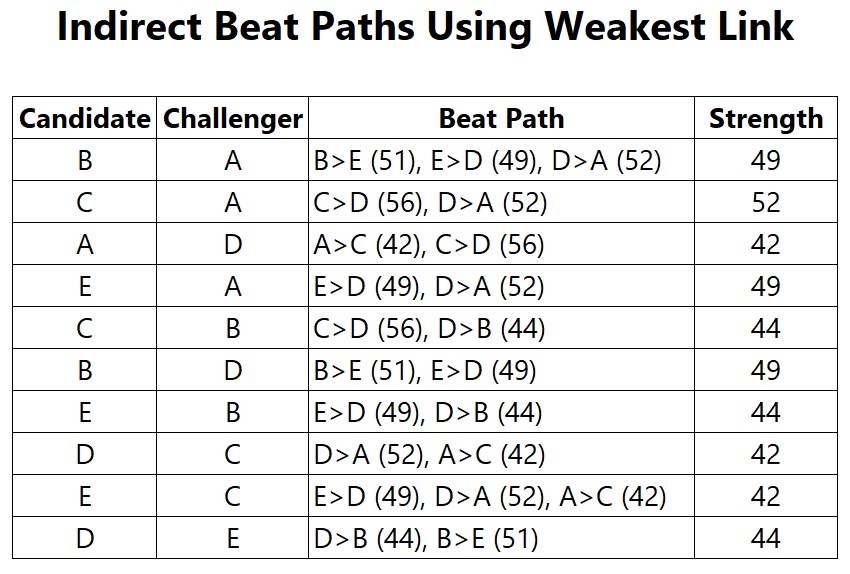
Comparing the strongest path strengths in each direction produces the following pairwise results:
| B defeats A | B defeats D |
| C defeats A | B defeats E |
| D defeats A | C defeats D |
| E defeats A | C defeats E |
| C defeats B | E defeats D |
Using these pairwise results, the resulting Schulze ordering is C > B > E > D > A. So under Schulze, Candidate C becomes the winner.
One important takeaway is that all of the methods described above would elect an undefeated head-to-head candidate whenever one exists. However, when no undefeated head-to-head candidate exists, different cycle-resolution methods can produce different winners. Even though examples like this are uncommon, they demonstrate an important property of head-to-head systems. Different methods can interpret the same set of ranked ballots differently when cyclical outcomes occur. There is much deeper mathematics surrounding cyclical results and cycle resolution methods than what is covered here, and readers interested in these topics can find extensive academic discussion online.
Because different methods resolve cycles differently, the rules for resolving them should be defined before the election takes place. If the voters' preferences ever produce a cycle, those predefined rules should determine the result.
Comments
This site does not manage comment accounts. Comment data is handled by a third-party discussion service.