Indifference in Ranking Choices
When given a large number of options to choose from, some people may have a complete order of preference, but people are often indifferent between many of the possible selections.

There is no reason to invent an order of preference among choices considered equal. Voters can feel the same way about candidates. A voter might feel one group of candidates would do a great job, another group could do a perfectly fine job, while another group would do a terrible job. There may also be candidates the voter knows nothing about, but they would absolutely prefer those unknowns over candidates they don't like.
Some Ranked Choice Voting (RCV) systems permit voters to express indifference at any level, while others require voters to manufacture distinctions between candidates they consider equal in order to separate candidates they prefer more from candidates they prefer less. We will discuss how different ranked election systems handle indifference in this article.
Instant Runoff Voting
Instant Runoff Voting (IRV) does not handle indifference naturally. Under common IRV ballot rules, ranking more than one candidate at the same rank is treated as an overvote. When an overvote is reached during the count, the ballot becomes exhausted and no longer counts for any candidate or transfers to any lower-ranked candidates.1
Consider an IRV election where, after eliminations and ballot transfers, Amy and Ben are the final two candidates. First, consider this ballot:
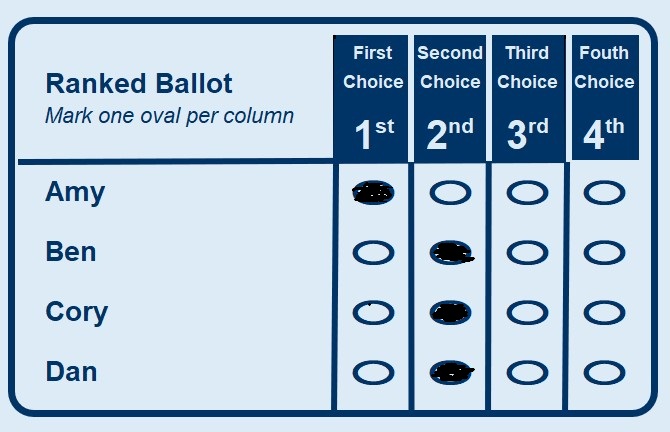
Although the voter is indifferent between Ben, Cory, and Dan, Amy is the voter’s unambiguous first choice, and because the overvote occurs after the vote has already counted for Amy, this ballot will count for Amy in the final matchup. Now consider this ballot:
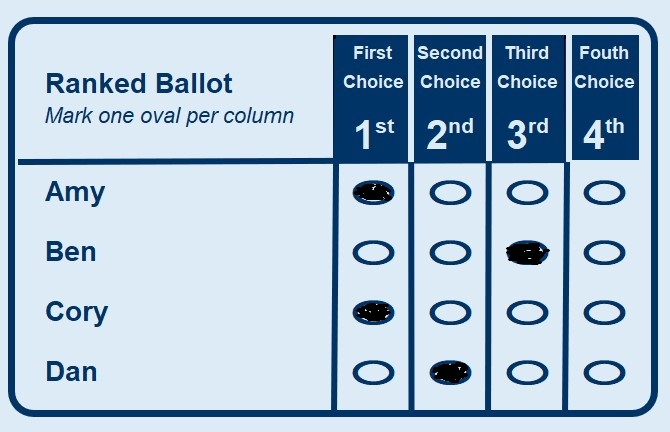
This voter clearly expressed a preference of Amy over Ben, but showed indifference between Amy and Cory. Because Amy and Cory are both ranked first, standard IRV treats this as an overvote and exhausts the ballot, so it would not count for either finalist despite the voter's clear preference for Amy over Ben.1 Finally, consider this ballot:
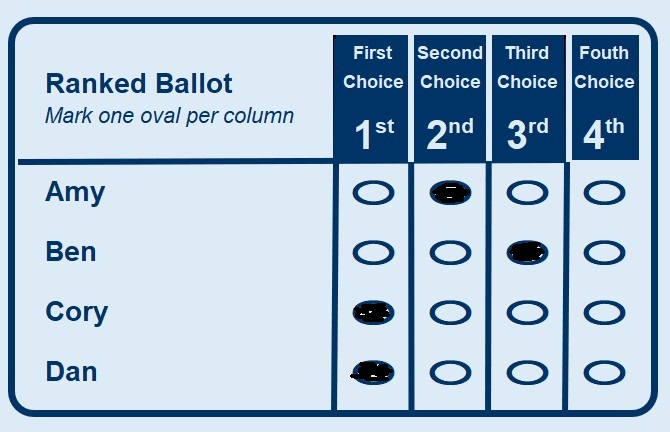
This voter also expressed a clear preference of Amy over Ben, but showed indifference between Cory and Dan at a higher rank. Because the higher ranking has an overvote, standard IRV also exhausts this ballot, and the voter’s clear preference for Amy over Ben is not counted in the final round.1
Split-IRV (Fractional IRV)
One proposed modification to IRV that permits indifference is Split-IRV.2 When multiple candidates are tied as a voter's highest-ranked remaining choices, the vote is divided equally among those candidates. For example, reconsider this ballot we just discussed:
With Amy and Cory both ranked first, the ballot initially gives ½ vote to Amy and ½ vote to Cory. If Cory is eliminated, Amy becomes the voter's sole highest-ranked remaining candidate, and the ballot continues as a full vote for Amy. The elimination process continues just like standard IRV, until a candidate achieves a vote total greater than 50% of the continuing vote.
Split-IRV can also create vote-splitting problems between similar candidates. When voters rank two similar candidates equally, their support is divided between them. Although that support can consolidate if one of them is eliminated, the divided support can change the order in which candidates are eliminated and cause a candidate to lose an election they otherwise would have won if the votes were not split.
Approval-IRV (Whole Vote IRV)
Another proposed modification is Approval-IRV.3 When multiple candidates are tied as a voter's highest-ranked remaining choices, the ballot gives one full vote to each of those candidates.
For example, reconsider the same ballot. With Amy and Cory both ranked first, the ballot initially gives one vote to Amy and one vote to Cory. If Cory is eliminated, the ballot continues to give one vote to Amy.
This can create a dilemma because multiple candidates can have greater than 50% approval in the same round. The system could immediately elect the candidate with the highest approval once one or more candidates exceed 50%, or continue eliminating the candidate with the lowest approval until only one candidate remains. This is another detail that must be worked out prior to the election.
Head-to-Head Record
Head-to-Head Record does not require any modifications to address indifference. Each ballot is used to determine which candidate the voter prefers in every head-to-head matchup. If a voter ranks two candidates equally, the ballot simply counts for neither candidate in that matchup, while all of the voter’s other expressed preferences continue to count. This also retains the key strengths of head-to-head processing: voters are always incentivized to list their choices sincerely and are never punished for selecting their true order of preference.
In the ballot we have been using as an example, Amy would win her matchups against Ben and Dan, and Cory would also win her matchups against Ben and Dan. Dan would win the matchup against Ben, and there would be no winner between Amy and Cory. The indifference between Amy and Cory does not weaken any of the other preferences expressed by the voter.
Allowing indifference gives voters a way to express the preferences they actually have without requiring them to express preferences they do not. IRV has multiple proposed variations to accommodate indifference, each with various tradeoffs, while Head-to-Head Record accommodates indifference naturally without the need for any additional rules.
An experimental electronic ballot designed to make indifference effortless has been posted here.
1 FairVote’s Ranked Voting Guidelines state that when a ballot reaches a ranking with more than one candidate selected, it becomes an “overvote,” and that an overvote “shall remain so and shall not count towards any candidate in that round or in subsequent rounds.”
2 Aziz and Lee describe a fractional approach to handling indifference in transferable voting, where equal rankings are represented by splitting a voter's weight among the possible rankings. Delemazure and Peters later refer to the corresponding single-winner rule as Split-IRV.
3 Delemazure and Peters propose Approval-IRV, in which a ballot gives one full vote to each of its highest-ranked remaining candidates.
Comments
This site does not manage comment accounts. Comment data is handled by a third-party discussion service.