2026 Alaska House Election CVR Analysis
The 2026 Alaska House election is a single-winner election using the Hare form of Ranked Choice Voting, commonly called Instant Runoff Voting (IRV). This analysis is based on preliminary Cast Vote Records (CVRs) released by the Alaska Division of Elections on November 17, 2026, at 6:16 PM AKST. The CVRs represent approximately 98.2% of the estimated total vote (AP estimate). This page will be updated as additional CVRs become available. Based on the CVRs, the current counts of first choice preferences for each candidate are as follows:
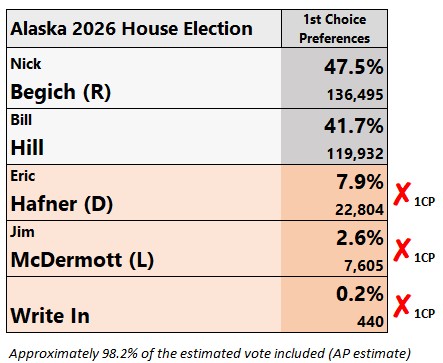
After the candidates with the fewest first choice preferences are eliminated and their ballots transfer to the next remaining ranked candidate, the preliminary totals would be:
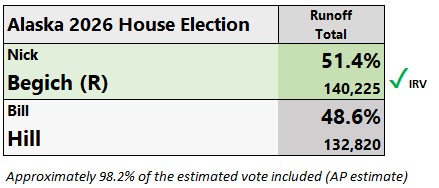
Based on the preliminary CVR data, Nick Begich leads in both first choice preferences and the final runoff. Nick Begich’s runoff 140,225 votes represent 51.4% of the continuing vote, 48.8% of valid House ballots, and 48.7% of ballots that attempted to vote for Representative.
Eric Hafner, who was serving a federal prison sentence in New York, drew controversy over concerns that he was a decoy candidate intended to draw votes away from independent Bill Hill, who was endorsed by the Alaska Democratic Party. Hafner received 22,804 legal first choice votes. Of those ballots:
- 10,176 of those ballots (44.6%) ranked Bill Hill > Nick Begich.
- 1,476 of those ballots (6.5%) ranked Nick Begich > Bill Hill.
- 11,152 of those ballots (48.9%) expressed no preference between Bill Hill and Nick Begich.
Some ballots attempting to vote for Representative had issues affecting how their preferences were counted under Hare IRV:
- 1,107 ballots contained equal rankings at some level that could spoil the ballot using Hare IRV.
- 504 ballots contained candidate markings but had no valid first choice vote under Hare IRV tabulation rules and were disqualified.
- 206 ballots expressed a clear Nick Begich > Bill Hill that will not count in the final runoff.
- 190 ballots expressed a clear Bill Hill > Nick Begich that will not count in the final runoff.
Additional numbers of interest include:
- 188,844 voters (65.7%) selected only a single distinct candidate.
- 33,250 voters (11.6%) ordered 4 or more unique preferences.
- 5,385 voters (1.9%) had skipped ranks, which in some cases could also spoil a ballot.
- 149 voters appeared to try to vote right-to-left.
- 6,708 voters ranked the same candidate in multiple ranks.
- 3,574 voters voted for the exact same candidate in all 5 ranks.
- 2,223 voters skipped the House race completely.
Using the same ballots, the results with Head-to-Head RCV (currently being promoted by Better Choices for Democracy) would be:
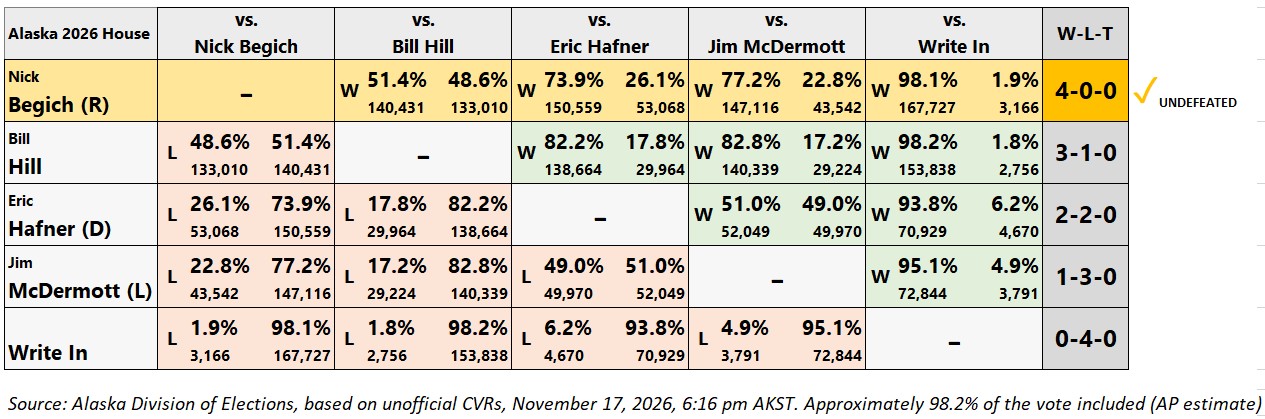
Nick Begich also leads in the head-to-head results, with an undefeated 4-0-0 record. When the IRV winner is also the undefeated head-to-head winner, none of the voters are penalized for expressing their sincere order of preference on the ballot. For a simpler example of why some election reformers prefer Head-to-Head RCV over Instant Runoff Voting, see this classroom pizza election article.
If there are any calculation errors, please let me know in the comments. Thanks!
Source: Alaska Division of Elections – 2026 General Election Results. Analysis based on preliminary Cast Vote Records released November 17, 2026, at 6:16 PM AKST. Results are independently calculated and are not official certified election results.
Comments
This site does not manage comment accounts. Comment data is handled by a third-party discussion service.