Single Transferable Vote (STV) for Proportional Representation
In previous articles, we discussed how territorial voting systems can skew representation based on how district boundaries are drawn and populations are distributed. Party-list voting reduces many of these territorial effects by assigning seats proportional to party support, but requires voters to vote for parties instead of individual candidates.

Single Transferable Vote, also called STV, is a proportional representation system built using Ranked Choice Voting. Instead of voting only for a party, voters rank individual candidates. Candidates who reach the quota threshold are elected, and surplus votes beyond the quota can transfer to other candidates ranked lower on those ballots. Those transfers may remain inside the same coalition, or move to entirely different candidates, depending on the voter’s indicated preference.
STV uses the same quota calculation described in Party-List Voting:
but applies it to individual candidates instead of parties. When a candidate reaches the quota needed to be elected, only the votes needed to elect that candidate remain assigned to that candidate. If there are excess votes, then all of the ballots that helped elect that candidate are reduced proportionally, and can continue to the next ranked candidate on the ballot still remaining in the election. Different STV systems may handle these surplus transfers somewhat differently, particularly in older hand-counted systems, but the overall transfer process remains similar.
To explain this mathematically, every initial ballot \(i\) is given a voting weight of \(B_i=1\). If a candidate \(X\) receives \(V_X\) total vote strength which is greater than the quota threshold \(Q\), the excess vote strength \(R_X\) is:
Each ballot \(i\) that helped elect candidate \(X\) is then proportionally reduced using:
Those ballots can then continue transferring to other remaining candidates at the reduced voting weight. The additional voting strength from these ballots can help other candidates reach quota or avoid elimination.
When no remaining candidates can reach quota directly, the candidate with the lowest total vote strength is eliminated. Those ballots then transfer at their existing vote strength to the next ranked candidate on the ballot still remaining in the election.
Because ballots may continue transferring beyond a voter’s local area, STV systems can reduce some of the geographic distortions found in territorial winner-take-all systems. However, STV systems are also more complicated. Ballots can transfer multiple times, candidates can be eliminated, surplus votes may transfer at fractional strength, and ballots can eventually exhaust if no ranked candidates remain.
We will demonstrate this process in the following example.
Red Barn Elementary School
The Principal of Red Barn Elementary School is allowing the students to select three community pets for the school grounds. There are a total of 10 pets the students may choose from:
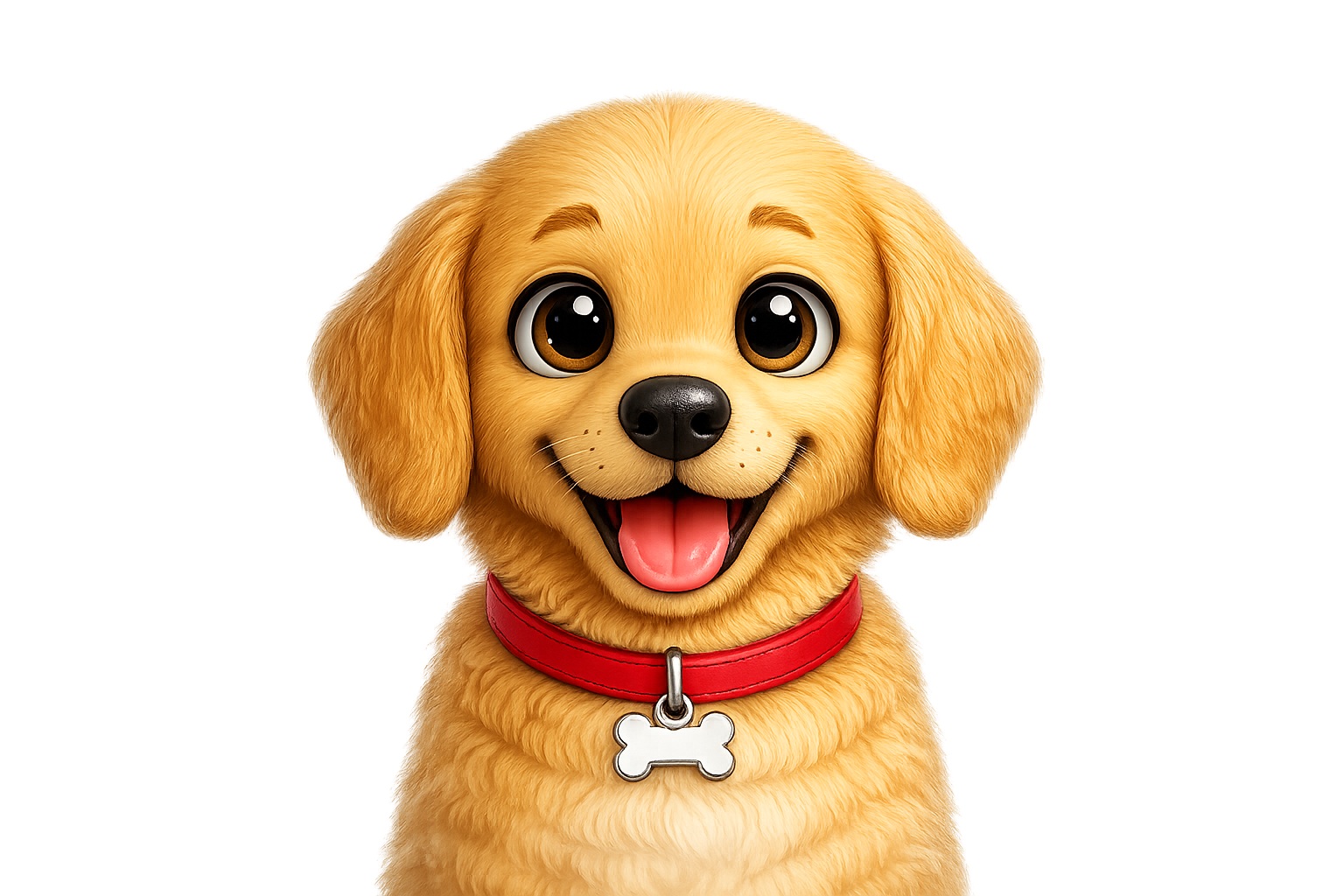
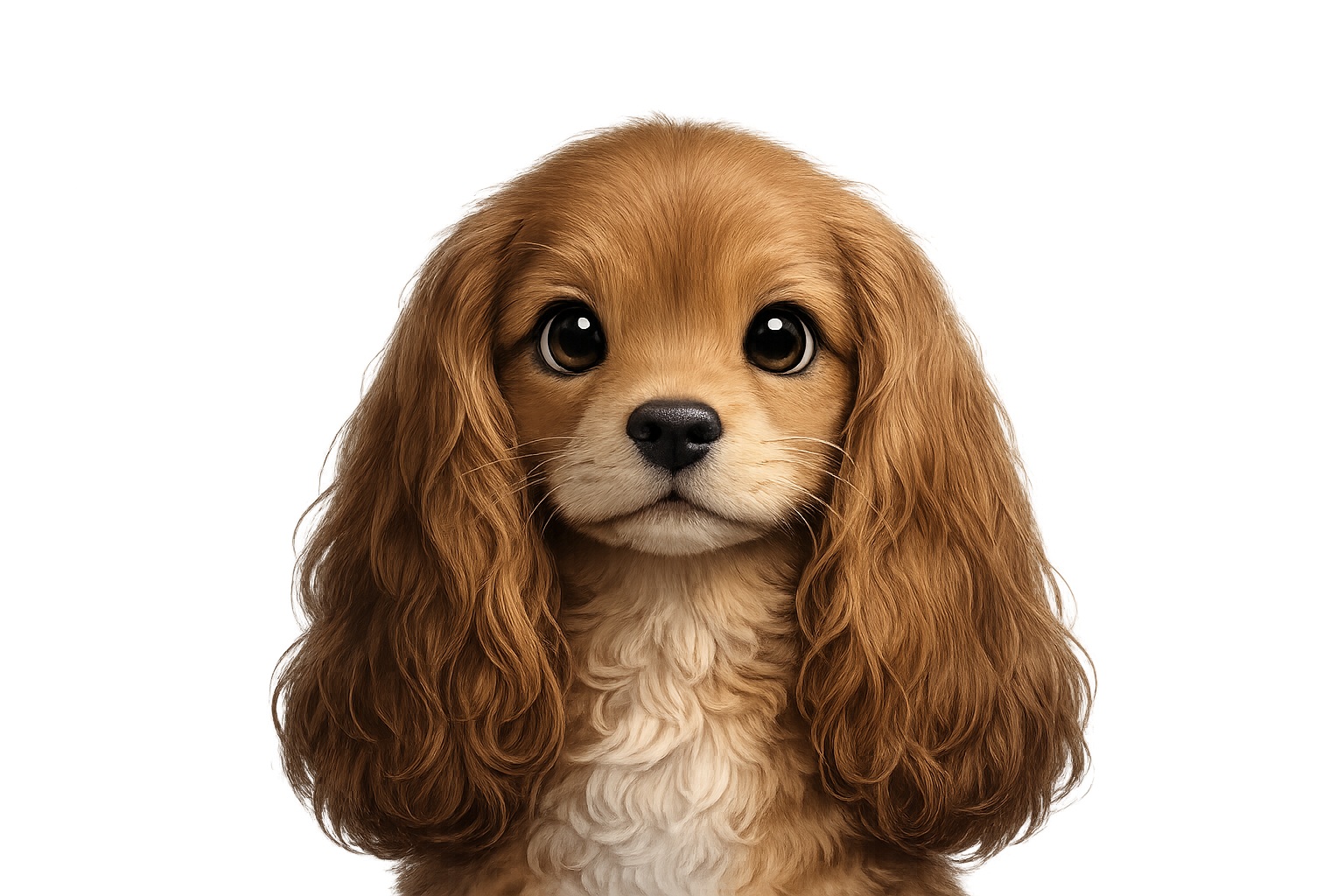
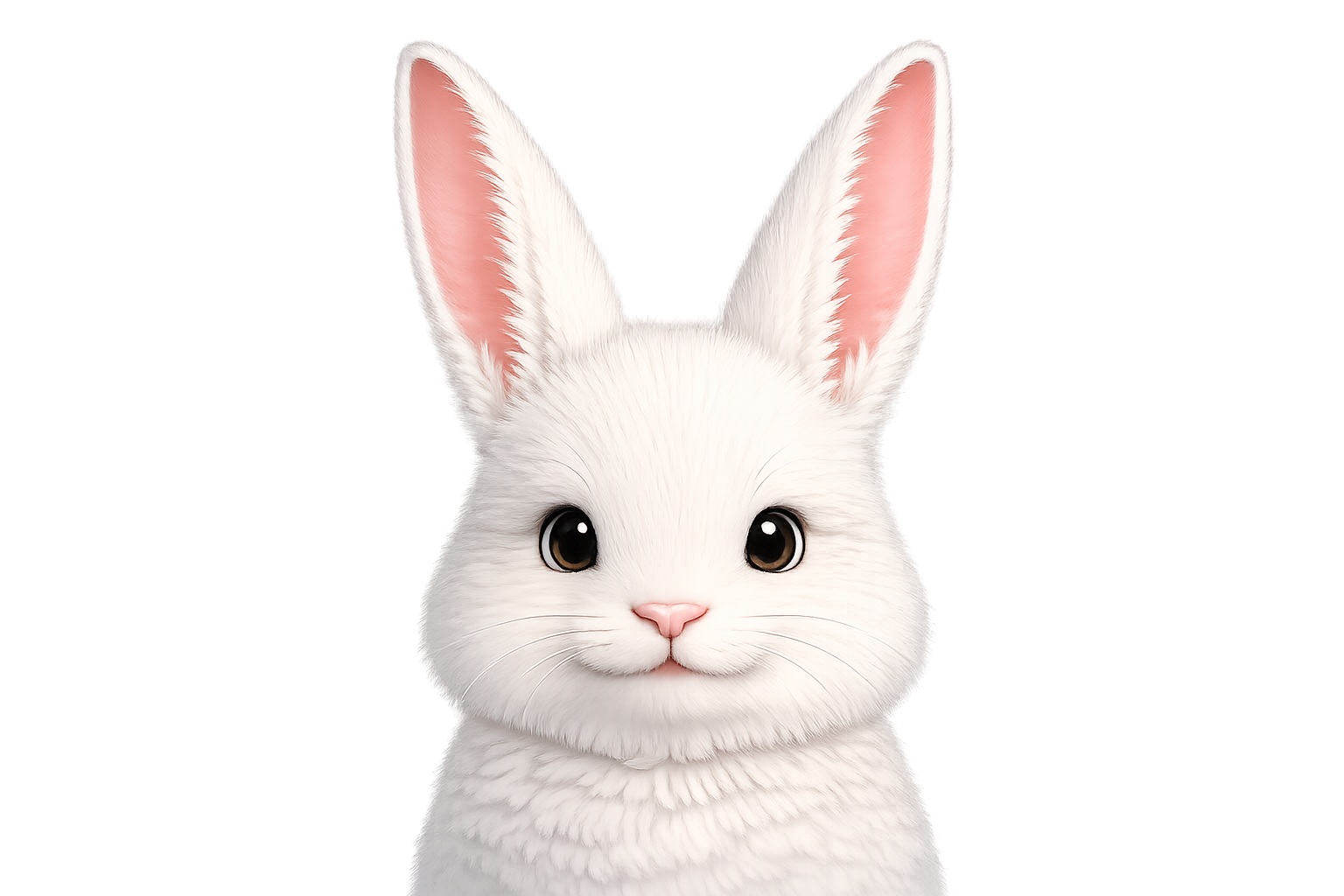


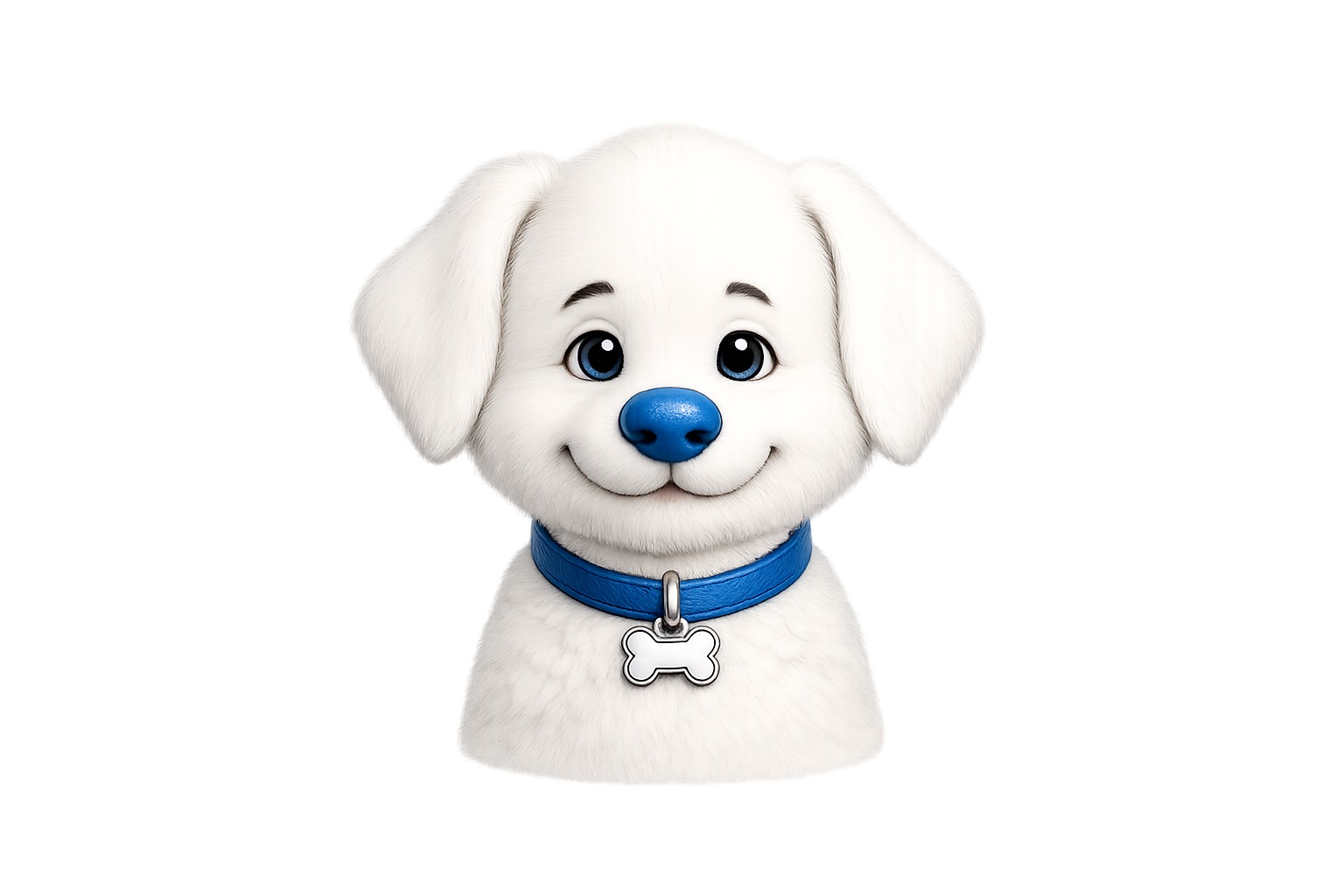
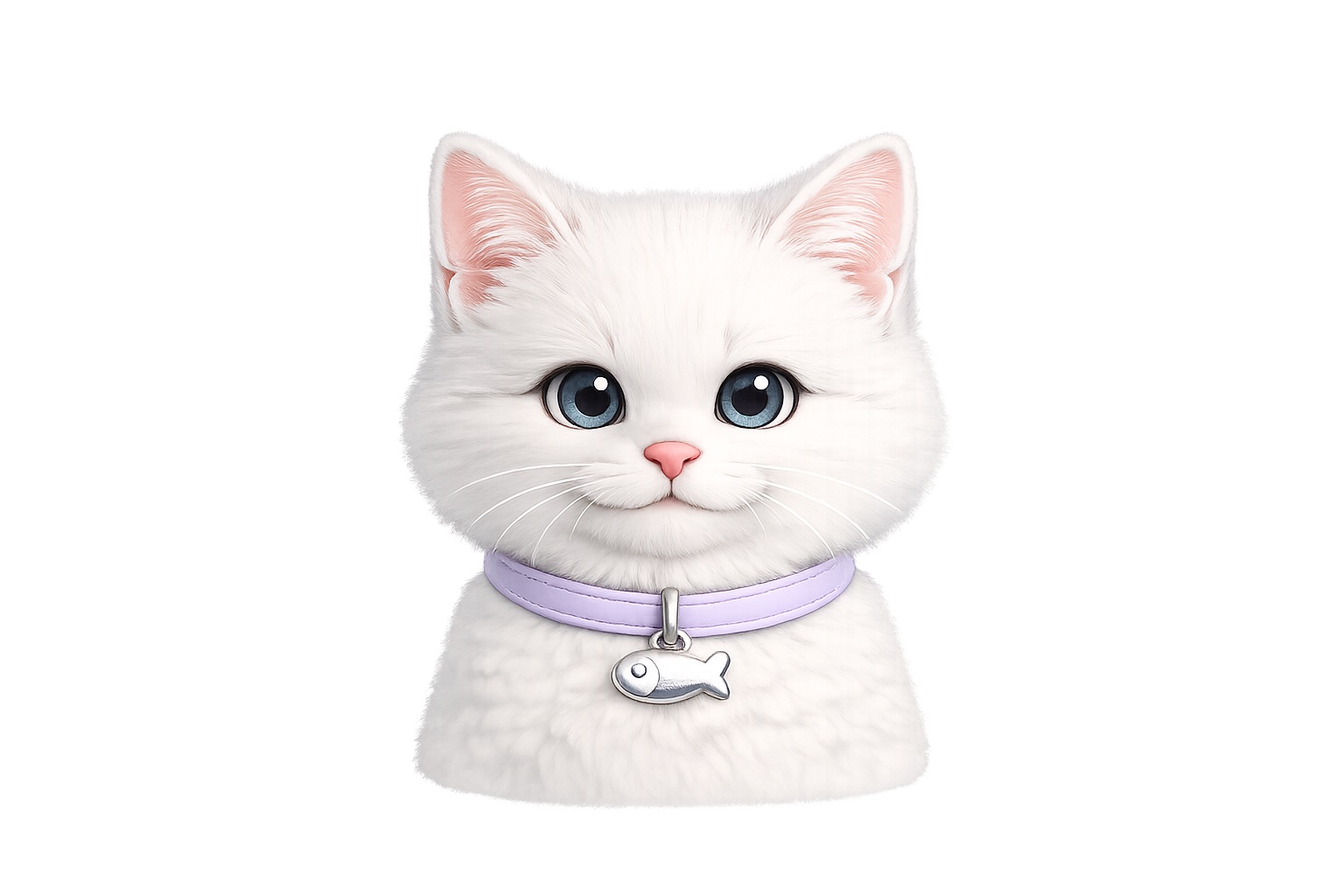


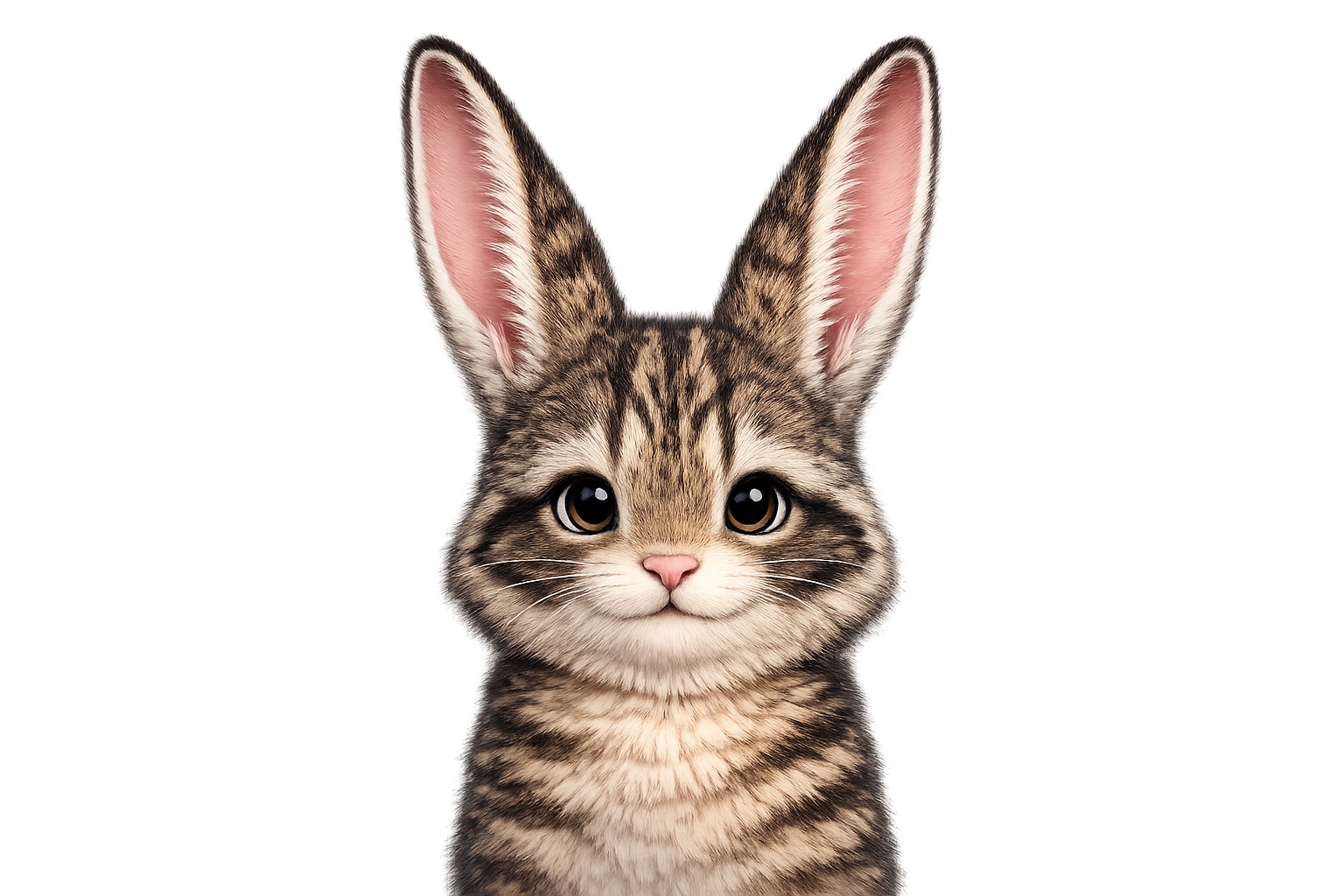
The students fell into 7 voting groups:
- The Cat Voters only wanted cats.
- The Dog Voters only wanted dogs.
- The LongEar Voters only wanted pets with long ears.
- The BigEye Voters only wanted pets with large eyes.
- The Stripe Voters only wanted pets with stripes.
- The WhiteFur Voters only wanted pets with white fur.
- The BlueNose Voters only wanted pets with blue noses.
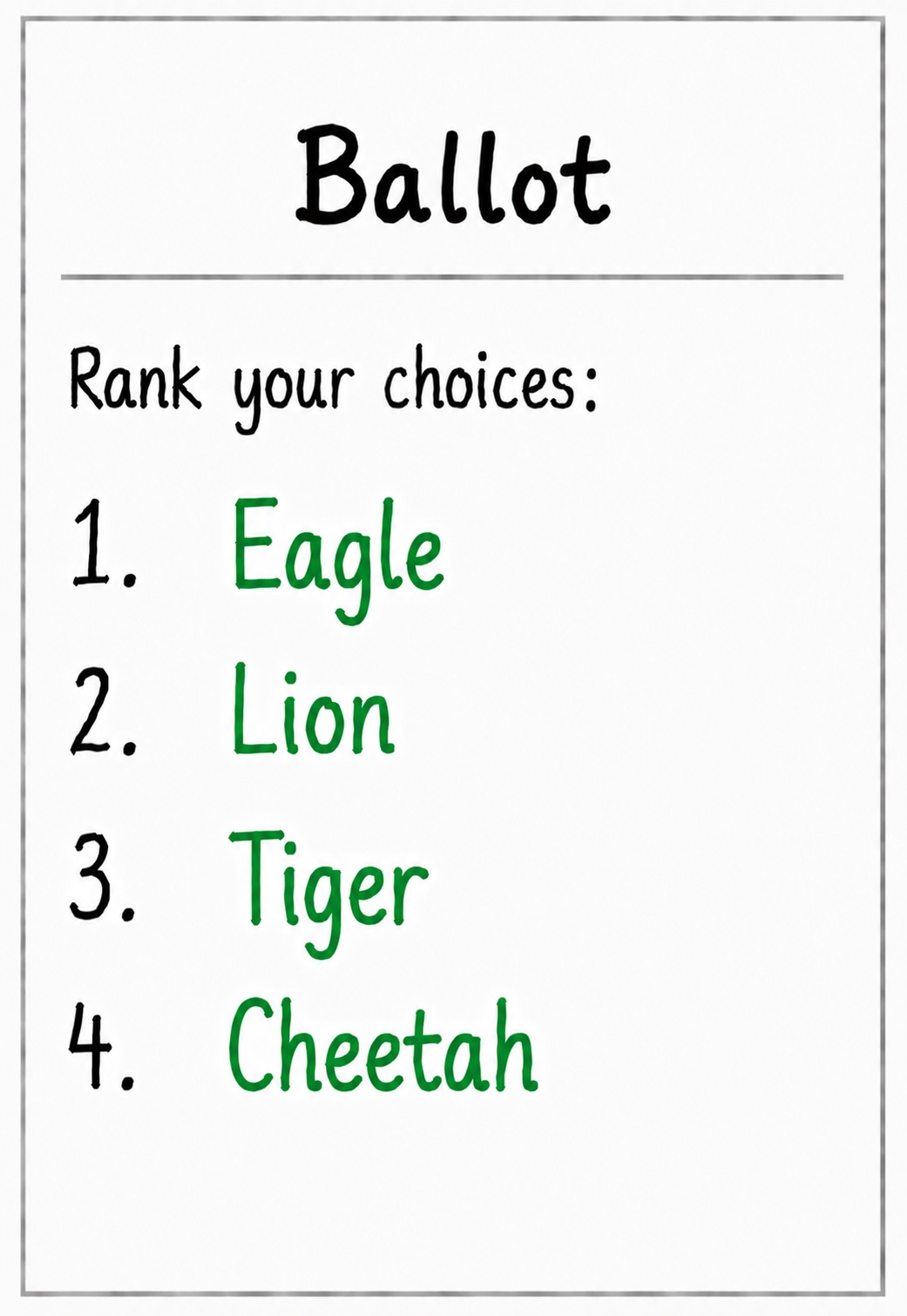
All of the students were indifferent after their top 3 choices. They filled out their ballots:
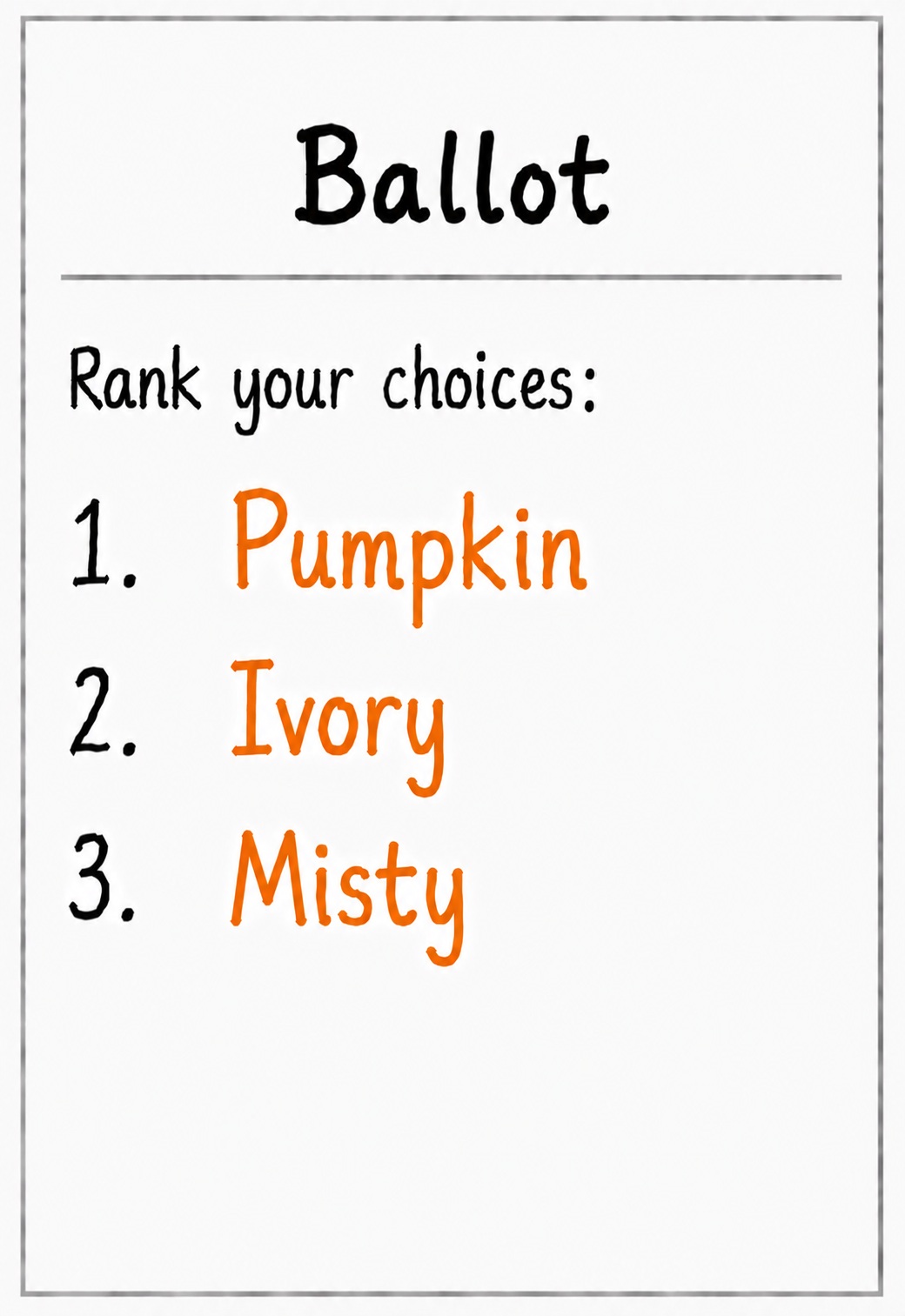
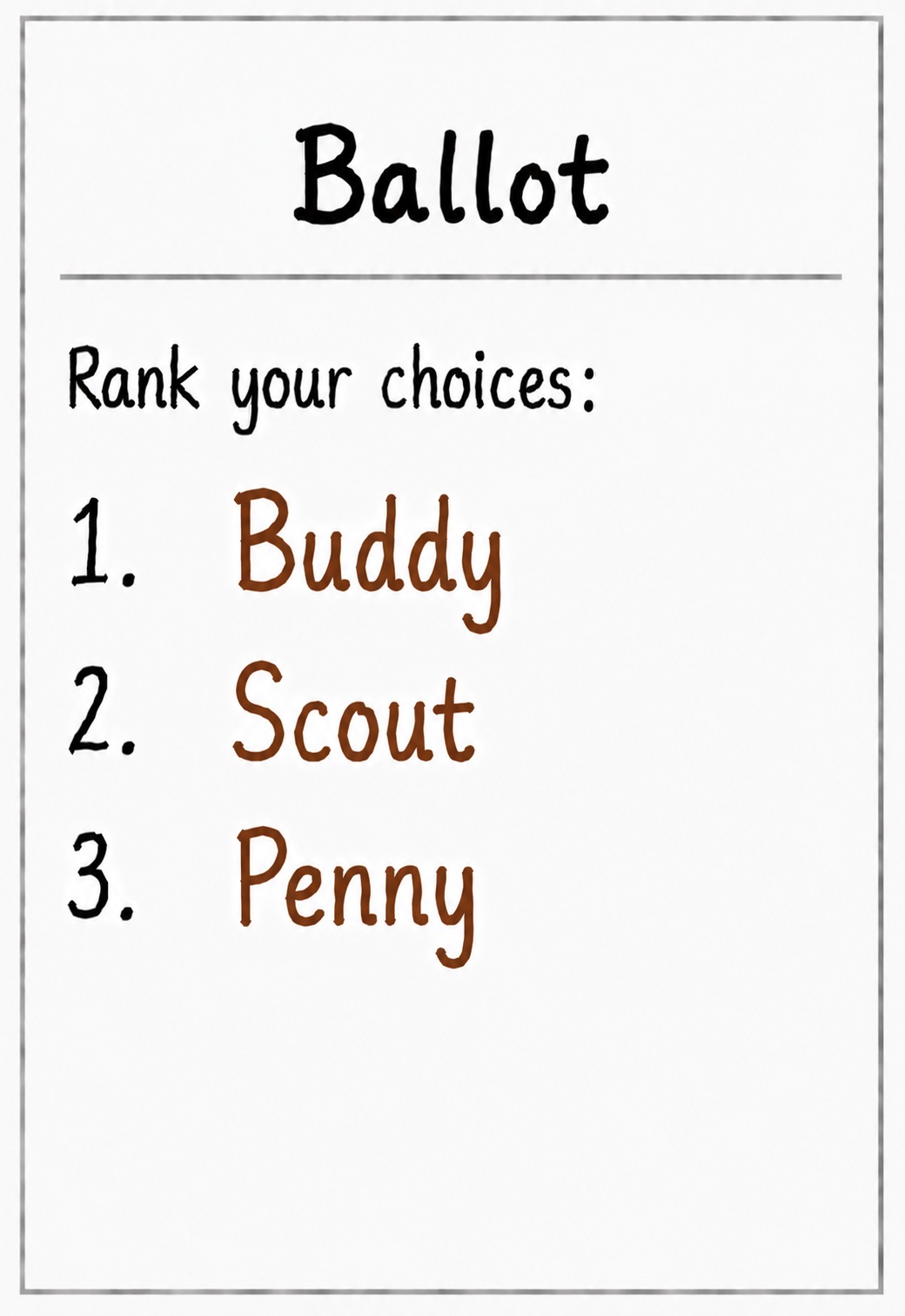
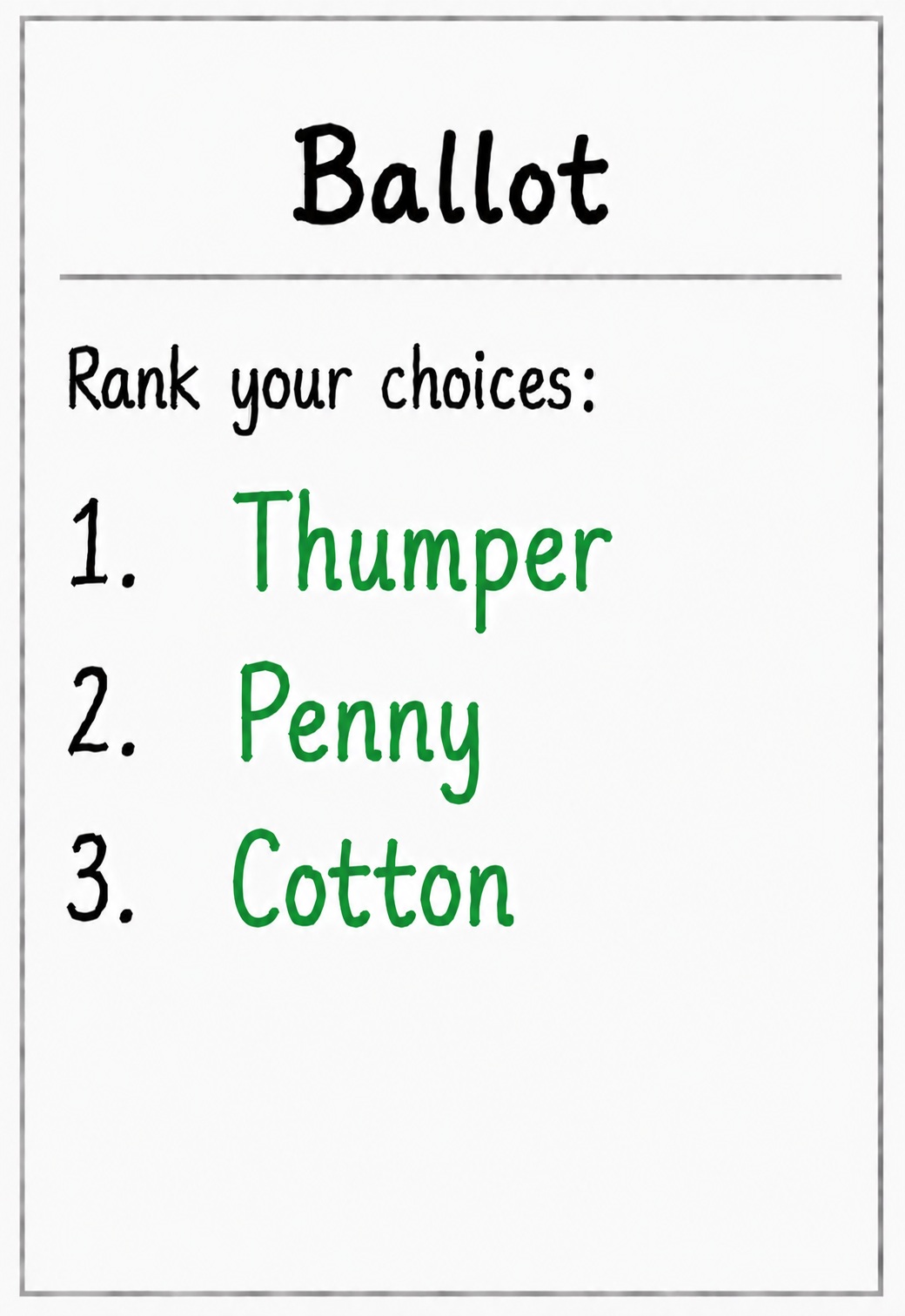
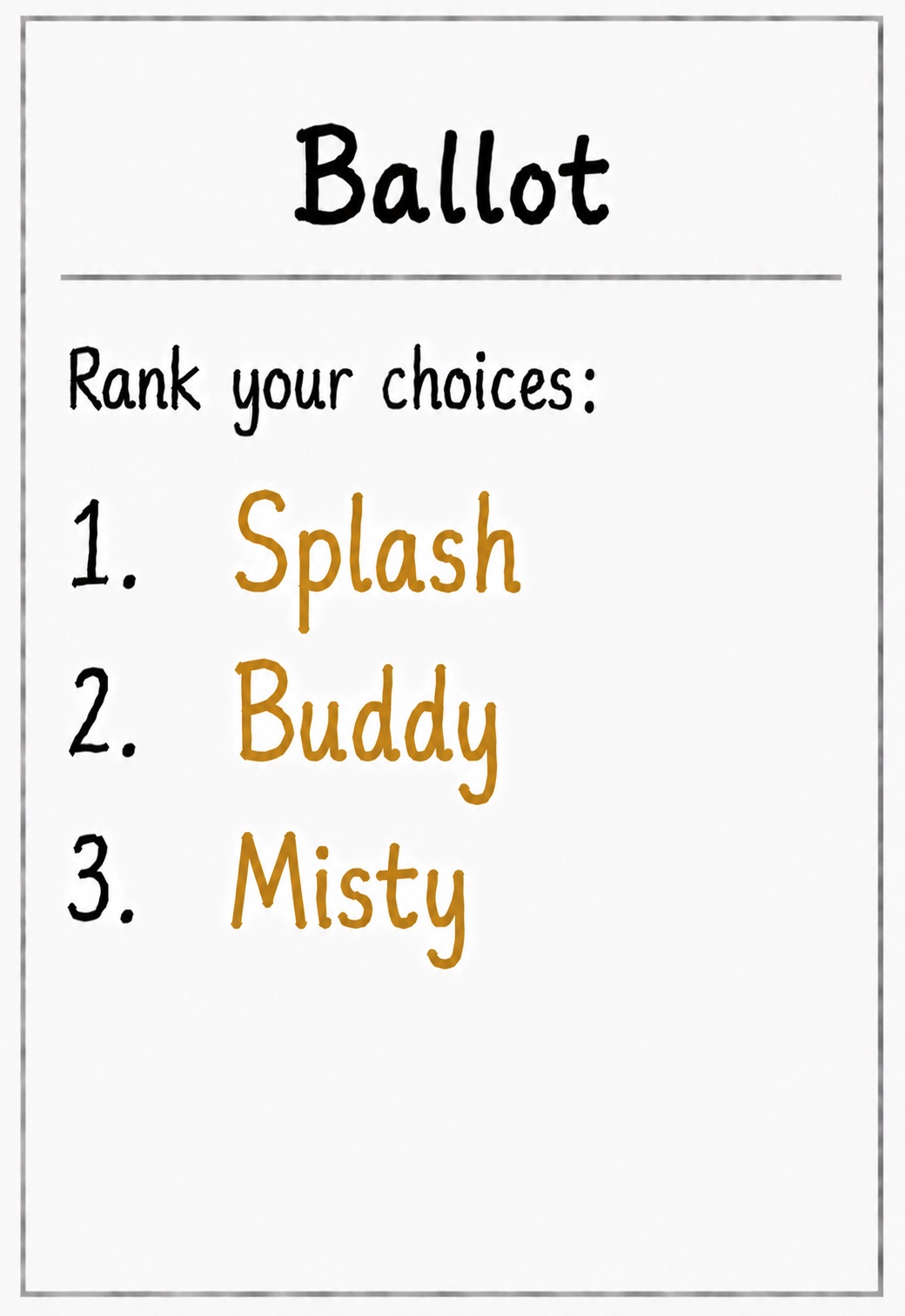
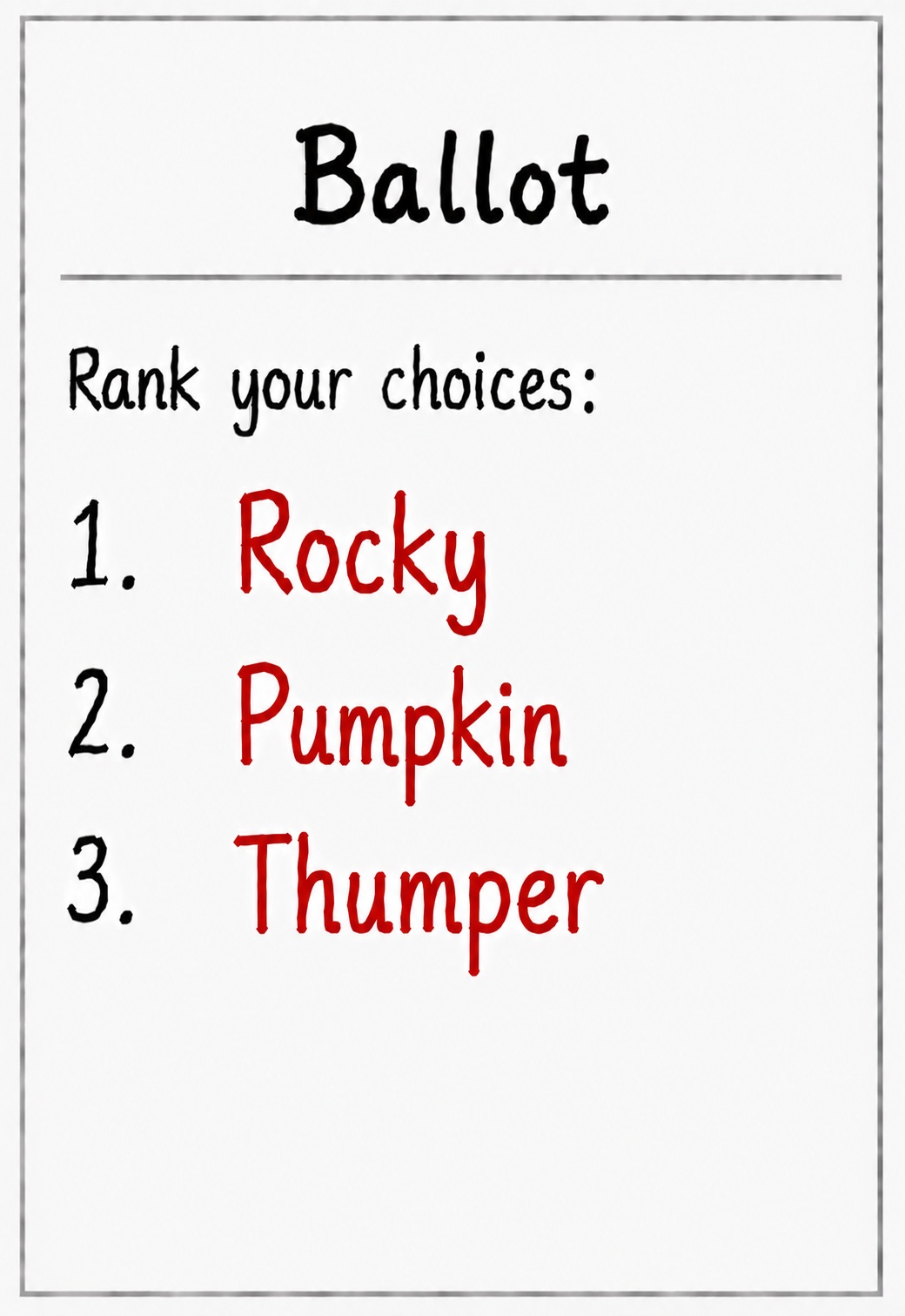
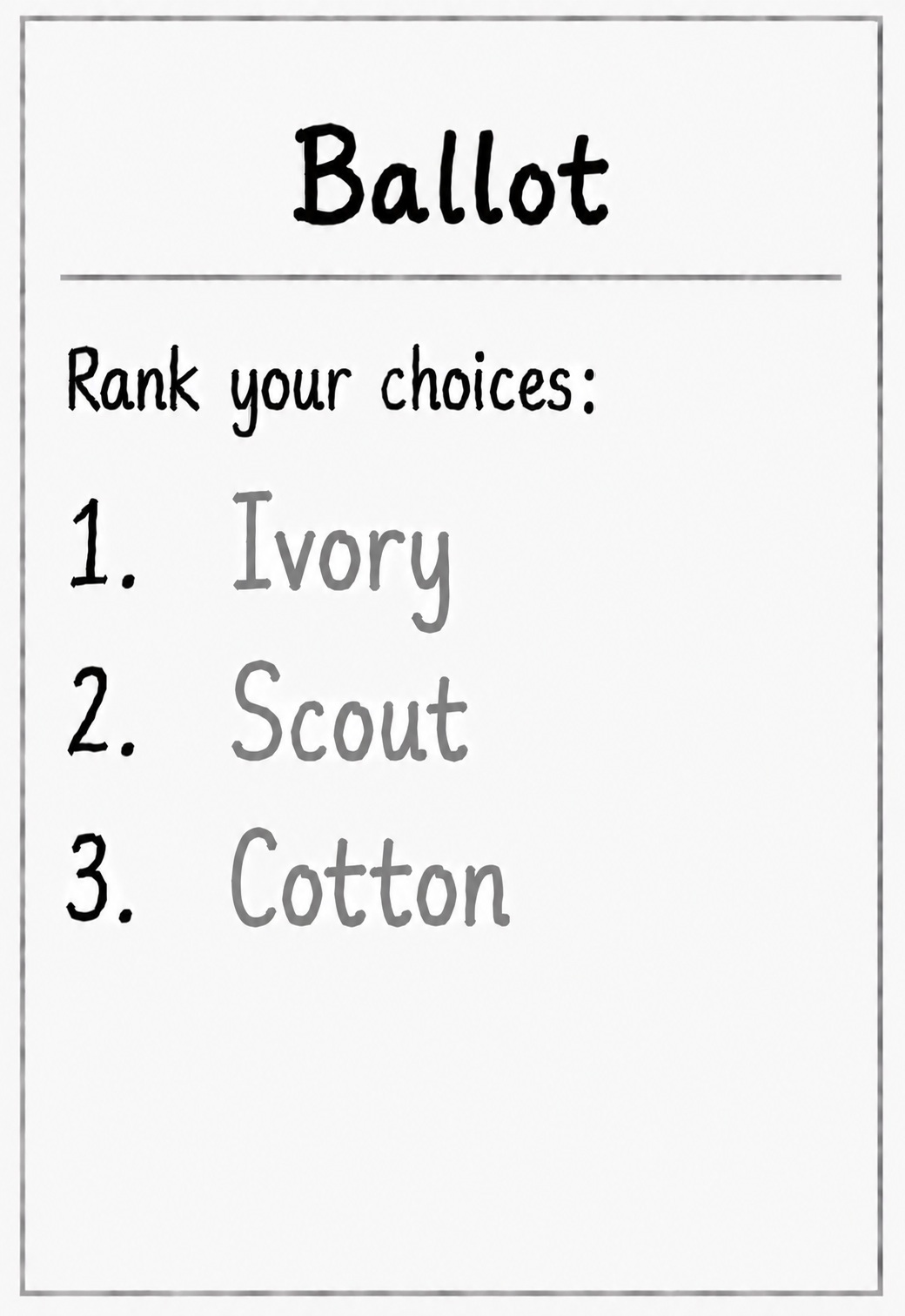
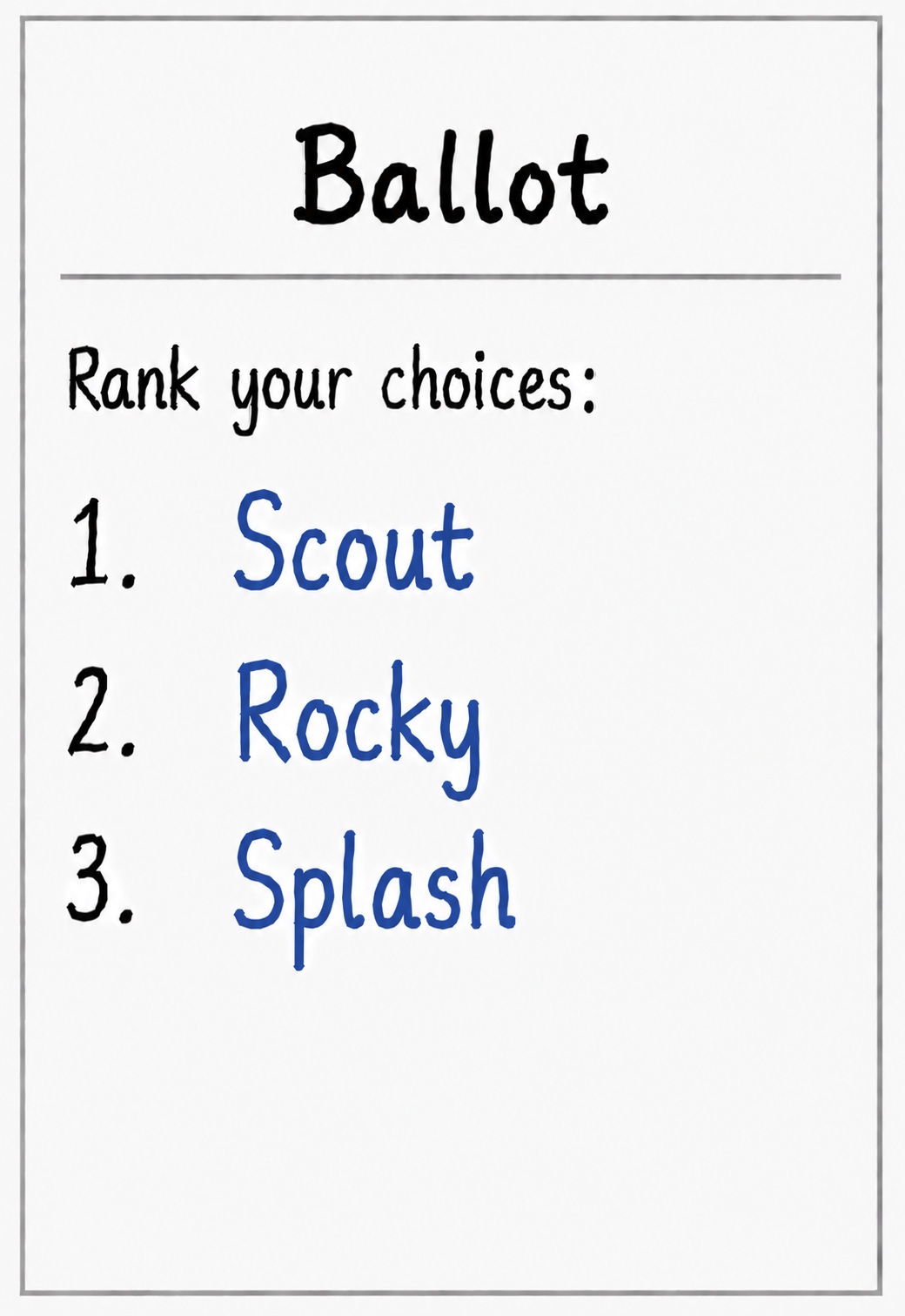
The school received a total of \(V_{TOTAL}=79\) student ballots. Since the school is selecting \(S=3\) pets, the election quota is:
So any pet reaching 20 votes is guaranteed to be selected. All 79 ballots begin with an initial voting strength of 1:
We then calculate the initial first-place votes:
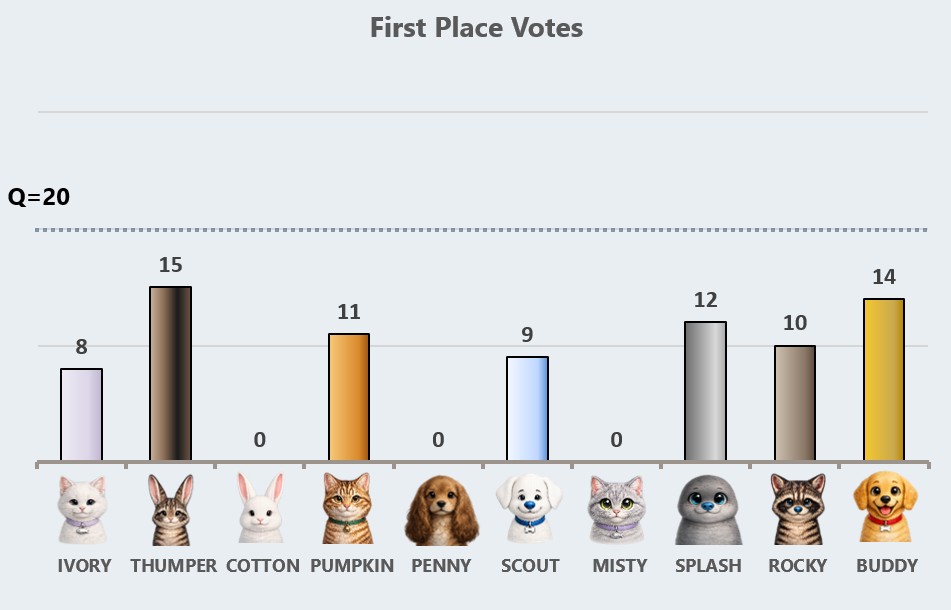
No pet initially reached the 20-vote quota needed to be selected. Misty, Cotton, and Penny received no first-place votes and were eliminated before the first transfer. Ivory then had the fewest remaining first-place votes, so Ivory was eliminated, and all 8 WhiteFur ballots transferred from Ivory to Scout:
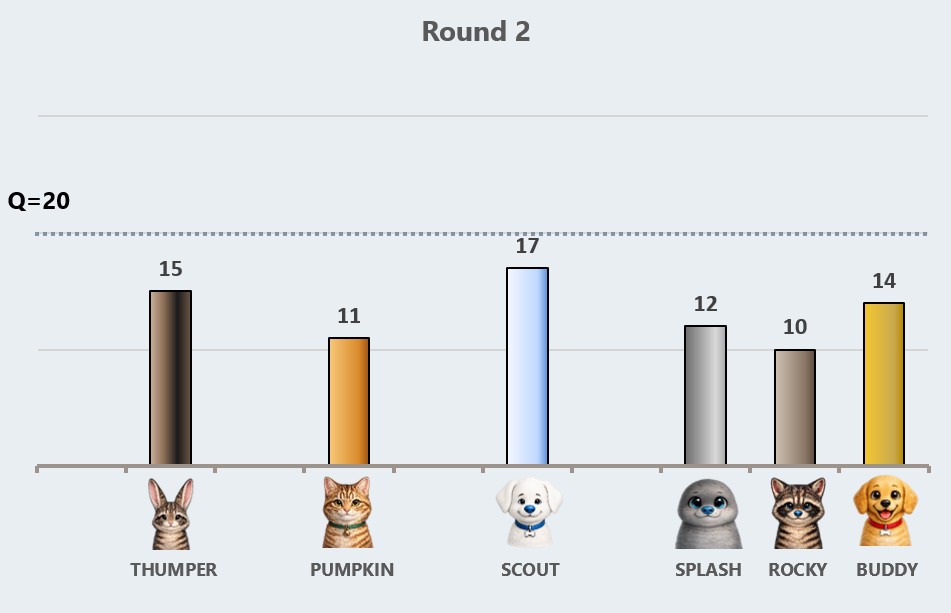
Still no pet had reached the 20-vote quota, so Rocky, with the fewest votes, was eliminated next, and all 10 Stripe ballots transferred from Rocky to Pumpkin.
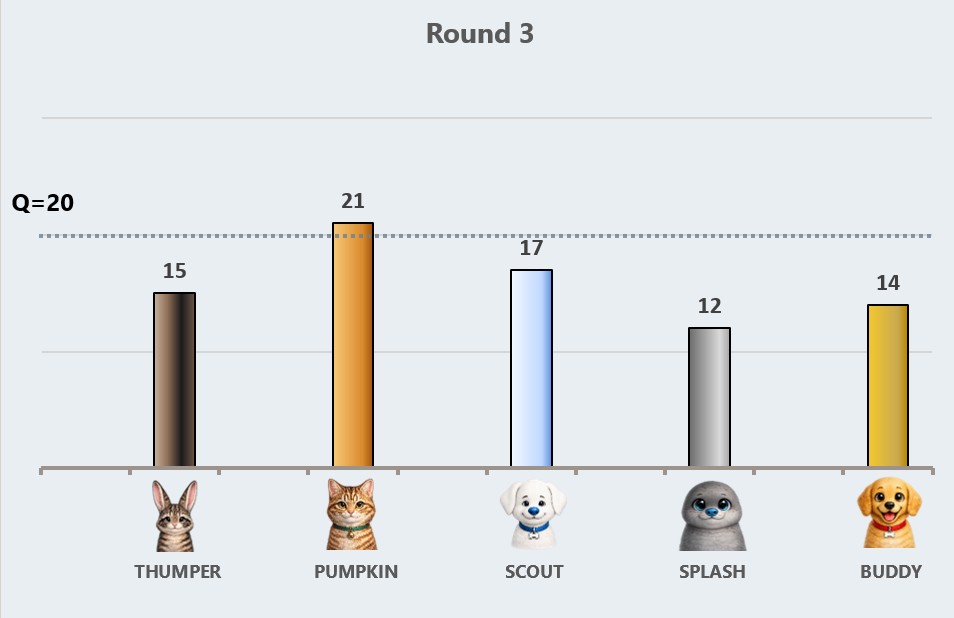
Pumpkin reached 21 votes and crossed the quota, becoming the first selected pet. Since Pumpkin only needed 20 votes to be selected, each of those 21 ballots was reduced proportionally so the excess voting strength could continue transferring onward. The reduced ballot strengths were calculated as:
The 11 Cat ballots had no remaining choices, since Ivory and Misty had already been removed, so those ballots became exhausted and no longer participated in the election.
The 10 Stripe ballots transferred to Thumper with a combined voting strength of:
So the totals after those ballots transfer become:
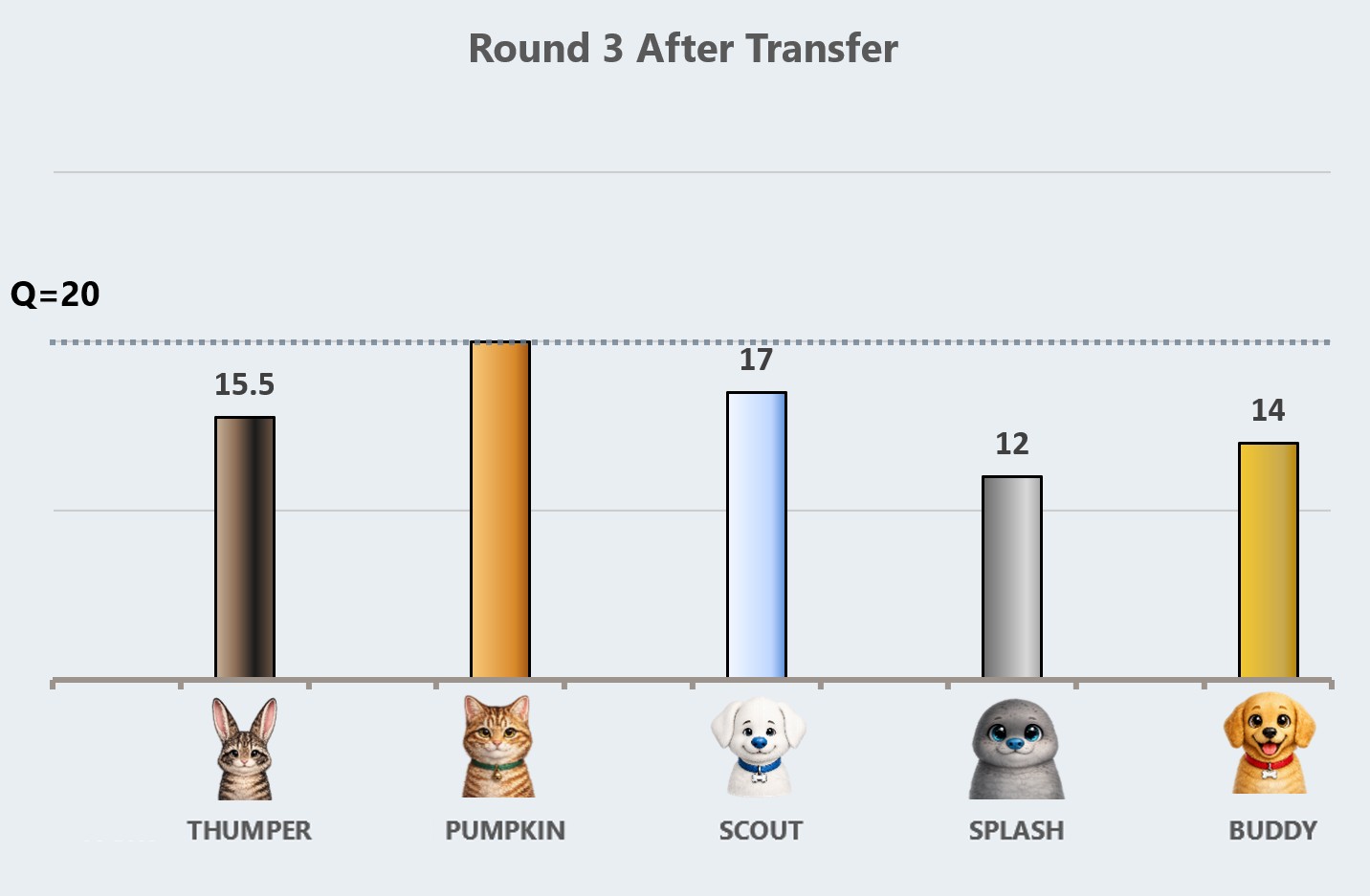
No pet reached the quota, so Splash was eliminated next. All 12 LargeEyes ballots transferred from Splash to Buddy.
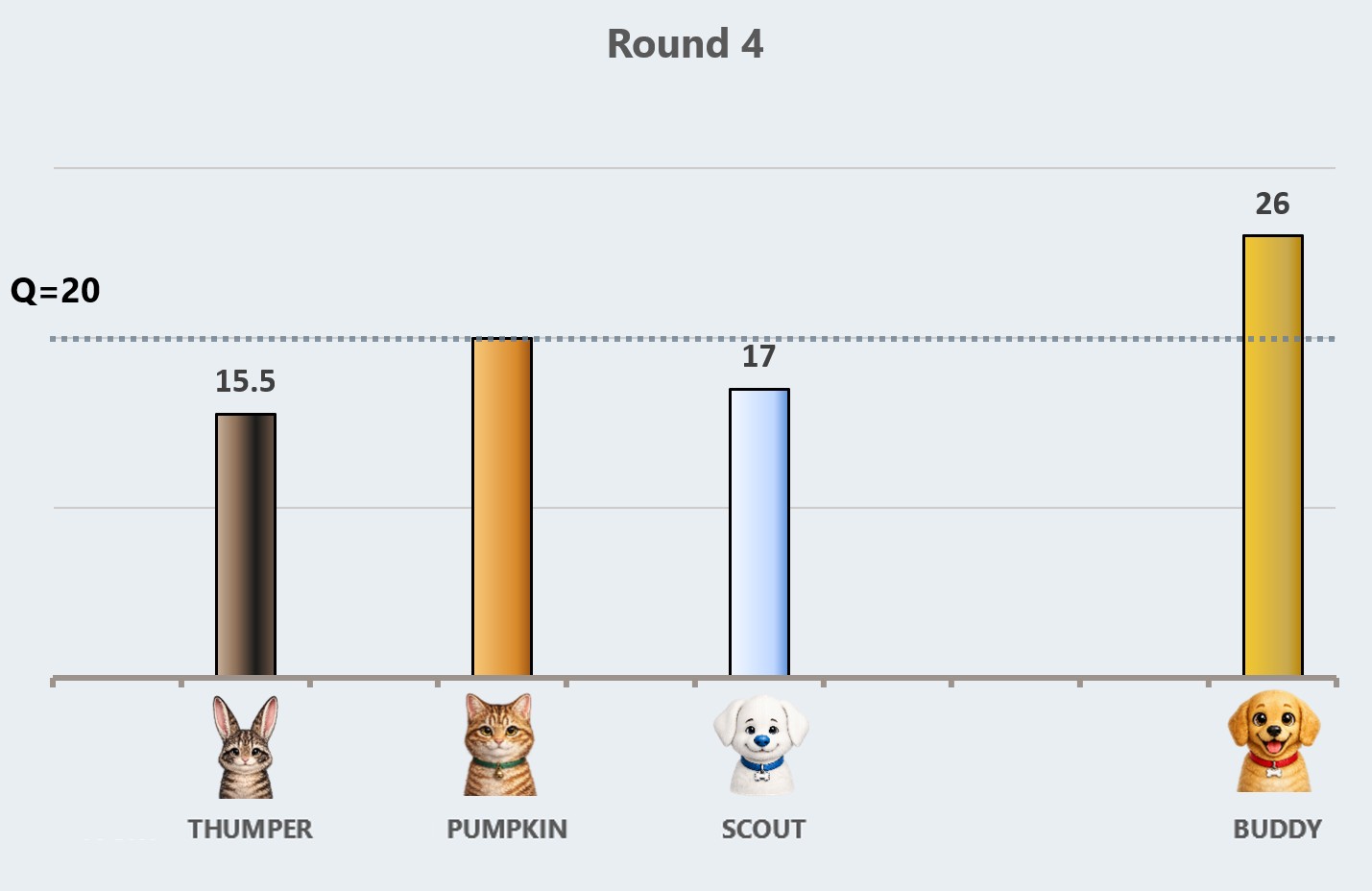
Buddy increased to 26 votes and became the second selected pet. Since Buddy only needed 20 votes to be selected, each of those 26 ballots was reduced proportionally so the excess voting strength could continue transferring onward. The reduced ballot strengths were calculated as:
The 12 BigEye ballots had no remaining choices, since Misty had already been removed, so those ballots became exhausted and no longer participated in the election.
The 14 Dog ballots transferred to Scout with a combined voting strength of:
So the totals after those ballots transfer become:
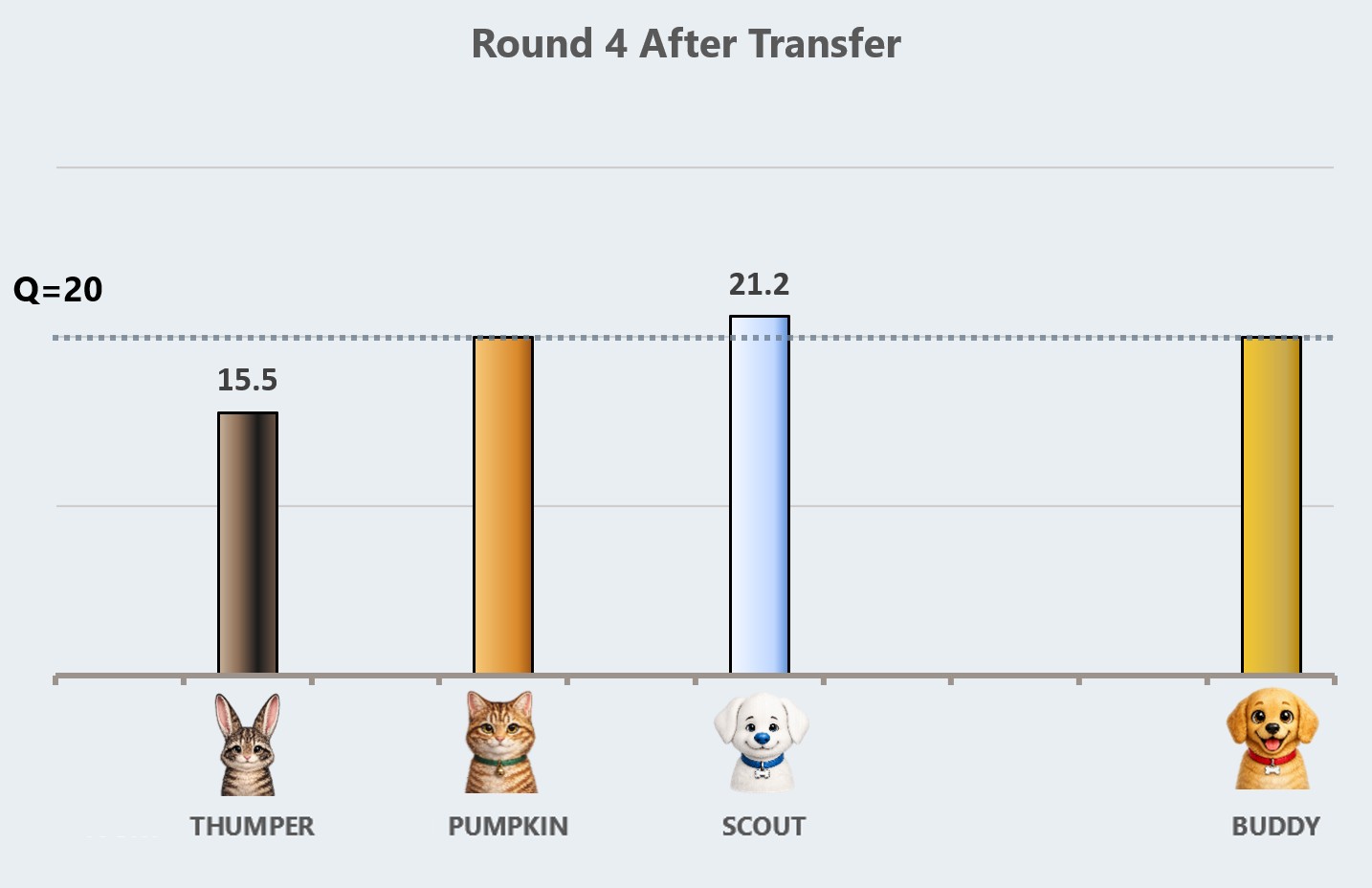
Scout increased from 17 votes to 21.2 votes, crossing the quota and becoming the third selected pet. So the pets chosen are:
Even though Thumper received the most initial first-place votes, Thumper was not selected. Scout began with only 9 first-place votes, but later transfers from other ballots allowed Scout to eventually reach quota and become the final selected pet.
This example also shows how lower-ranked choices can continue influencing the outcome after earlier choices have either been selected or eliminated. Some ballots eventually became exhausted because the students did not rank additional remaining pets beyond their first 3 choices. The next example shows how these same mechanics can affect representation inside a much larger system.
This example also shows how lower-ranked choices can continue influencing the outcome after earlier choices have either been selected or eliminated. Some ballots eventually became exhausted because the students did not rank additional remaining pets beyond their first 3 choices. Readers interested in how these same transfer mechanics can affect representation inside a much larger assembly can find a larger example here.
Our final example illustrates some of the important strategic incentives that should be understood for STV elections:
The Wilderlands Executive Council
The Wilderlands has decided to create a 5-member executive council. Seven candidates have emerged to compete for those seats:




- The Foresters support the Bear, Wolf, and Fox, and hope to secure 3 of the 5 council seats. They support the Eagle as a next choice, as they do not want the Felines to control the council.
- The Felines support the Lion, Tiger, and Cheetah, and also hope to secure 3 of the 5 council seats. They also support the Eagle next, as they do not want the Foresters to control the council.
- The Avians support the Eagle, and primarily want the Eagle to become the deciding voice on the council. If they cannot secure that final seat, they prefer the Felines over the Foresters.
A total of 975 Foresters, 875 Felines, and 150 Avians fill out their ballots as follows:
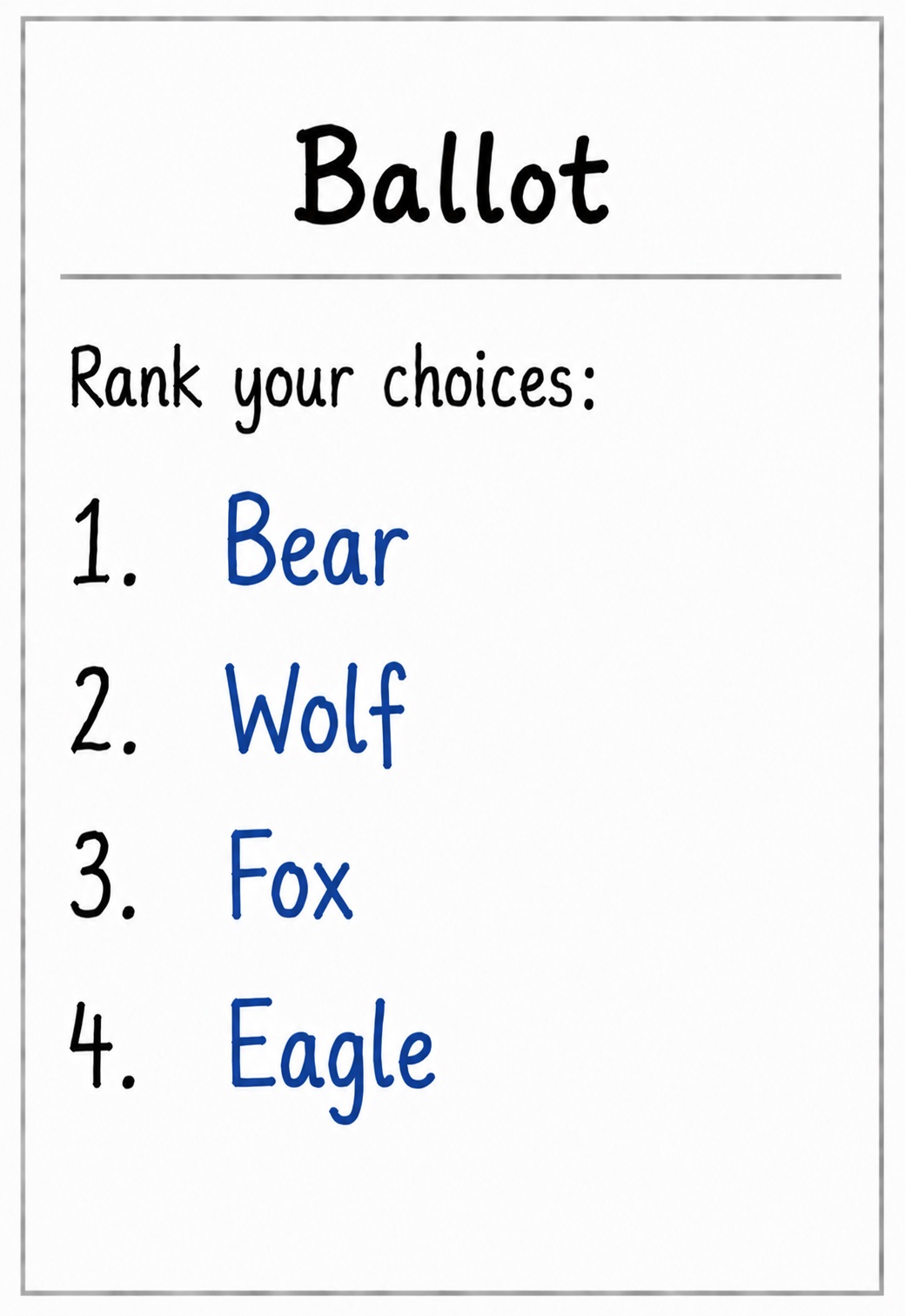
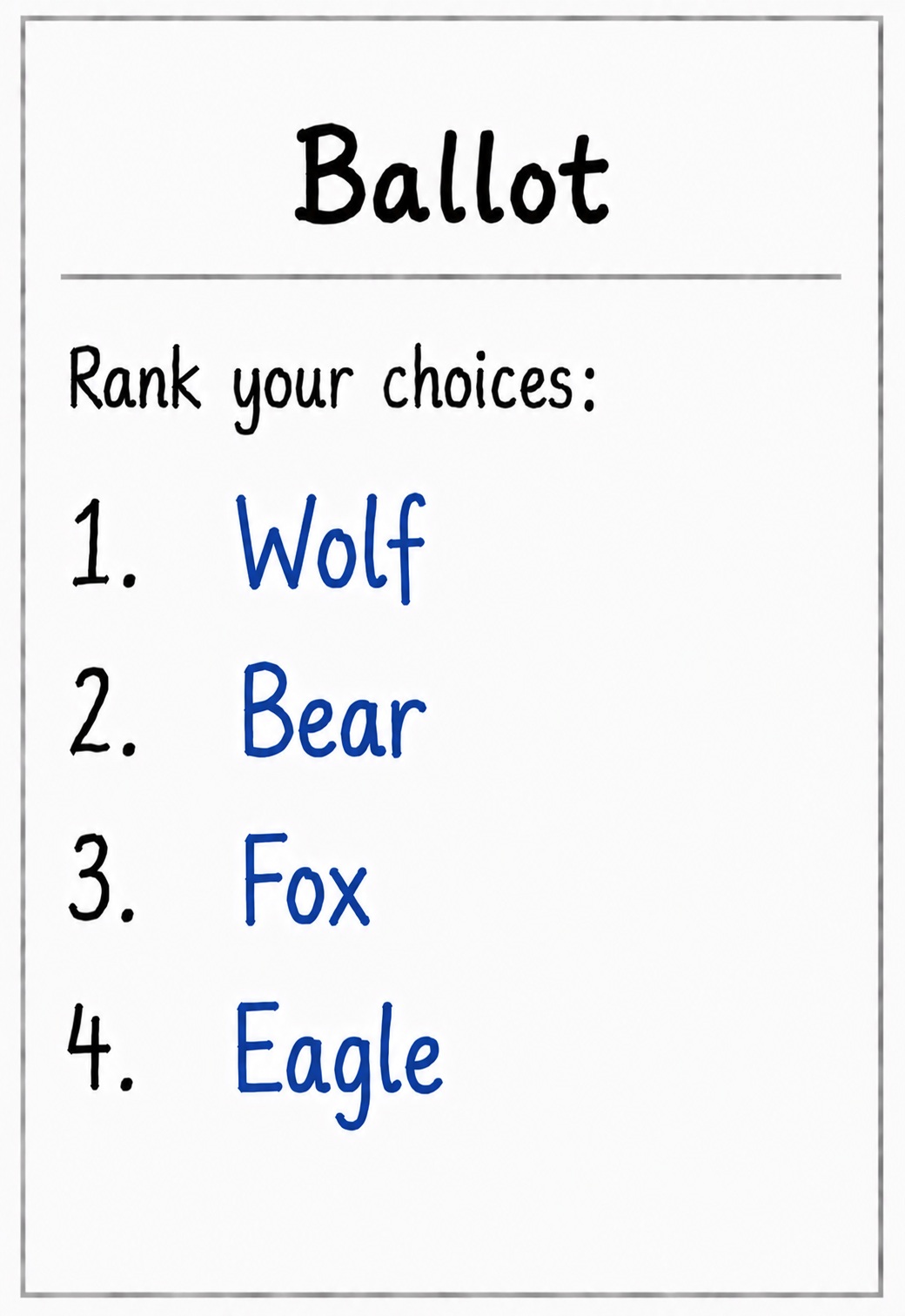
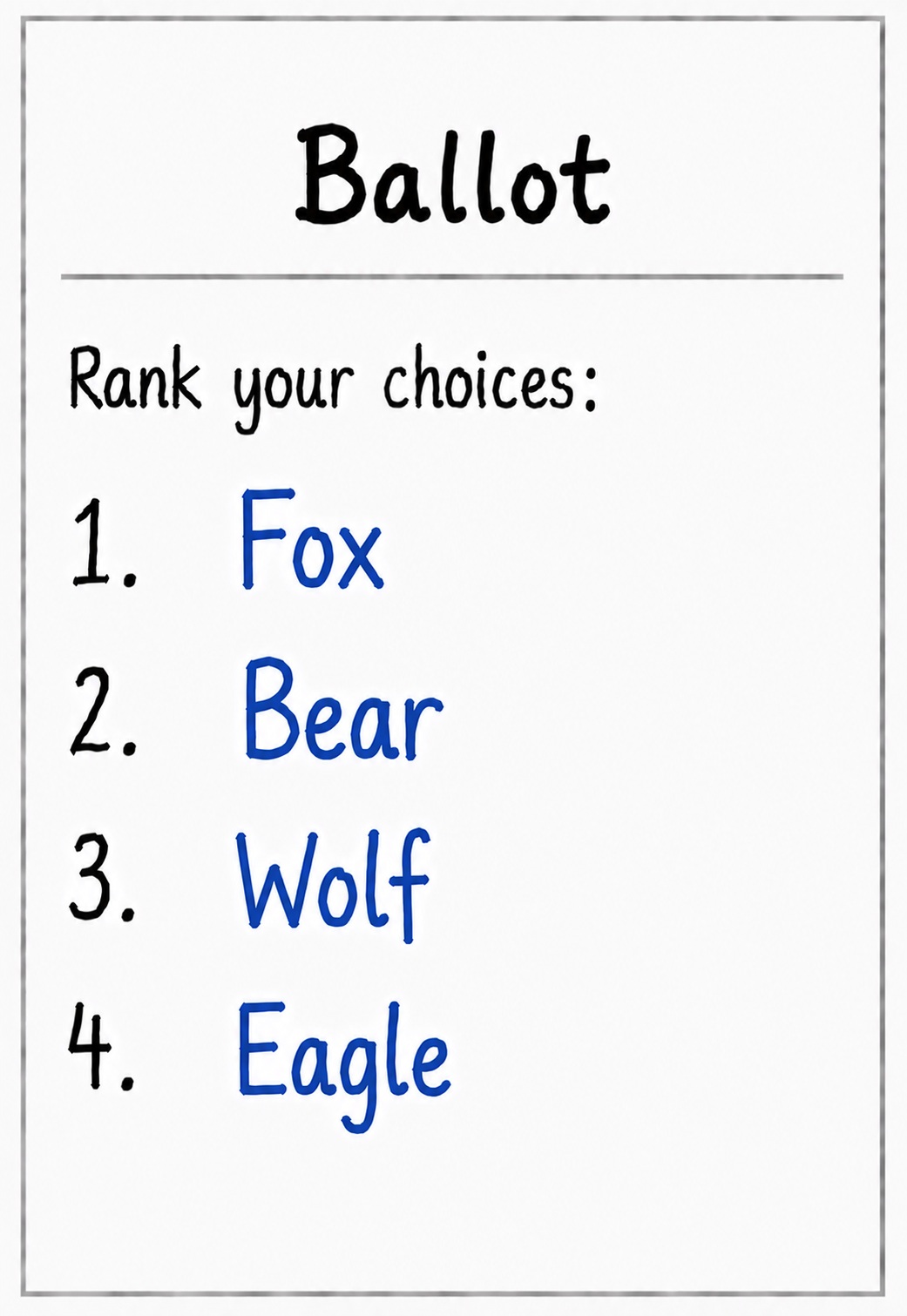
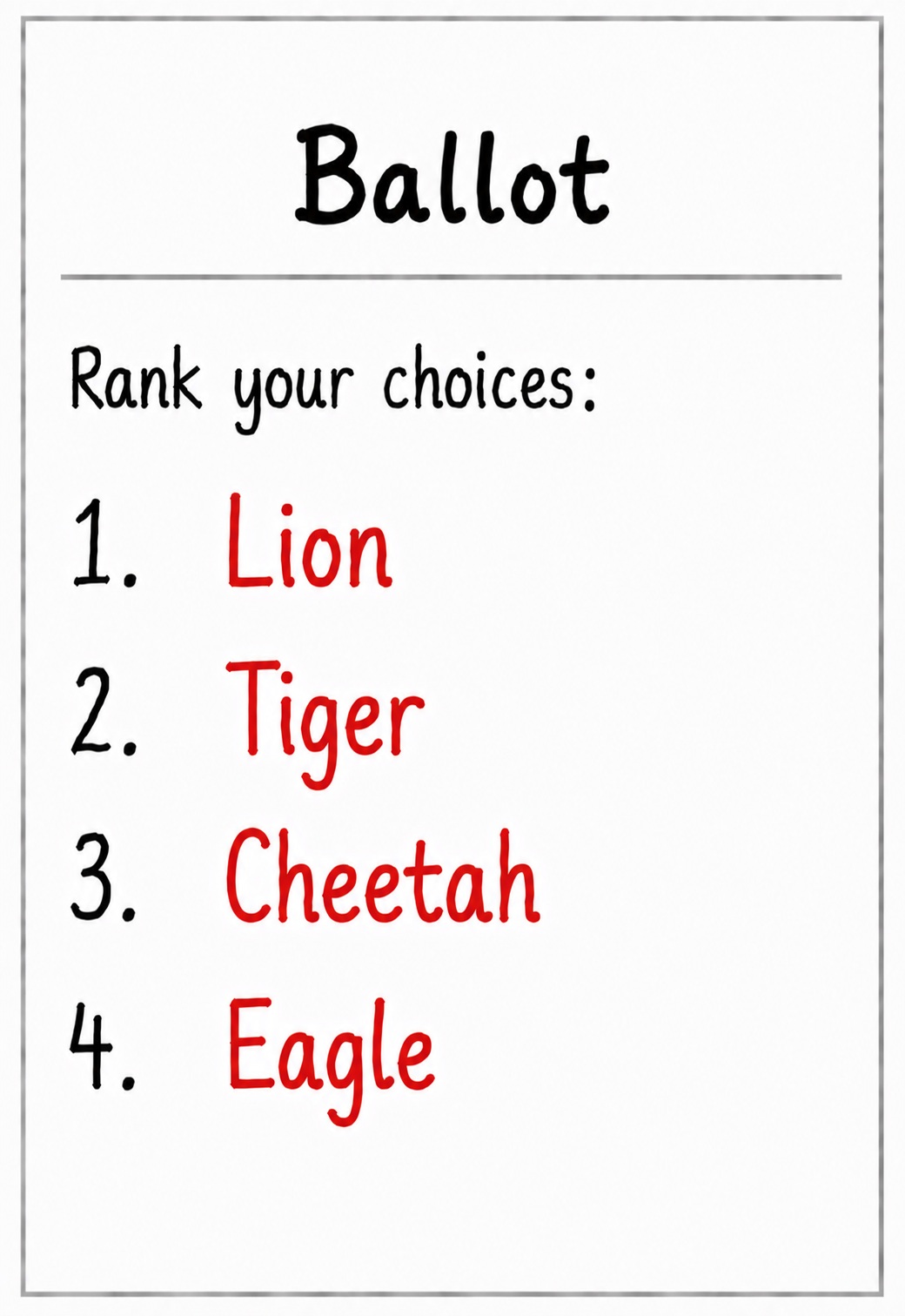
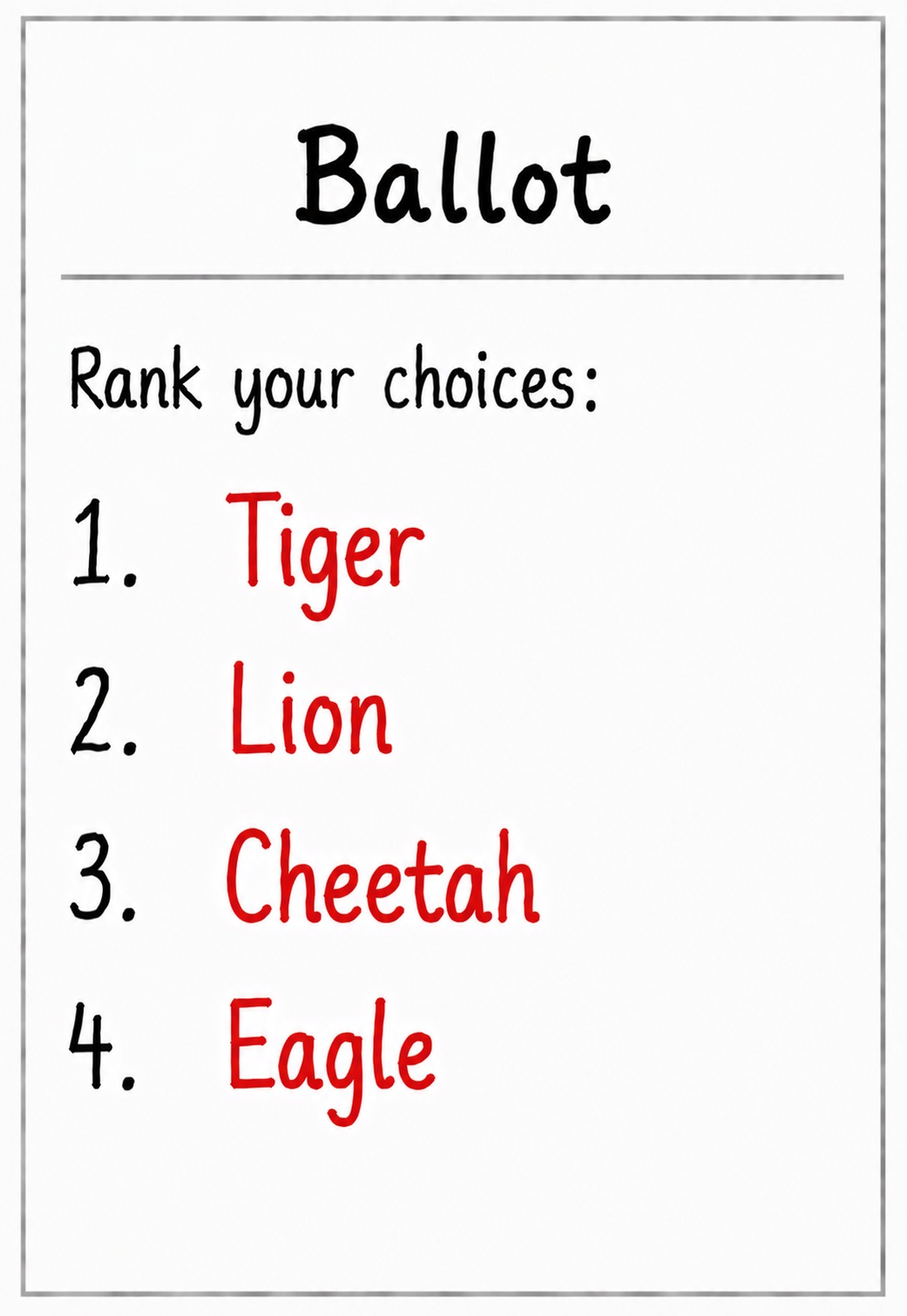
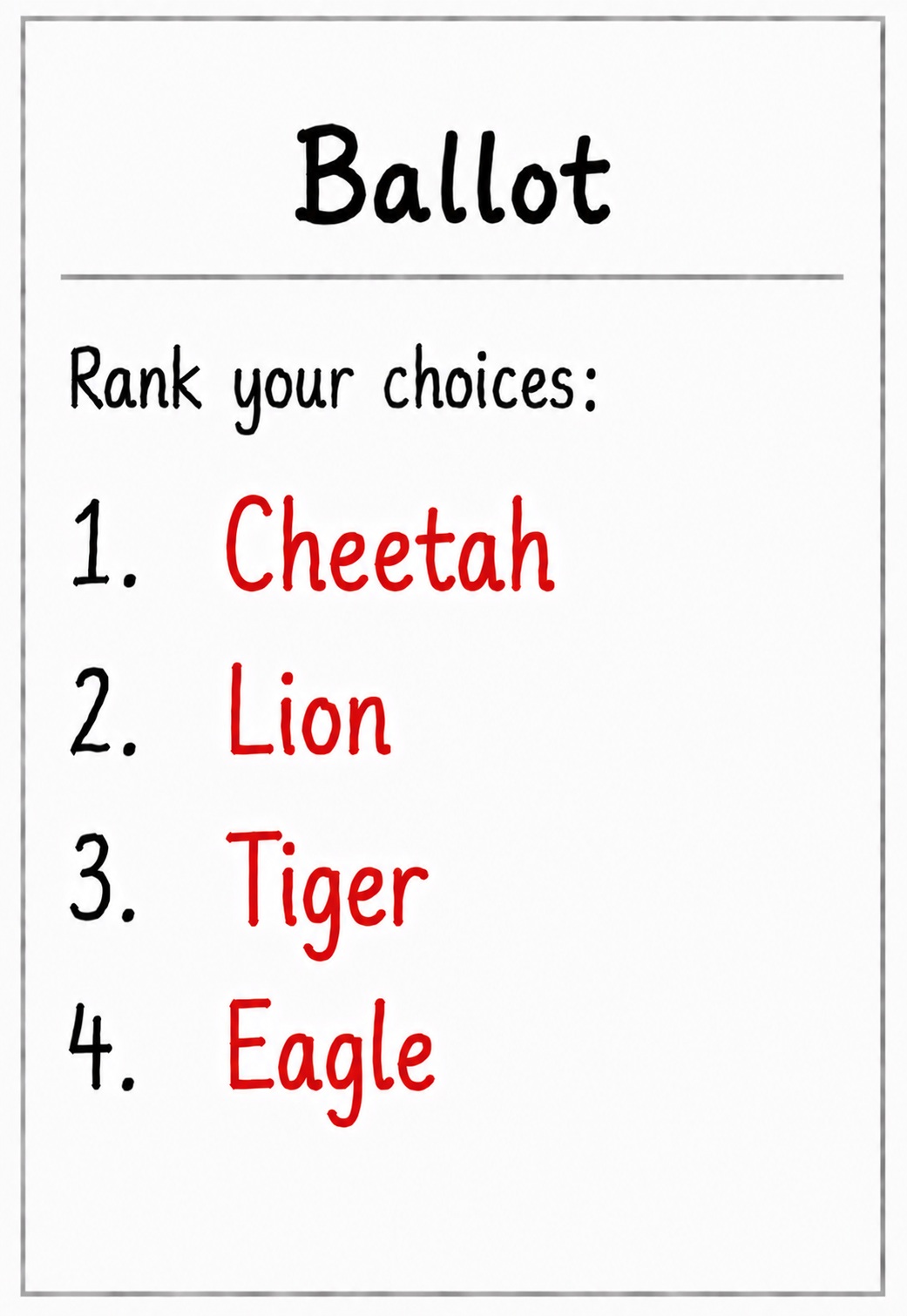
The election quota is:
The initial first-place totals are:
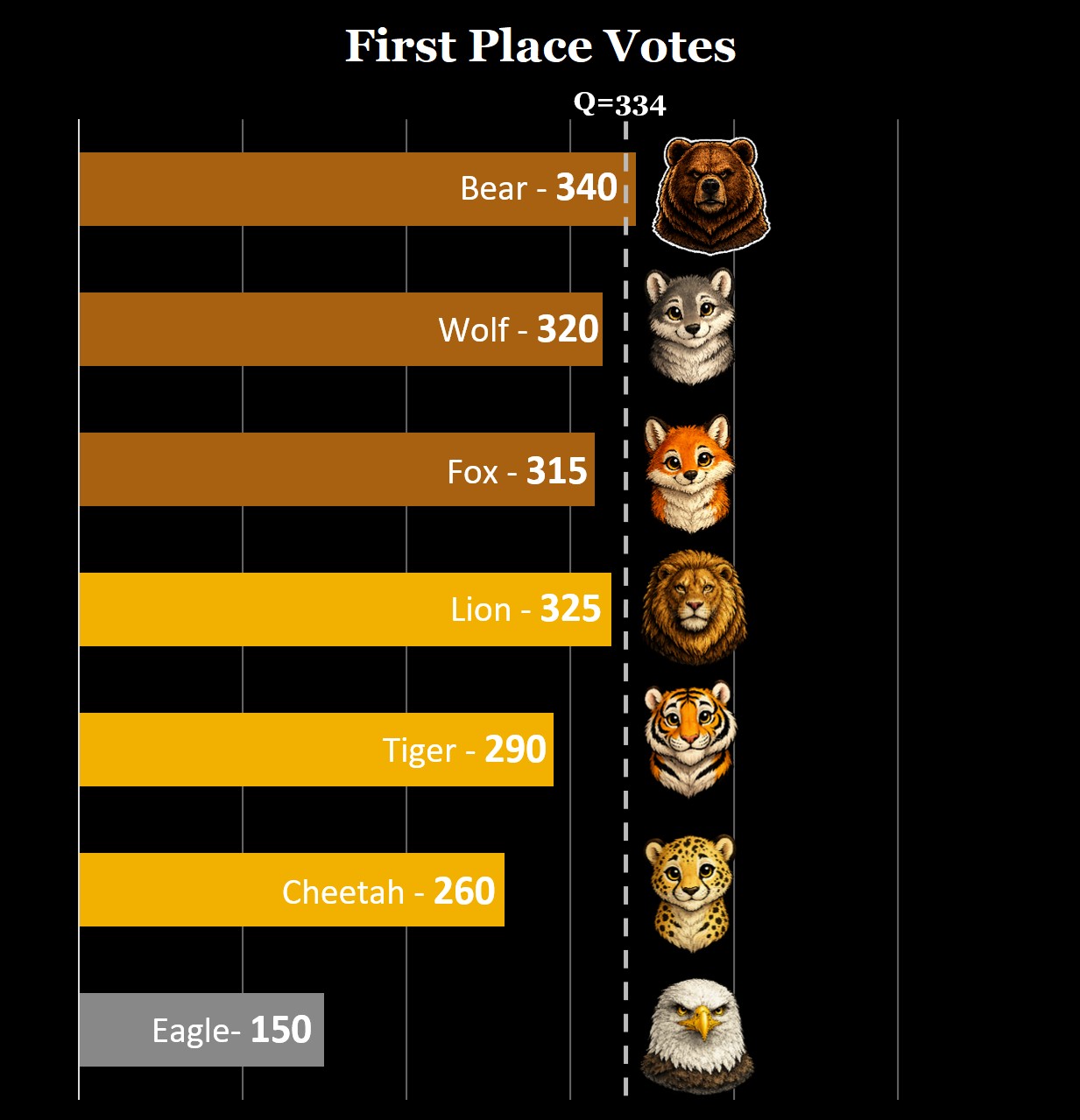
The Bear immediately crosses the 334 vote quota and claims the first council seat. The Bear’s 6 excess votes transfer to the Wolf:
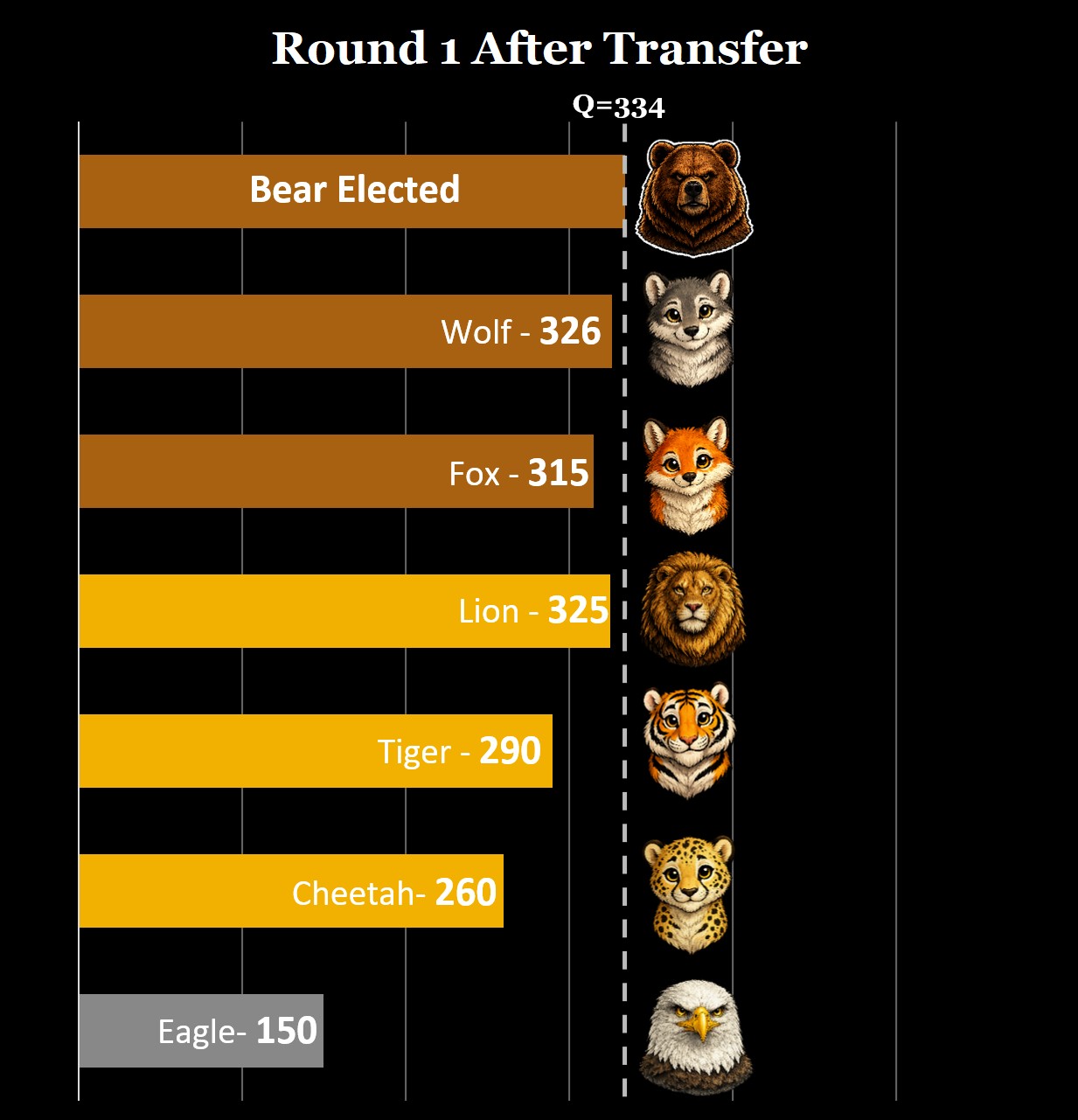
After the transfer, no other candidate reaches quota. The Eagle, having the fewest votes, is eliminated, and the 150 Avian votes transfer to the Lion:
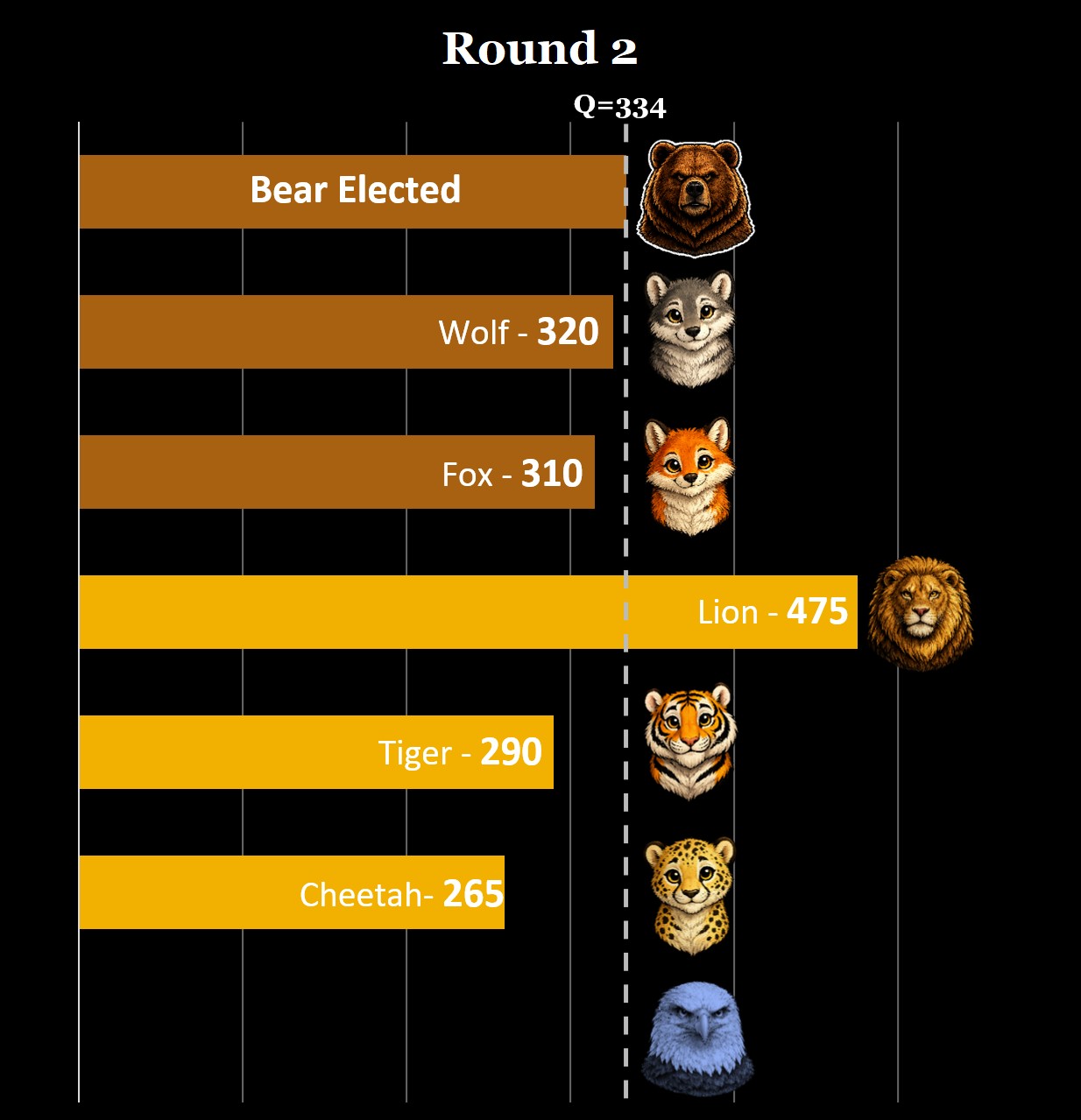
The 150 votes from the Avians put the Lion at 475 votes, so the Lion claims the second council seat. The Lion’s 141 excess votes transfer to the Tiger:
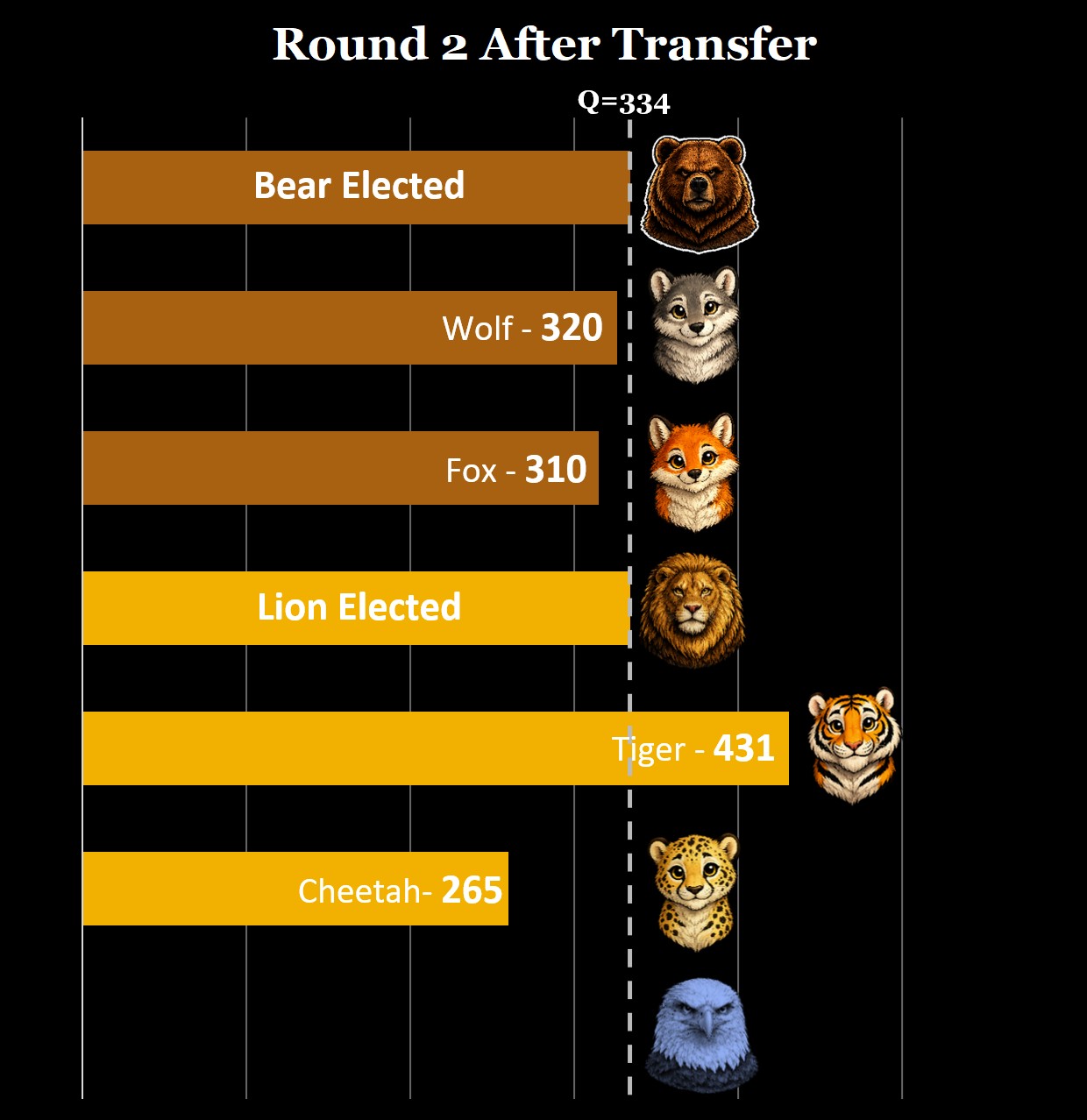
The Lion’s transferred 141 votes put the Tiger at 431 votes, so the Tiger claims the third council seat and transfers 97 excess votes to the Cheetah:
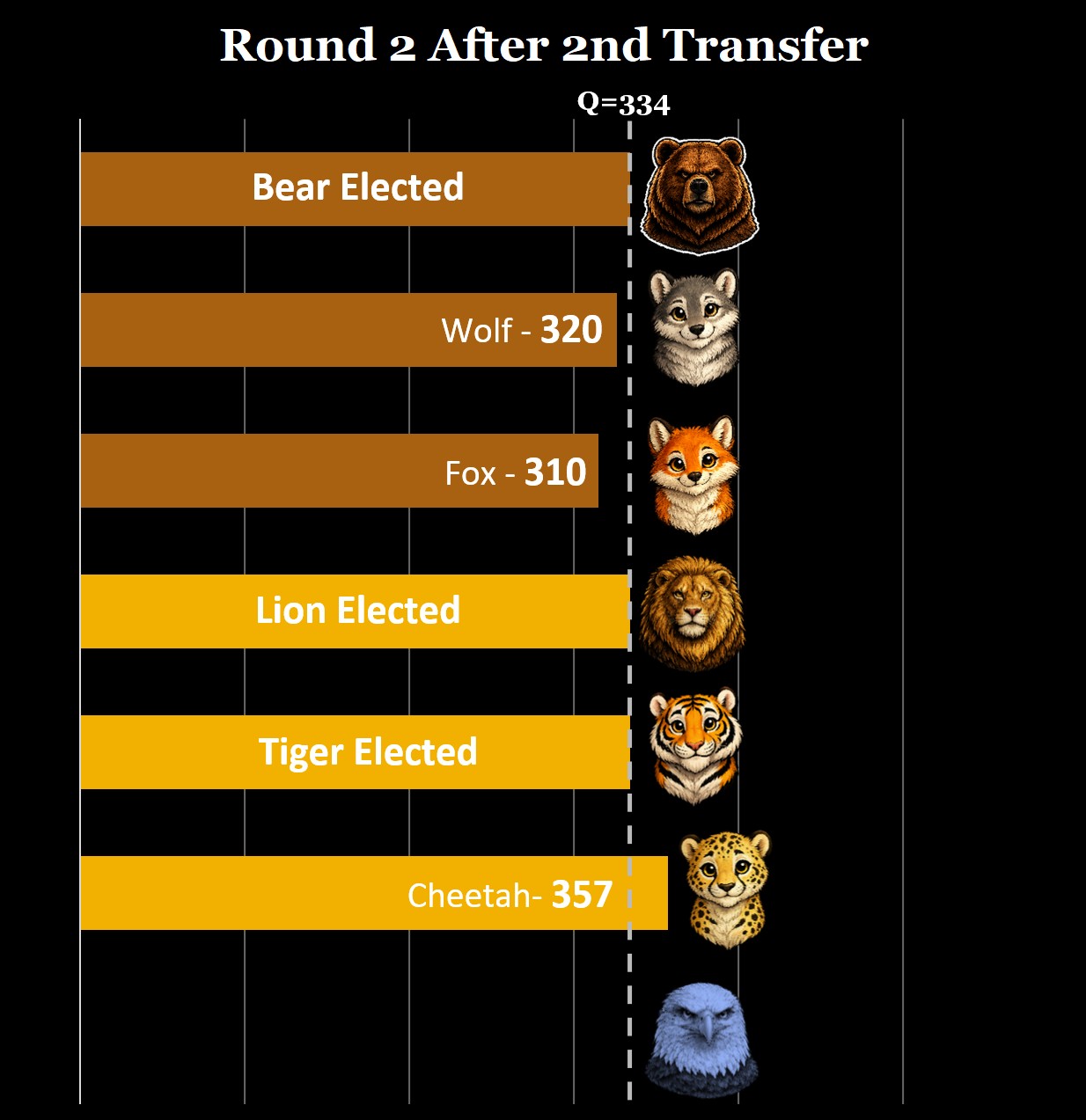
With 357 votes, the Cheetah claims the 4th council seat, giving the Felines majority control of the council. Because no Foresters appeared on any of the ballots that elected the Cheetah, the remaining 31 votes become exhausted. With one seat remaining and 2 candidates left, neither candidate has over 334 votes, so the Fox is eliminated and his 310 votes are transferred to the Wolf:
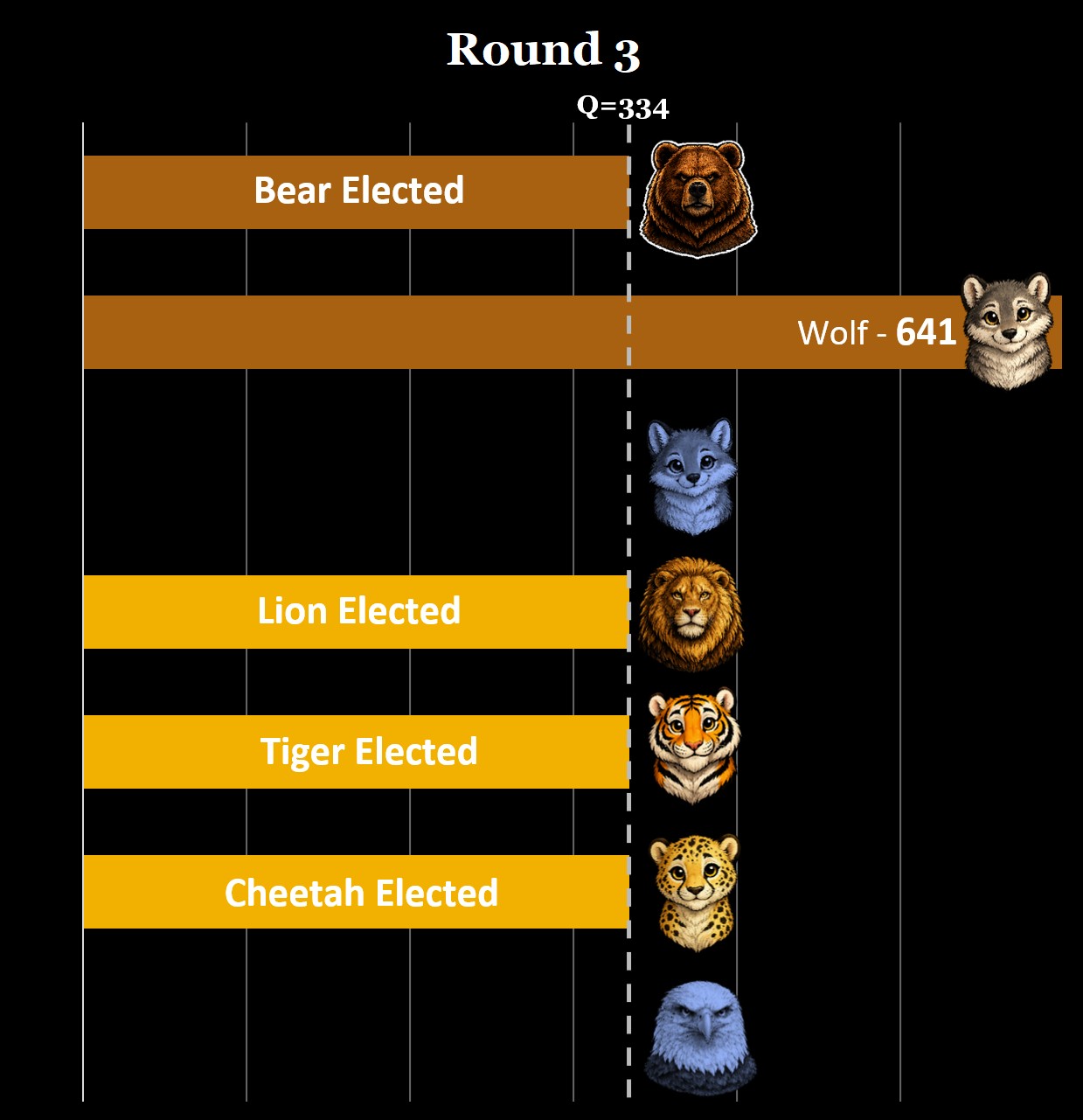
The Wolf is then elected to the final seat with 630 votes, which is 296 votes over the threshold. The final 5-member executive council becomes:





Giving the Felines a majority of the Executive Council. Both the Foresters and the Avians now have a legitimate gripe. The Eagle started with 150 votes, and the Foresters finished with 296 votes over the threshold, which combined would have been more than enough to elect the Eagle and create the best achievable outcome for both groups. But the Eagle was eliminated early, giving the Felines majority control of the council.
This creates an important strategic incentive in STV elections. In some situations, coalitions may need to think not only about their own candidates, but also about helping candidates in allied coalitions secure transfers to achieve their best possible outcome. This can become very difficult for coalitions to manage, and very complicated for voters to navigate.
Comments
This site does not manage comment accounts. Comment data is handled by a third-party discussion service.