Single Transferable Vote (STV) in a Large Representative Assembly
This example shows how STV mechanics can affect representation inside a much larger system. It was originally included as part of the main STV article, but was moved here to keep that introduction focused on the core mechanics of STV.
The Wilderlands
We return to the Wilderlands, which will be represented by a 20-member assembly. The 4 major factions are:


As we discussed previously, the Wilderlands is divided into 20 regions:
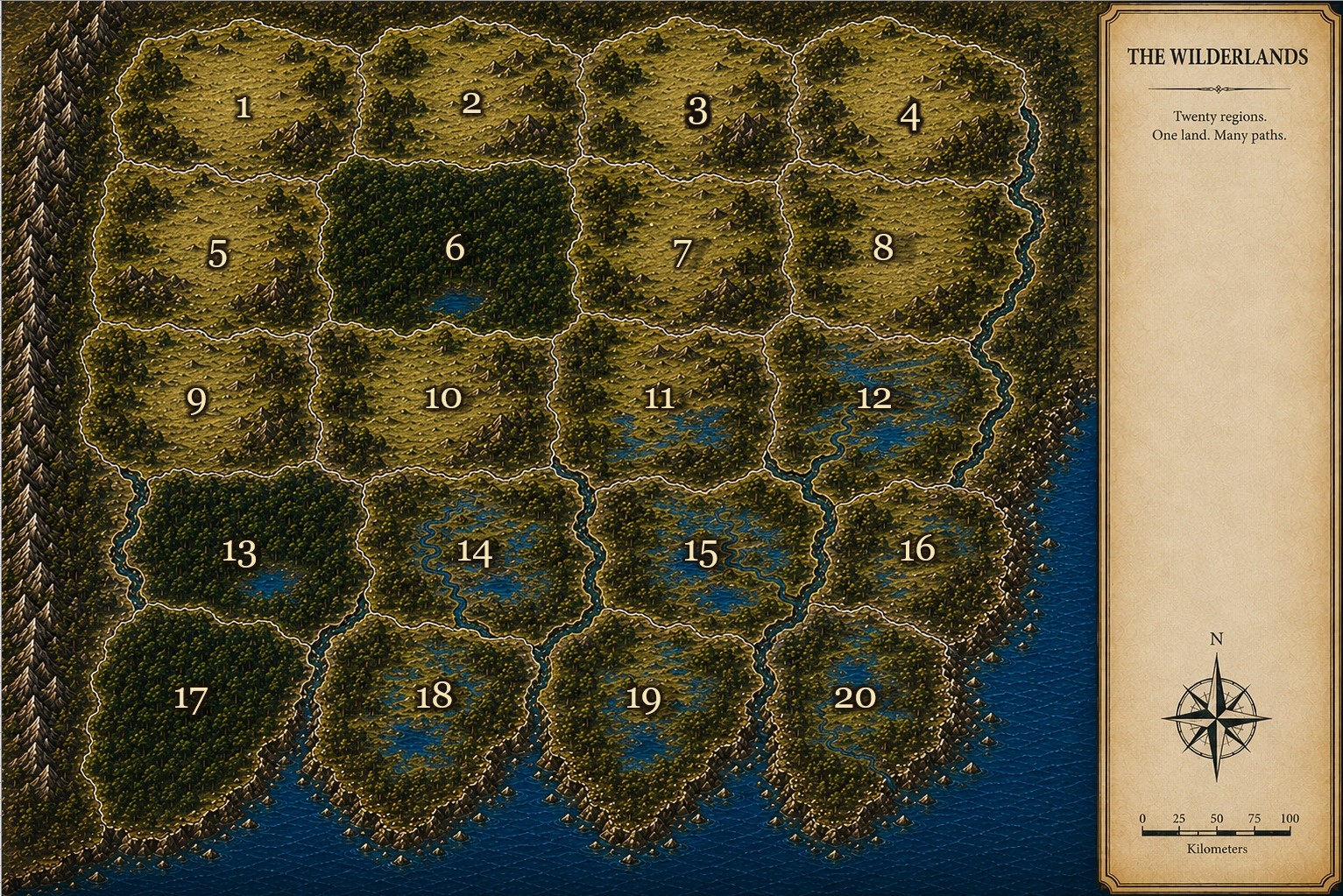
- The Foresters have the largest total population across all regions.
- The Felines have the second-largest population, but much of their population is concentrated in the 11 northern regions.
- The Avians are smaller in population, and their population is spread evenly across all regions.
- The Mariners are even smaller in population, and are spread across the southern coastal regions.
How the factions vote in each region are described in the following chart.
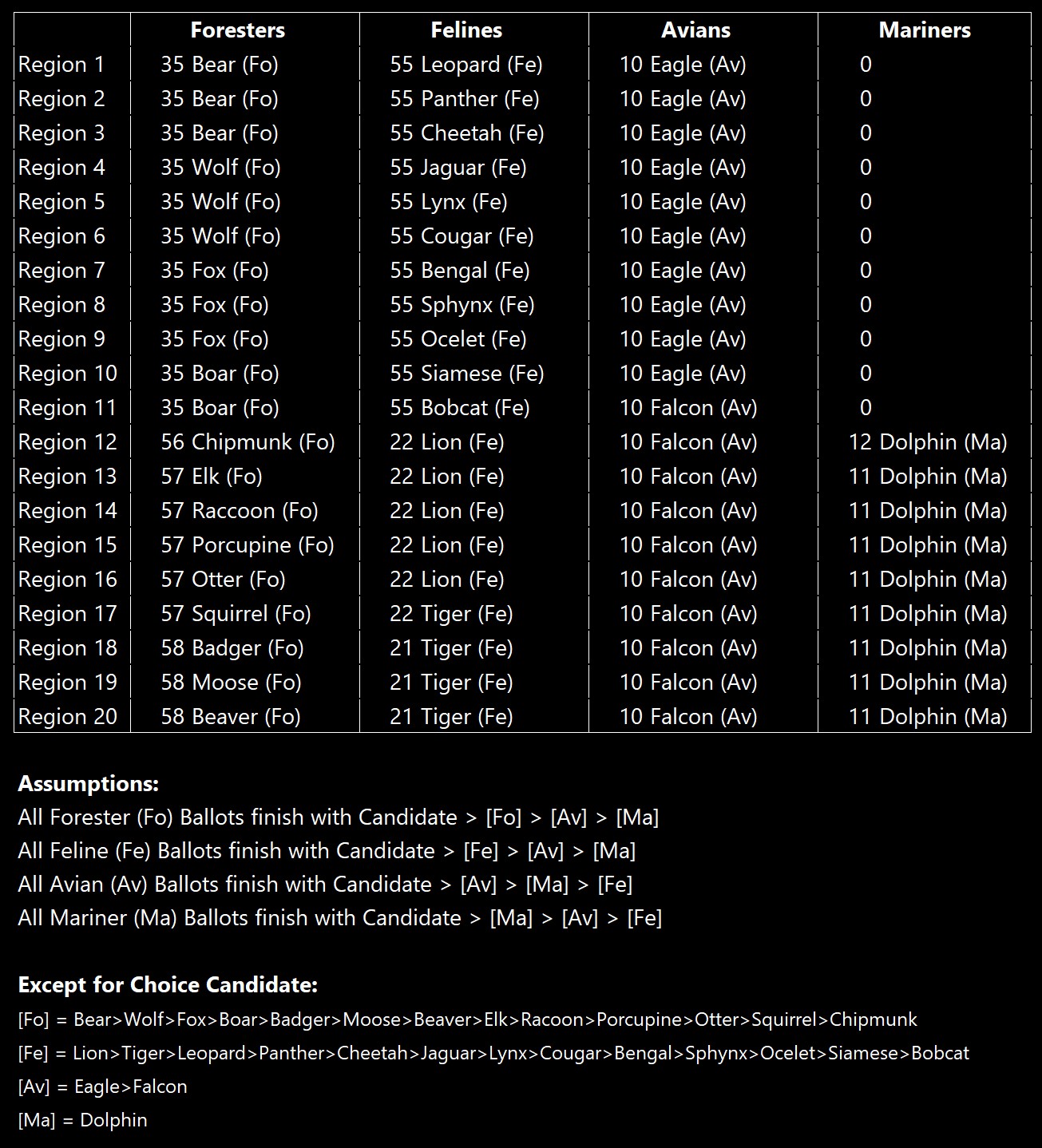
There were several broad assumptions made about these voters:
- The first-choice candidate for each voter in each region and faction is shown in the chart.
- Voters then continue ranking additional candidates from their own faction highly.
- Voters then continue ranking candidates from 2 additional factions according to the coalition assumptions above.
This example intentionally assumes unusually consistent coalition voting behavior in order to make the transfer process easier to follow. Real elections are generally far less organized, and voters within the same coalition often rank candidates very differently. Later articles will discuss some of the ways large STV elections can be simplified through ballot design, regional organization, coalition coordination, and other approaches that can both simplify ballots for voters and improve transparency for election observers.
For this election with \(V_{TOTAL}=2000\) and \(S=20\) elected members:
Each candidate will need 96 votes to claim a seat in the assembly. The election progress is summarized through the following transfer markers:
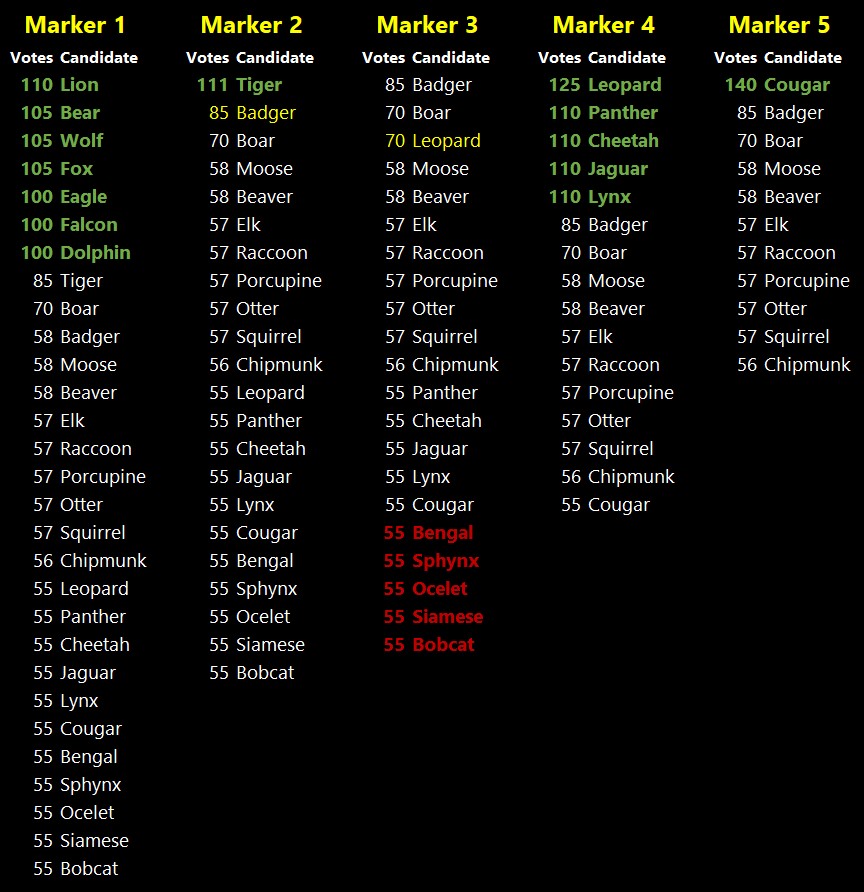
Marker 1: 7 candidates (the Lion, Bear, Wolf, Fox, Eagle, Falcon, and Dolphin) immediately begin above the 96-vote threshold and secure seats. Their remaining excess votes begin transferring to allied candidates, particularly the Tiger and several additional Forester candidates.
Marker 2: The Tiger rises above quota with 111 votes and secures another seat. The Tiger’s remaining excess votes then transfer onward to additional Feline candidates.
Marker 3: As smaller candidates are gradually eliminated, transfers consolidate support into the remaining Feline candidates, including the Leopard, Panther, Cheetah, Jaguar, and Lynx.
Marker 4: The Panther, Cheetah, Jaguar, and Lynx all eventually cross the 96-vote threshold. Their remaining excess votes then transfer onward to the Cougar.
Marker 5: The Cougar secures a seat with 140 votes. Because all remaining Feline, Avian, and Mariner candidates had either already secured seats or been eliminated, the remaining 44 Cougar ballot strength became exhausted instead of transferring onward.
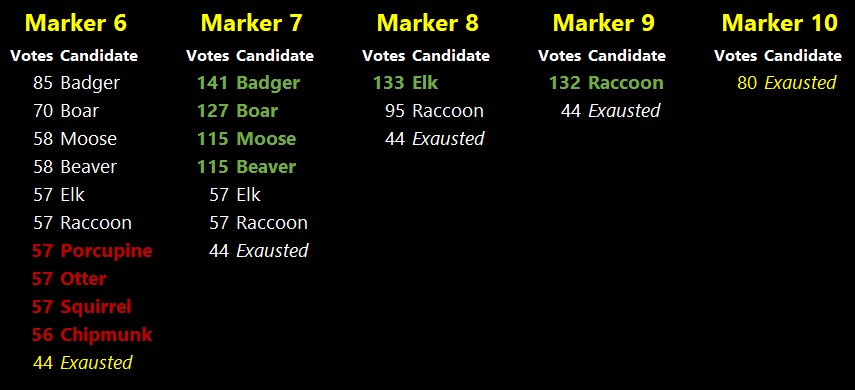
Marker 6: As additional smaller candidates are eliminated, Forester support gradually consolidates into the Badger, Boar, Moose, and Beaver.
Marker 7: The Badger, Boar, Moose, and Beaver all cross the 96-vote threshold and secure seats. Their remaining excess votes then transfer onward to the Elk and Raccoon.
Marker 8: The Elk rises above the 96-vote threshold and transfers additional votes to the Raccoon.
Marker 9: The Raccoon eventually crosses the 96-vote threshold. Because every remaining candidate had either already secured a seat or been eliminated, additional remaining ballot strength became exhausted.
After the transfers are complete, the 20-member assembly becomes:

The Foresters had the largest total population across the Wilderlands, but with only 45% of the population they could only claim 9 of the 20 seats. The Felines held majorities in 11 of the 20 regions, but with only 40% of the total population they could only claim 8 of the 20 seats. The Avians and Mariners, with respective 10% and 5% shares of the population, were still able to secure representation within the assembly even though their populations were spread out across the regions.
Unlike territorial systems, no single coalition was able to convert regional advantages into overwhelming assembly control. The regional boundaries could be redrawn, but because votes transfer across regions, representation in this system can remain broadly proportional if voters continue transferring support within their coalitions. This example also demonstrates how STV can reward transferable coalition support rather than simply rewarding the largest initial voting bloc.