Favorite Betrayal and Later-No-Harm
Critics of head-to-head methods often point to their failure of the Favorite Betrayal and Later-No-Harm properties as a significant weakness. In fact, one lengthy academic critique describes the Later-No-Harm criterion as an indispensable property of voting systems and argues that head-to-head methods are fundamentally flawed because they allow lower preferences to harm higher ones, encouraging strategic voting, undermining the sincere expression of voter preferences, and even causing elections to degenerate toward plurality-like behavior.1 What this critique, like many others, fails to mention is that these properties can only affect the outcome of an election in the extremely rare case that the voters' original sincere preferences, together with those of the remaining electorate, themselves produce a preference cycle.2
As discussed throughout this site, preference cycles in ideological elections are not only extremely rare, but if they are truly based on voters' original sincere preferences, they would represent an electorate that has evolved beyond bitterly polarized politics. We have also shown that preference cycles can result from voters having little interest in a race and submitting arbitrary preferences, or from voters intentionally manipulating their preferences to create a cycle.
To illustrate these properties, our example electorates are intentionally constructed so that a majority of voters submit arbitrary rather than ideological preferences, creating a preference cycle in which the ideological voters find themselves in the minority. We begin by examining Favorite Betrayal.
Favorite Betrayal
We will use the down-ballot Rail Corridor race we have discussed several times on this site:



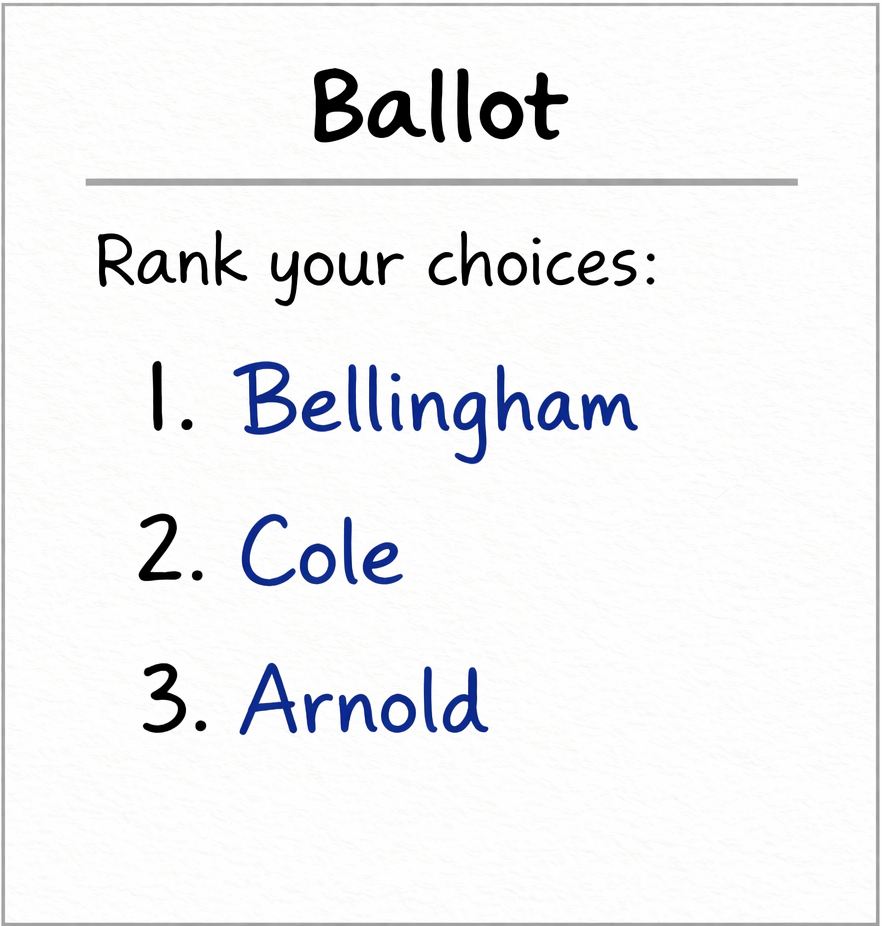
- The Transit Voters still support Bellingham first because of his experience, Cole second because he seems well-intentioned, and Arnold last because of his questionable intentions. However, they have declined in number from previous examples.
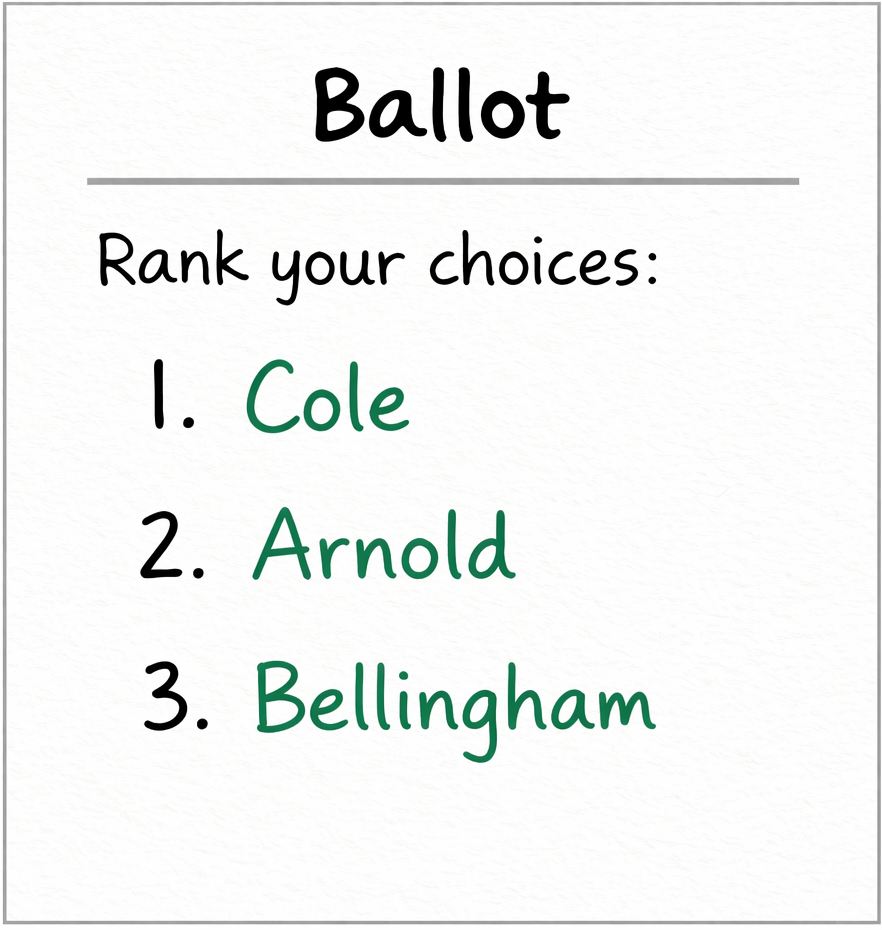
- The Short-name Voters still blindly support Cole > Arnold > Bellingham.
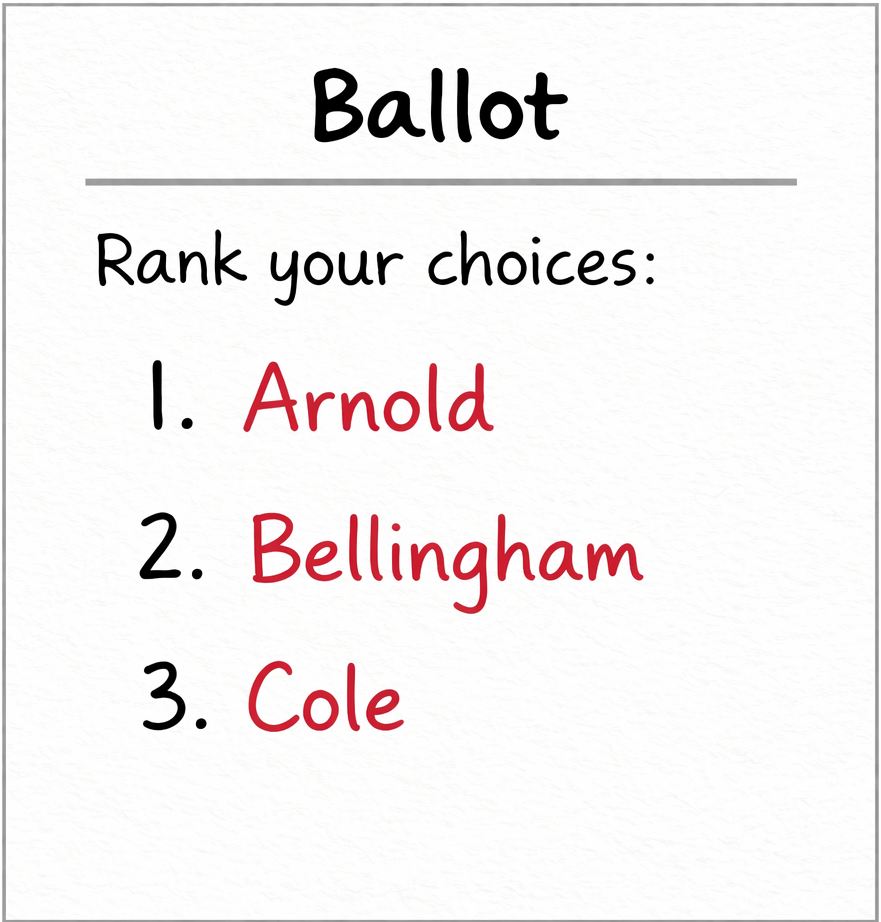
- The ABC voters still blindly support Arnold > Bellingham > Cole.
In an election with 25 Transit voters, 35 Short-name voters, and 40 ABC voters, if the Transit Voters vote sincerely, the ballots would look like:
The results would be:
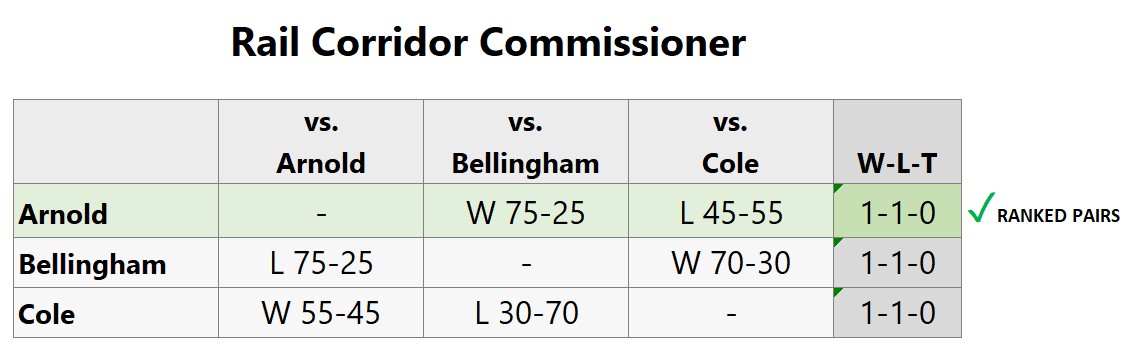
Which would produce a preference cycle, and Arnold would win through the First Choice Preferences and most cycle-resolution methods. This is the worst possible outcome for the ideological Transit voters. Suppose, however, that the Transit voters understand how the remainder of the electorate is likely to vote. Rather than allow Arnold to win, they could betray their favorite Bellingham by ranking Cole first instead:
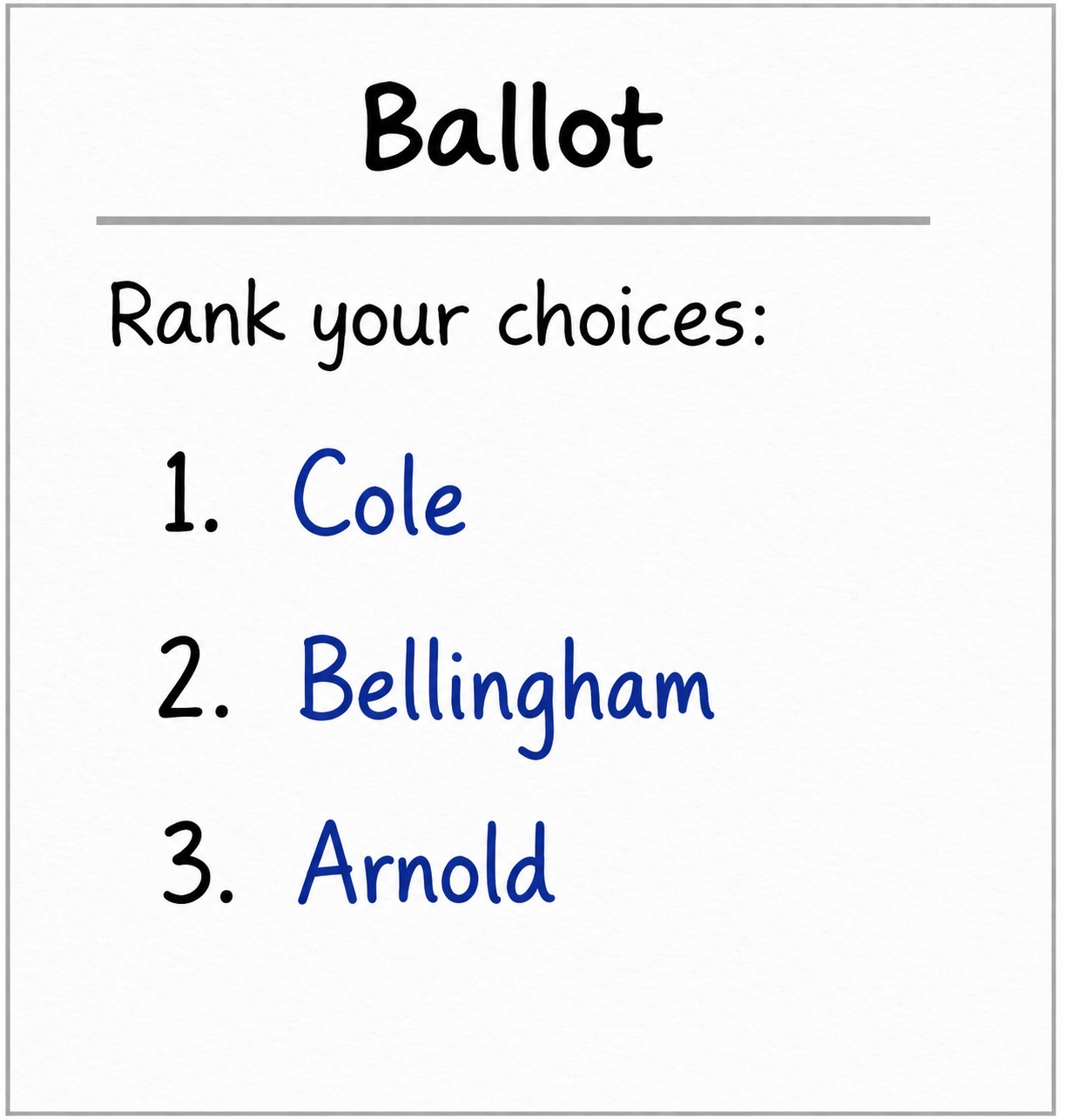
The ballots become:
The results become:
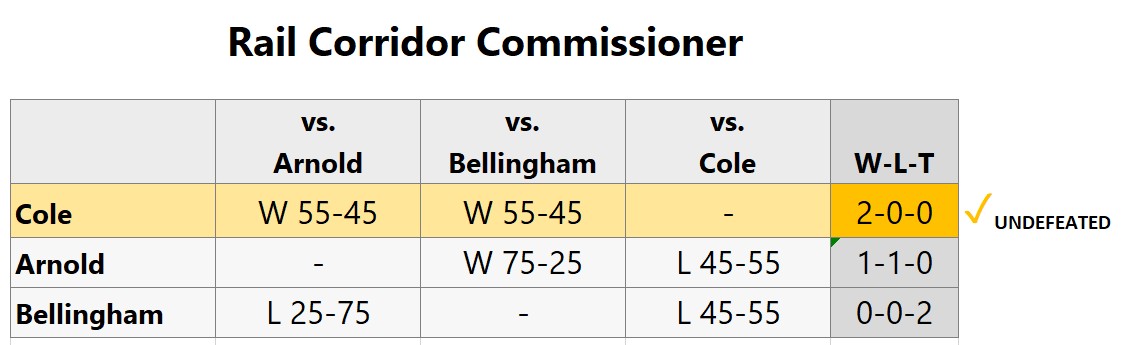
The preference cycle disappears, and Cole becomes the head-to-head undefeated candidate, which is a better outcome for the Transit voters. This strategy is known as Favorite Betrayal because voters deny their first preference to their sincere favorite in order to reach a better outcome.
This Favorite Betrayal strategy also exists in traditional elections and IRV elections, where voters are regularly incentivized to abandon their sincere favorite in favor of a dominant contender, contributing to political polarization. In head-to-head elections, however, Favorite Betrayal can only occur when the voters' original preferences within an electorate produce a preference cycle2, which is an exceptionally rare event. For this reason, advocates of head-to-head elections describe Favorite Betrayal as negligible compared to other election methods.
Later-No-Harm
We will use the Rail Corridor example again, with the same candidates, but who have evolved over time:


- The Transit voters still support Bellingham as their first preference. However they now prefer Arnold over Cole, as Arnold has shown signs of redemption, while Cole has shown signs of corruption. Their numbers have been restored.
- The Short-name voters still blindly support Cole > Arnold > Bellingham.
- The ABC voters still blindly support Arnold > Bellingham > Cole.
Returning to the original electorate of 40 Transit Voters, 35 Short-Name Voters, and 25 ABC Voters, the ballots were:
The results were:
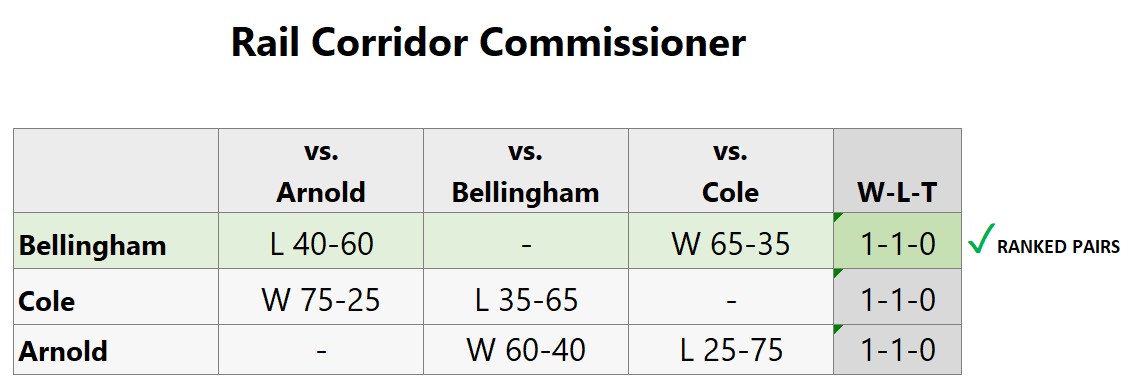
Their original sincere preferences produce a preference cycle, and Bellingham would win through the First Choice Preferences and most cycle-resolution methods. Now suppose the Transit voters update the later preferences on their ballot to reflect their sincere change in opinion, raising Arnold over Cole:
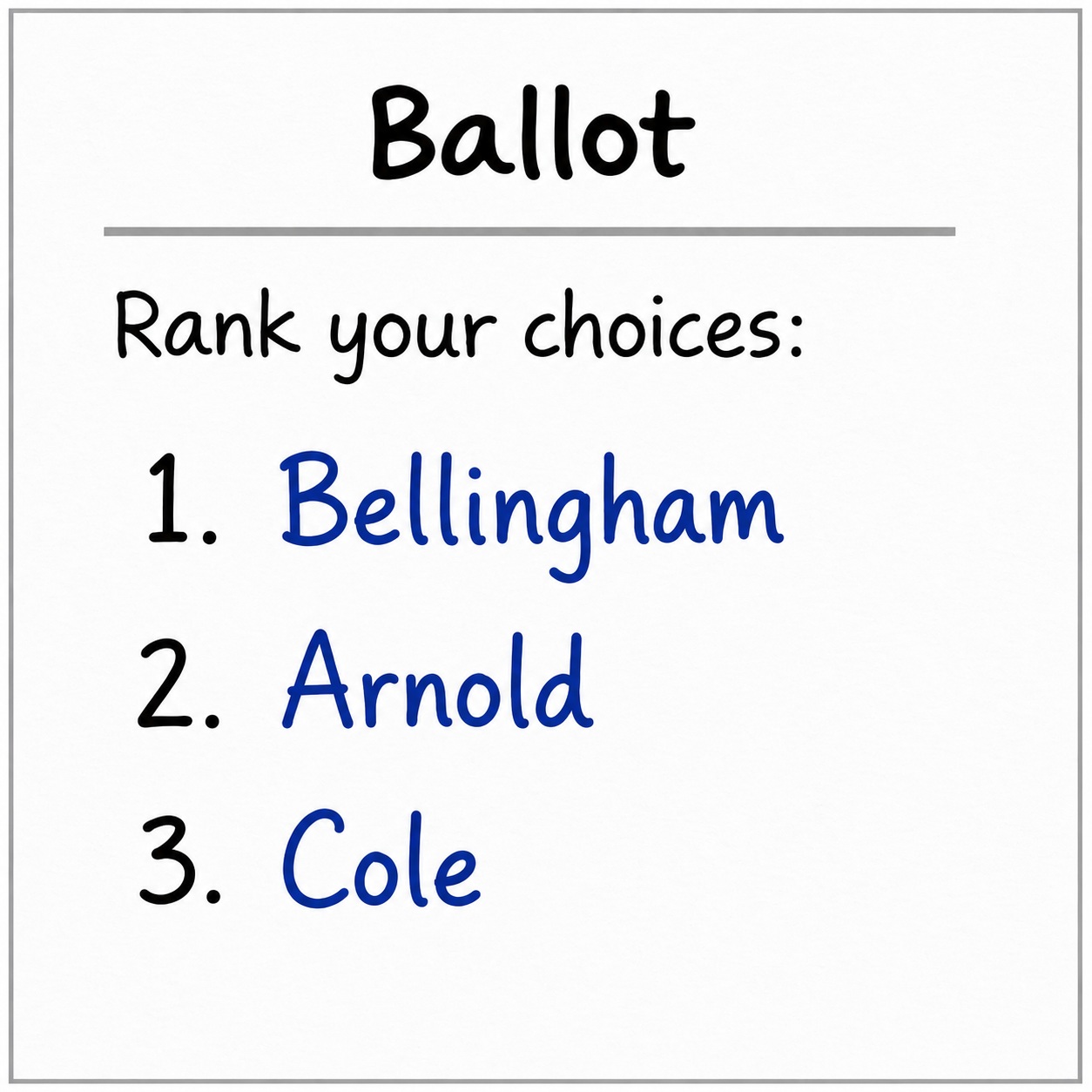
The ballots become:
The results become:
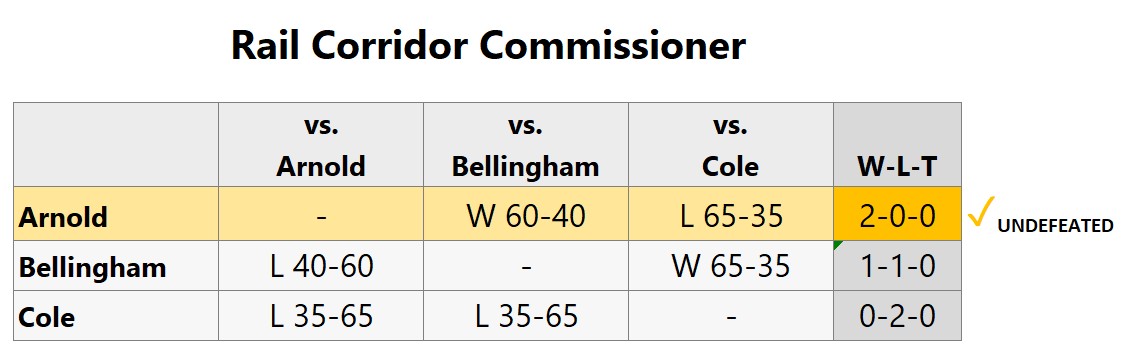
The preference cycle disappears, and Arnold becomes the head-to-head undefeated candidate. This is an example of the system failing the Later-No-Harm property. The Transit voters sincerely changed only their later preferences (Arnold and Cole), yet doing so harmed their favorite candidate, Bellingham, as he is no longer the winner. Critics argue that violating this property creates incentives for bullet voting and could cause head-to-head elections to regress toward plurality-like behavior.1 But just like the Favorite Betrayal property, Later-No-Harm can only fail in head-to-head systems when the voters' original preferences within an electorate produce a preference cycle2, a point that is rarely emphasized in discussions of these properties.
Relationship to Strategic Voting
The Later-No-Harm example also illustrates how the same election can create a strategic voting opportunity in head-to-head systems. Rather than sincerely updating their later preferences to Arnold over Cole, the Transit voters could instead strategically rank Cole above Arnold as in the original election, recreating the preference cycle and restoring Bellingham as the winner.
This strategy succeeds because the Transit voters have unusual knowledge of how the remainder of the electorate is likely to vote. The Short-Name and ABC voters are not making ideological choices, allowing the Transit voters to predict their behavior with unusual confidence.
In a genuinely ideological election, this burying strategy would be much less reliable. If the ABC voters had a sincere first preference in Arnold, and discovered that the Transit voters were intentionally burying him, they would likely respond by burying Bellingham:
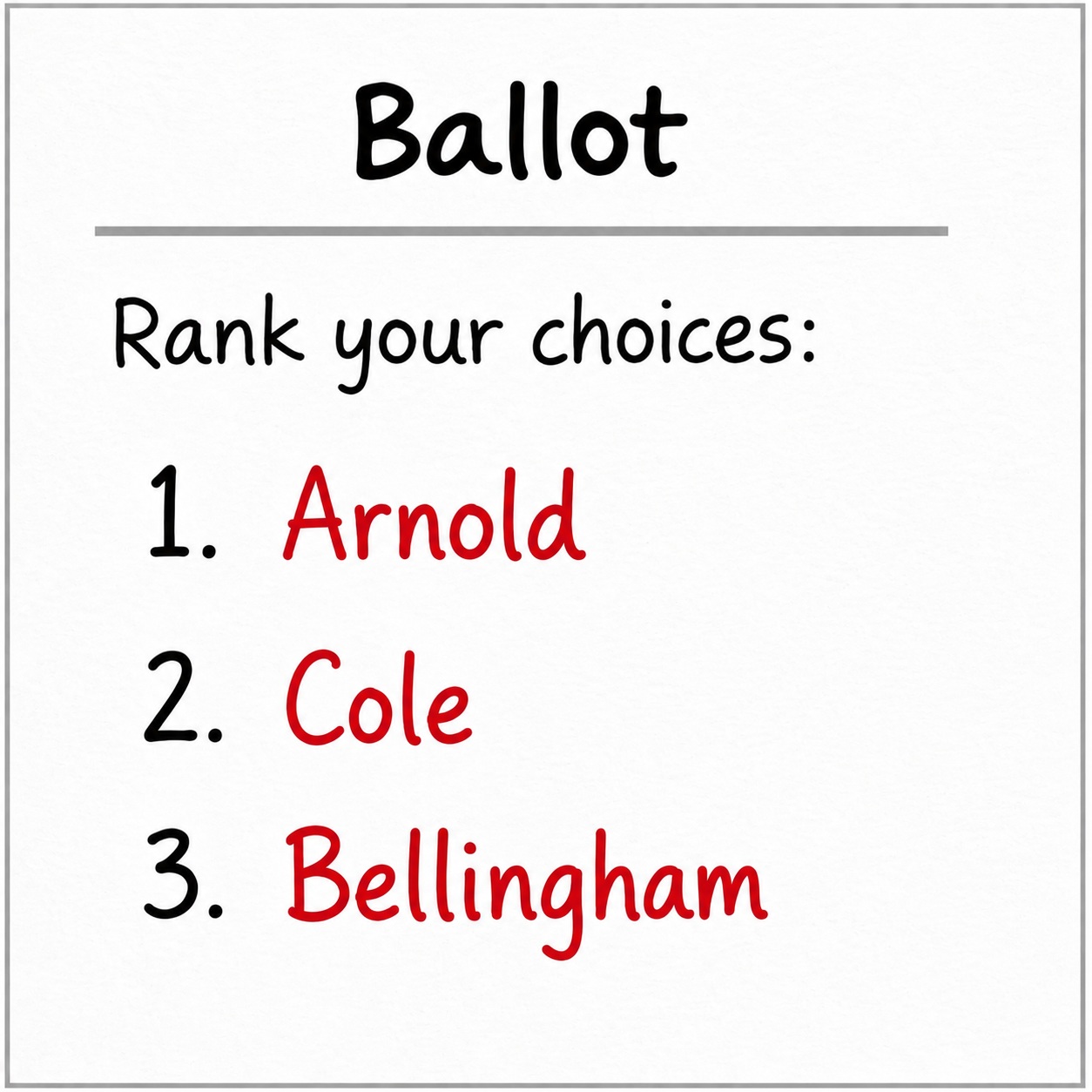
The ballots become:
The results become:
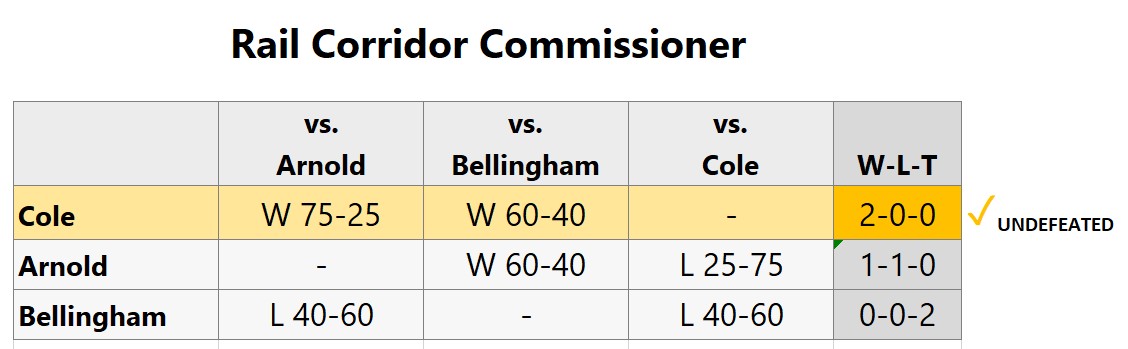
And Cole would become the head-to-head undefeated candidate, leaving both ideological groups worse off. As discussed previously in the Strategic Burial article, this ability of other voters to respond is one reason head-to-head advocates argue these methods are much more resistant to strategic manipulation than other methods.
1Marquette Law Review, “Reform for Realists: The False Promise of Condorcet Voting” (2025), pp. 209–10, 230–39. G. Michael Parsons & Rachel Hutchinson.
2A mathematical appendix containing formal proofs is available here. We are continuing to search the published literature to determine whether this relationship has previously been proven or disproven. To date, we have not found a counterexample, and every published example of Favorite Betrayal or Later-No-Harm in head-to-head systems that we have examined arises from an underlying preference cycle. If you know of a proof, disproof, or counterexample, we would genuinely appreciate hearing from you and would be happy to credit you for bringing it to our attention.
Comments
This site does not manage comment accounts. Comment data is handled by a third-party discussion service.