Point-Based Systems
A common misconception about Ranked Choice Voting (RCV) is that ballots are always processed by assigning points to each position and adding them up across voters. One well-known example of this type of method is the Borda count, often associated with ranked choice voting, though many variations exist. Point-based systems are among the simplest methods for processing ranked ballots, though that simplicity comes with tradeoffs.
Point-based approaches are also used in many other settings, including awards voting for the Oscars, Grammys, and Tonys, where voters rank their preferences and points are assigned based on position. A well-known example of this type of scoring is the AP Top 25 college football poll.
Each week during the football season, a panel of journalists and broadcasters from across the country lists their opinion of the top 25 teams in a private submission. In each submission, a first-place vote is worth 25 points, second place 24 points, and so on down to one point for 25th place. The points from all submissions are added together to produce the weekly rankings.
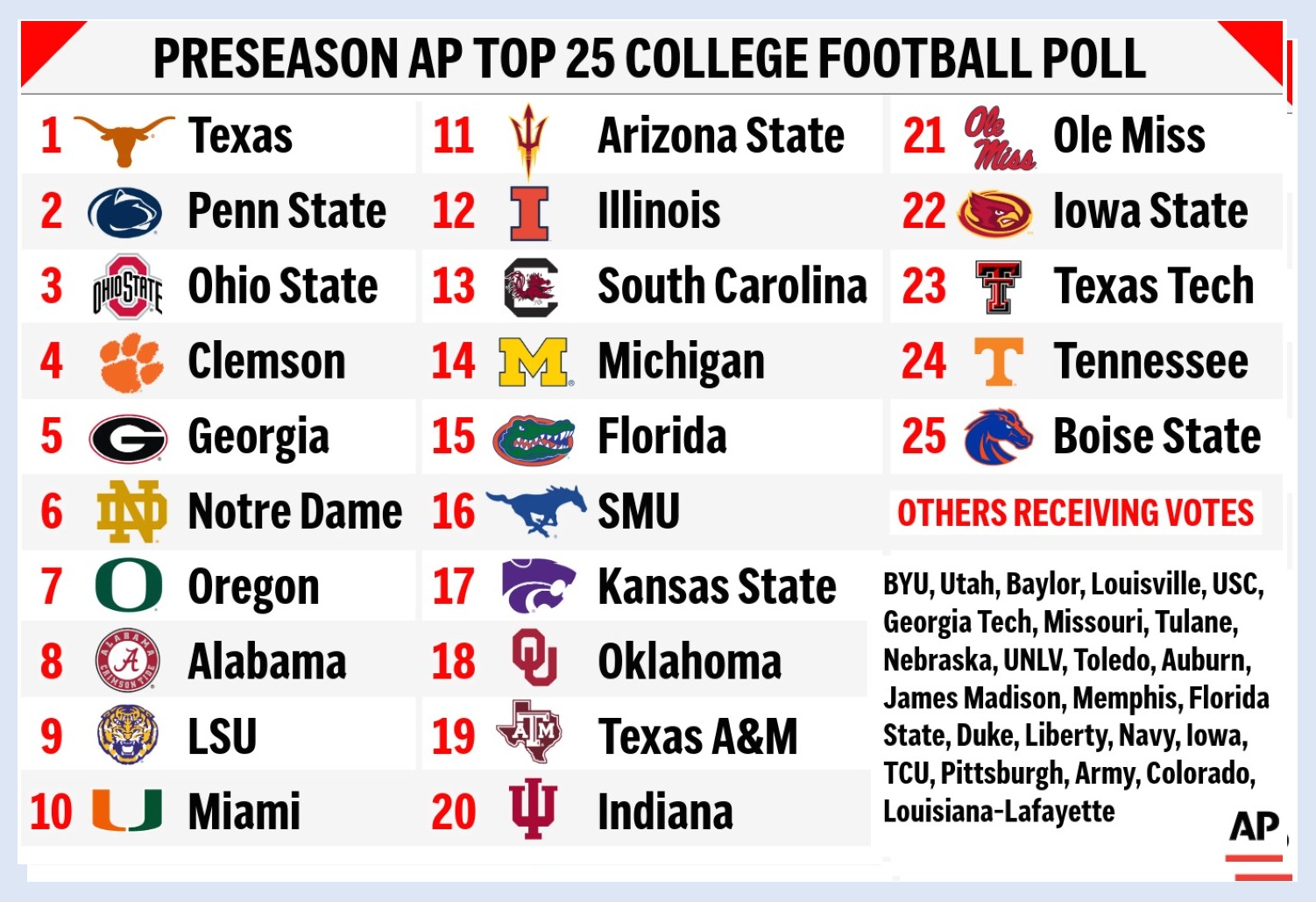
This system produces a single overall ranking based on the combined rankings of the voters. However, the published result is limited to a top 25 list and “Others Receiving Votes,” even though there are more than 130 teams under consideration.
This reflects a practical reality: the AP voters are being asked to rank only the teams they have a clear opinion about. The system does not require them to rank teams beyond the top tier they may be indifferent to. This type of scoring rewards teams that appear consistently near the top of many submissions. As a result, the team with the most first-place votes may not finish first overall.
This leads to one of the key criticisms of point-based systems in elections. While these methods work well for producing rankings, elections often have different goals. Consider the following example:
The Feline Community
In a friendly feline community, the well-liked Tiger and Cheetah are joined on the ballot by the Skunk, who is not really a feline but has somehow managed to get into the race.



They plan to use a point-based system where a first-place vote is worth 2 points, second place 1 point, and third place 0 points.
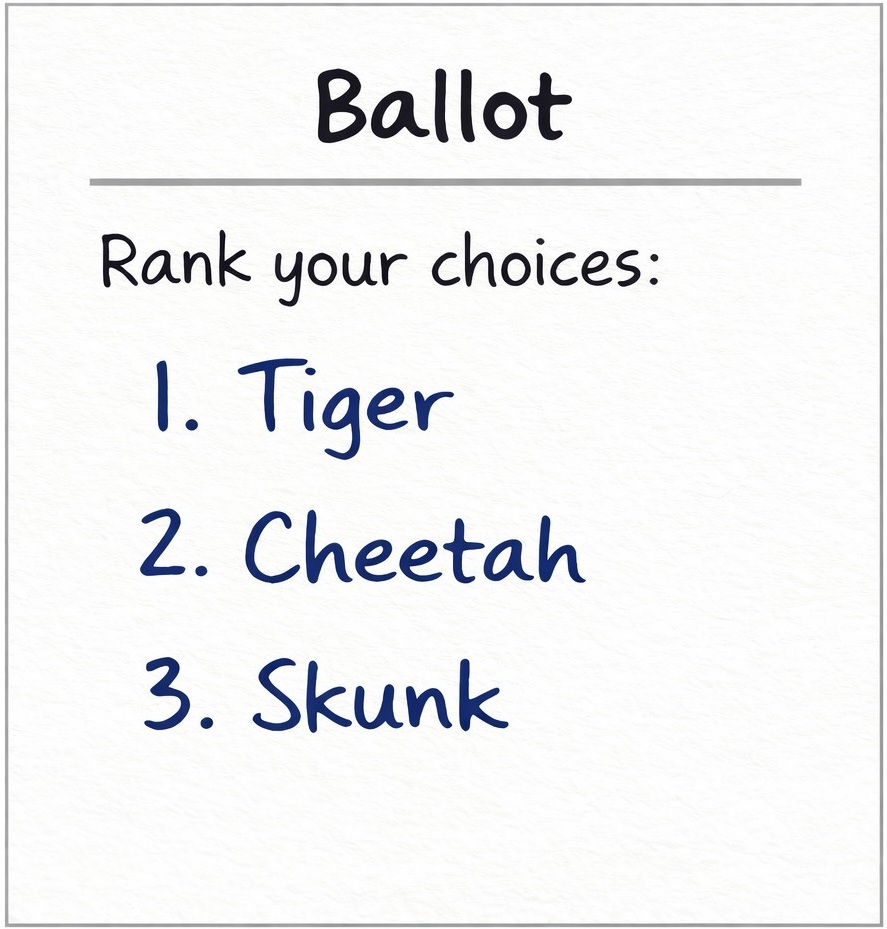
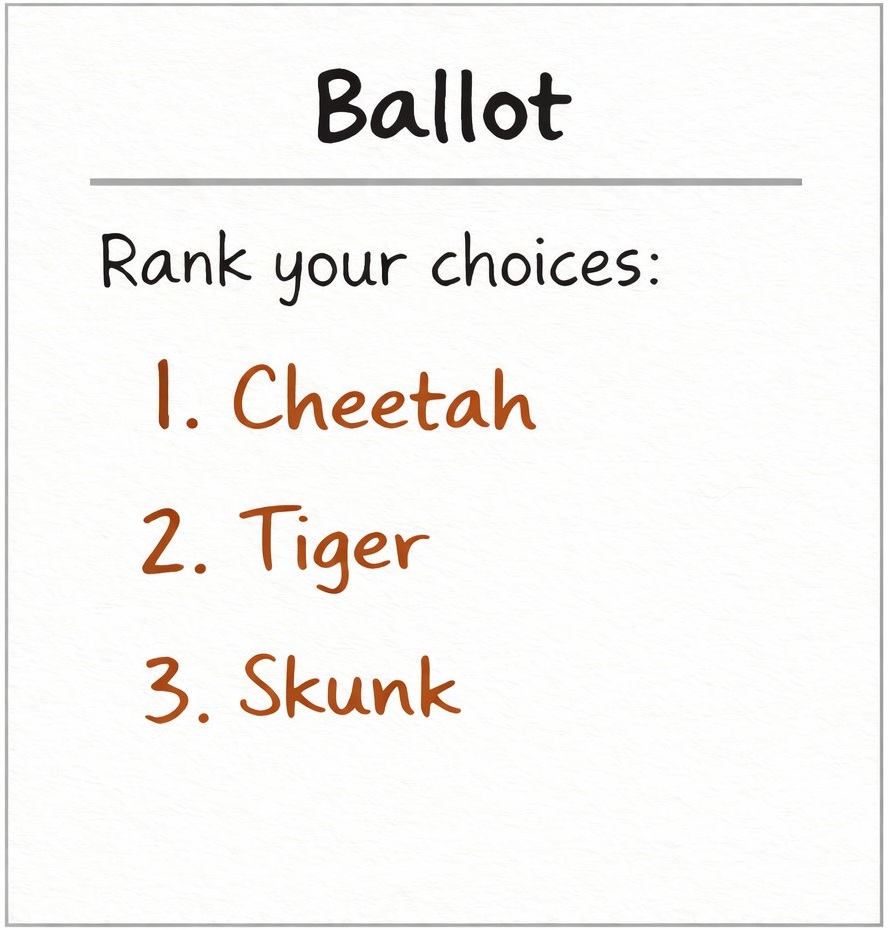
The community has 100 members. 60 are in the Jungle group and prefer the Tiger over the Cheetah, while the remaining 40 are in the Plains group and prefer the Cheetah over the Tiger. None have a strong preference for the Skunk.
The Jungle and Plains groups fill out their ballots as follows:
The totals are:
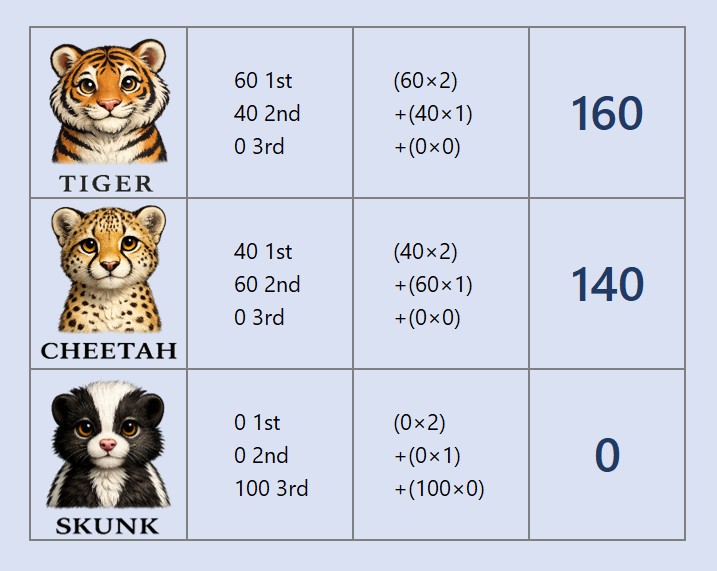
In this case, the Tiger finishes first, which matches expectations since a majority of voters ranked the Tiger first.
The Cheetah cannot win in this scenario because (a) a majority supports the Tiger, and (b) the Cheetah supporters are giving the Tiger second-place votes. Now suppose the Plains group stops giving the Tiger their second-place votes and instead gives those votes to the Skunk, not because they prefer the Skunk over the Tiger, but to improve the Cheetah’s chances of winning:

The totals become:
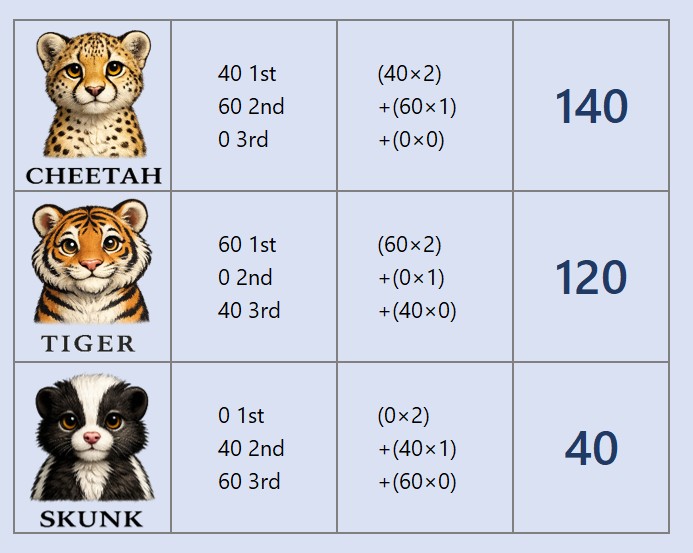
When this happens, the Cheetah finishes first overall, even though the Tiger received a majority of the first-place votes. This not only creates an incentive for voters to rank strong alternatives lower than their true preference order, but can also encourage negative campaigning, as candidates may urge supporters to rank their strongest opponents last. This type of behavior can contribute to a more polarized community.
More broadly, any system in which a candidate can receive a majority of first-place votes but not win is likely to face criticism. Some systems intentionally prioritize broad support over first-place majorities. Further, systems that incentivize strategic ranking or contribute to more polarized communities may also raise concerns. As we have said, there are numerous other systems; many address these issues, but they come with different tradeoffs.
Comments
This site does not manage comment accounts. Comment data is handled by a third-party discussion service.