Thank you for visiting. This is an independent website with a simple goal of helping readers understand existing election reform proposals, how these proposals create different incentives for voters, and why these changes in voter incentives matter. We do not promote any particular system or any political movement. To introduce these ideas, we'd like to begin with a simple story set in a classroom:

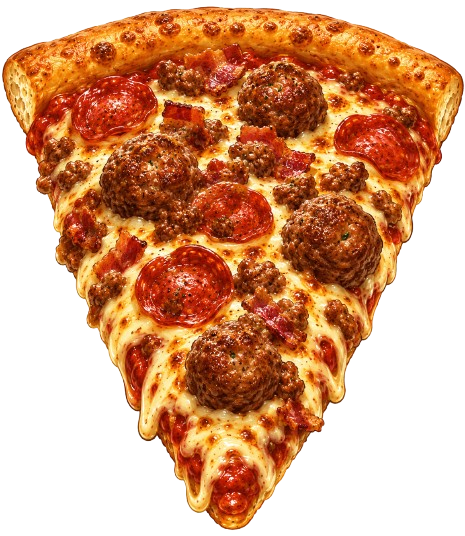
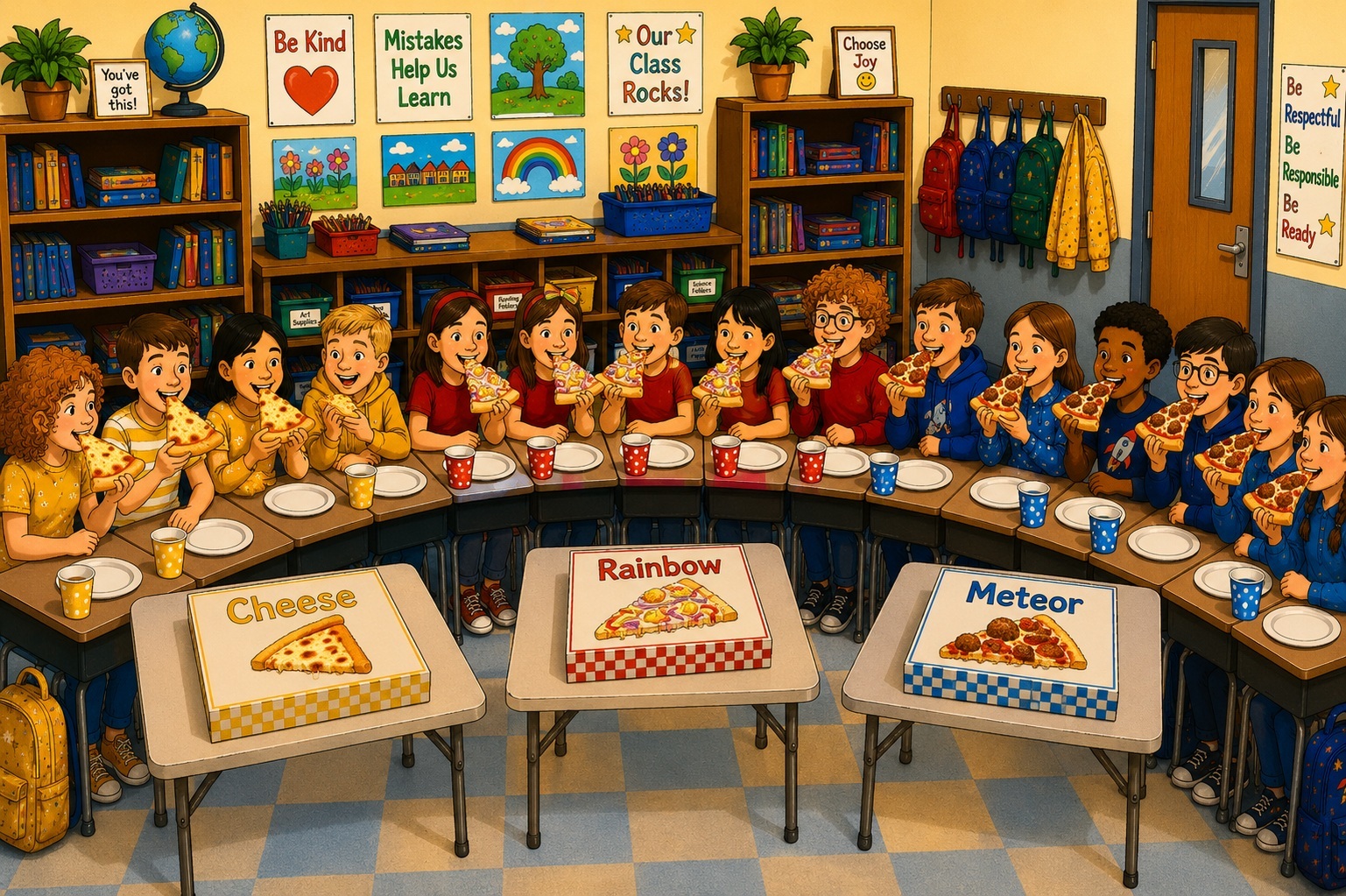
Mrs. Wilson tells her class of 15 students that today is a special day. A new pizzeria has opened in their town and will buy pizza for the entire class. The class cheers. However, they can only get one type of pizza that the entire class will need to share. The choices are Cheesy Cheese Pizza or Meaty Meteor Pizza. Nine students vote for Cheese, six students vote for Meteor; Cheese wins:

Pizza
Pizza
Mrs. Wilson smiles and steps out to place the pizza order. A minute later she returns. She apologizes and explains that there has been a mix-up with the menu. The choices are actually Cheesy Cheese Pizza or Zesty Rainbow Pizza. The students vote again. This time, ten students vote for Cheese and five students vote for Rainbow; Cheese wins again:
Pizza

Pizza
Mrs. Wilson smiles again and steps out to place the order. A minute later she returns once more. She apologizes and explains that there has been another mix-up. She tells the class that all three pizzas are actually available:
Pizza
Pizza
Pizza
She asks the class if they need to vote again. The class, now getting hungry, looks at the teacher with blank stares:

Finally, one of the students says, "No, Cheese already won twice. We can just order Cheese." Mrs. Wilson smiles and agrees, but explains that the pizzeria owner would like another vote, now that all three pizzas are available. So the class votes again. This time, 4 students vote for Cheese, 5 students vote for Rainbow, and 6 students vote for Meteor; Meteor wins:
Pizza
Pizza
Pizza
The six students who voted for Meteor clap and cheer, while the remaining nine students sit in disbelief. Finally, a student who voted for Rainbow stands up and says, "But I don't like Meteor. Why can't we just have Cheese? We already agreed on it twice." Mrs. Wilson thinks for a moment and says, "Well, there are 15 students, and only 6 voted for Meteor. That's not a majority, so we'll have a runoff election." She removes Cheese as an option and says the class will now vote between Zesty Rainbow Pizza and Meaty Meteor Pizza:
Pizza
Pizza
One of the students who voted for Cheese in both previous votes stands up and says, "Hold on, why are you eliminating Cheese? Cheese beat both of those pizzas when we voted earlier!" Mrs. Wilson thinks for a moment, and then responds, "Well, that's how runoff elections work. We eliminate the choice with the fewest votes and vote on the remaining choices." The student, seemingly confused, sits back down. The class proceeds with the vote. Nine students vote for Rainbow and six students vote for Meteor. Rainbow wins:
Pizza
Pizza
Five of the students who voted for Rainbow now start clapping and cheering. A student who voted for Meteor stands up and says, "But I don't like Rainbow! We originally all agreed on Cheese. What is going on here?"
This story actually has a happy ending. The pizzeria owner hears what happened, breaks down, and then buys the class all three kinds of pizza, so everyone is happy.
But not all stories where a democratic group is trying to decide among multiple choices have such happy endings. Please join us for an analysis of what happened, as well as a simple solution to multi-way elections that respects voters' complete order of preference.
Analysis
The class could be divided into three groups:
- Group 1's favorite was Cheese, but preferred Rainbow over Meteor.
- Group 2's favorite was Rainbow, but preferred Cheese over Meteor.
- Group 3's favorite was Meteor, but preferred Cheese over Rainbow.
If the students submitted ranked ballots, their order of preference would be as follows:
4 Members
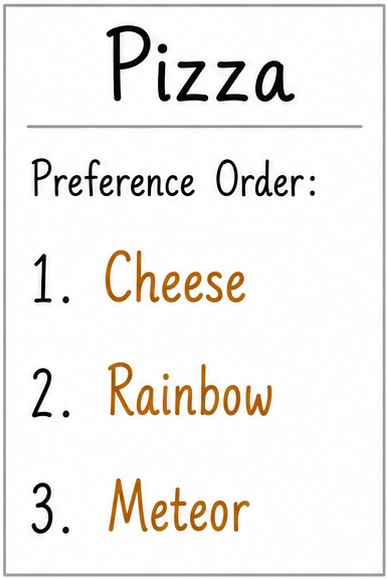
5 Members
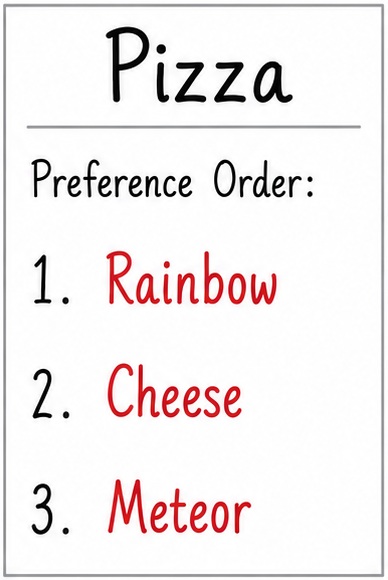
6 Members
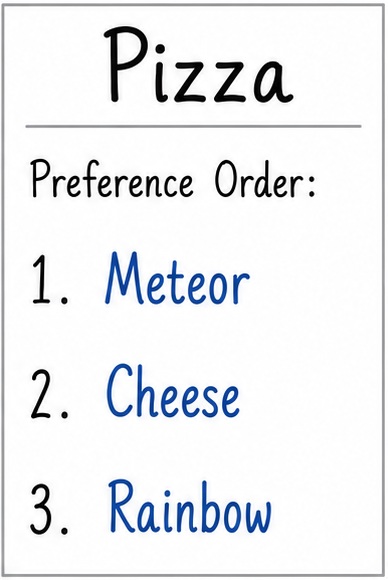
In a traditional single-choice election:
- Meteor would win with a vote of 6-5-4
- Group 1 could have improved their outcome by voting for Rainbow
- Group 2 could have improved their outcome by voting for Cheese
And in a runoff (or instant-runoff) election:
- Cheese would have been eliminated with the fewest first-choice preferences
- Rainbow would then win with a runoff vote of 9-6
- Group 3 could have improved their outcome if they made Cheese their first choice
In all of these cases, there were situations where students could improve their results by not submitting their true preferences. In other words, these students would be incentivized to vote strategically rather than sincerely in order to achieve a better outcome.
There is a reason why this matters. When enough voters face such incentives, support tends to concentrate behind fewer candidates. Over time, this can reduce voter choice and contribute to greater political polarization. Some people view this as a natural consequence of democratic competition. Others believe election systems can do more to allow voters to support their true preferences.
There actually is an election system that has been around for over 700 years that respects voters' sincere order of preference. The system uses the order of preference of each voter to determine the head-to-head winner between each pair of choices. It then looks for the winner with the best head-to-head record, the same way sports leagues have determined a champion for over a century. In the classroom pizza example, Cheese would defeat Rainbow 10-5, Cheese would defeat Meteor 9-6, and Rainbow would defeat Meteor 9-6. Listing these as head-to-head win/loss results:
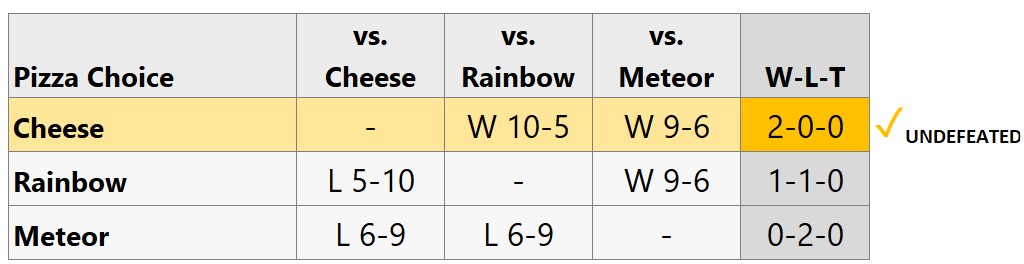
Cheese would win as the undefeated head-to-head choice. But the more important result is that the students no longer face pressure to abandon their favorites and strategically vote for something different. This method does not completely eliminate all incentives to vote strategically, but it allows voters to submit their sincere order of preference without concerns that they need to be concentrating support behind strategic choices. Neither major party is considering this type of election system, because an election system that consistently respects voters' complete order of preference would serve voters better than it would serve established political parties.
The goal of this website is not just to explain how different election systems work, but also how election systems change the incentives facing voters and candidates. Reasonable people disagree about how such elections should be interpreted, and we respect those differing interpretations.
This website does not endorse or defend the Instant Runoff Voting method currently used in Alaska, Maine, New York City, or other jurisdictions, nor does it endorse campaigns whose primary focus is opposing those systems. Instead, it explores numerous proposed and existing election systems, describes the ways voters can express their opinions under those systems, and explains the incentives those systems create for voters and candidates.
Thank you again for visiting. Please feel welcome to explore our site.
Comments
This site does not manage comment accounts. Comment data is handled by a third-party discussion service.