Party-List Voting for Proportional Representation
Party-list voting is one approach to proportional representation used in many representative bodies throughout the world, although it is not used in the United States. Voters do not vote for individuals or local district leaders, but instead vote for a party. Parties are then awarded a number of seats proportional to the number of votes they receive.
The math is fairly simple. If a body has STOTAL total seats and there are VTOTAL total votes, the number of votes required to automatically receive an initial seat assignment, called the quota threshold Q, is calculated as:
The floor symbols ⌊ ⌋ mean to round the result down to the nearest whole number before adding 1. For example, ⌊33.33⌋ becomes 33. Suppose an election has 100 voters:
| Total Seats | Quota Needed |
|---|---|
| 1 | 51 |
| 2 | 34 |
| 3 | 26 |
| 5 | 17 |
| 10 | 10 |
As the number of seats increases, the number of votes needed to claim a seat becomes smaller. In a 1-seat election, a candidate needs 51 out of 100 votes to guarantee victory. But in a 10-seat assembly, only 10 votes are needed to automatically receive one of the 10 seats.
After Q is calculated, the number of seats each party initially receives is determined by dividing the party's votes by Q. If a party receives VPARTY votes, the number of seats they initially receive is:
For example, if the quota threshold is Q=96 and a party receives 270 votes:
The party would initially receive 2 seats. We will describe this entire process using the same Wilderlands example introduced earlier.
The Wilderlands
Returning to the Wilderlands and the 4 major factions:




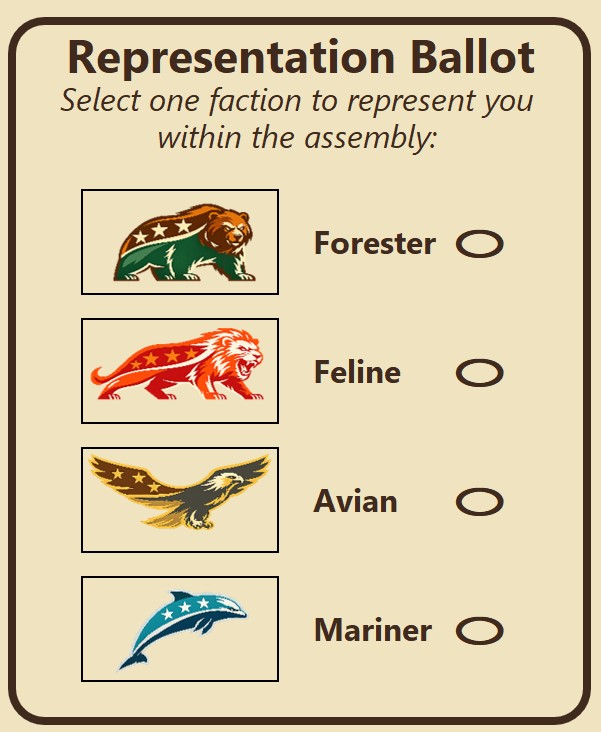 Voters now fill out representation ballots by selecting the faction they want represented within the assembly, similar to this one shown.
Suppose the Wilderlands assembly contains 20 seats, and there are 2,000 voters. The quota threshold is:
If the Foresters get 900 votes, the Felines get 800 votes, the Avians get 200 votes, and the Mariners get 100 votes, the total seats and remaining votes for each faction is:
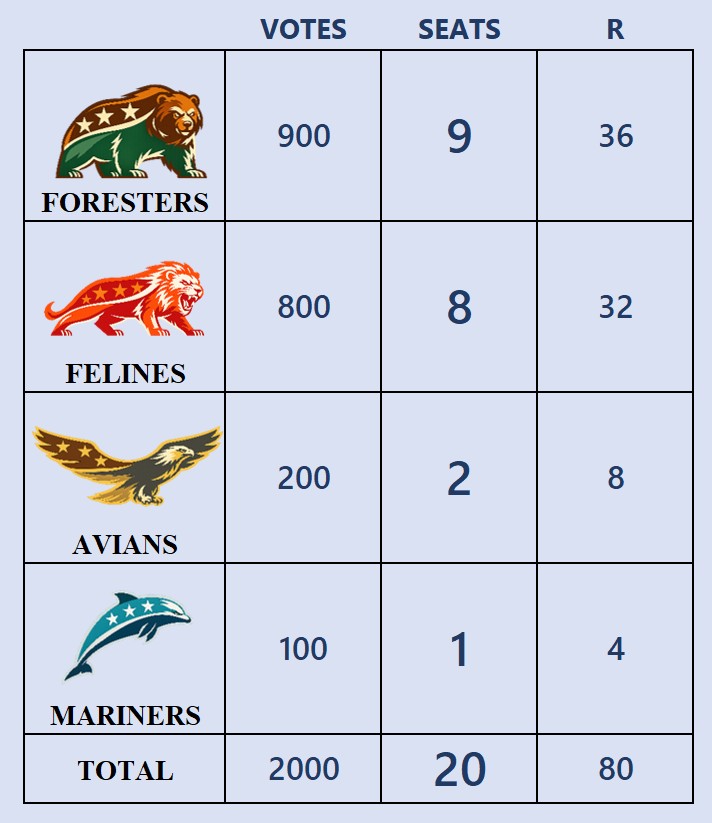
Note that all 20 seats are filled. Also note that all 4 factions combine for 80 remaining votes, which is less than the quota threshold required to gain another seat.
Now let’s consider if the 2,000 voters had 830 votes for the Foresters, 750 votes for the Felines, 270 votes for the Avians, and 150 votes for the Mariners. The quota threshold does not change, and the total seats and remaining votes for each faction becomes:
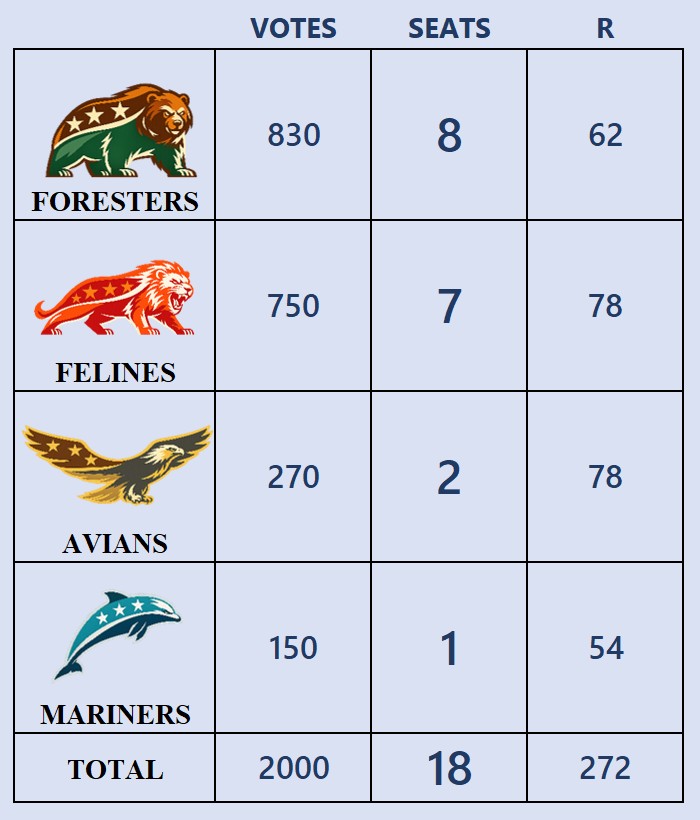
Note that in this case, only 18 of the 20 seats are initially assigned. The 4 factions combine for 272 remaining votes, but none of the factions individually have enough remaining votes to cross the 96 needed to gain another seat. Different systems may use different methods for assigning these remaining seats. One simple approach would be to award the remaining seats to the Felines and Avians because they have the highest remaining votes.
Supporters of party-list voting believe that these systems may more closely reflect the overall population and make it easier for smaller factions to gain representation. Critics argue that in elections, voters should be voting for people and not for parties.
Comments
This site does not manage comment accounts. Comment data is handled by a third-party discussion service.