Ballots for Ranked Choice Voting
One of the most common criticisms of ranked choice voting is that the ballots are confusing. That reaction is not surprising. Some ballots can look unfamiliar at first, especially compared to the simple “choose one” format many voters are used to. Further, there is no single correct way to design a ranked choice ballot.
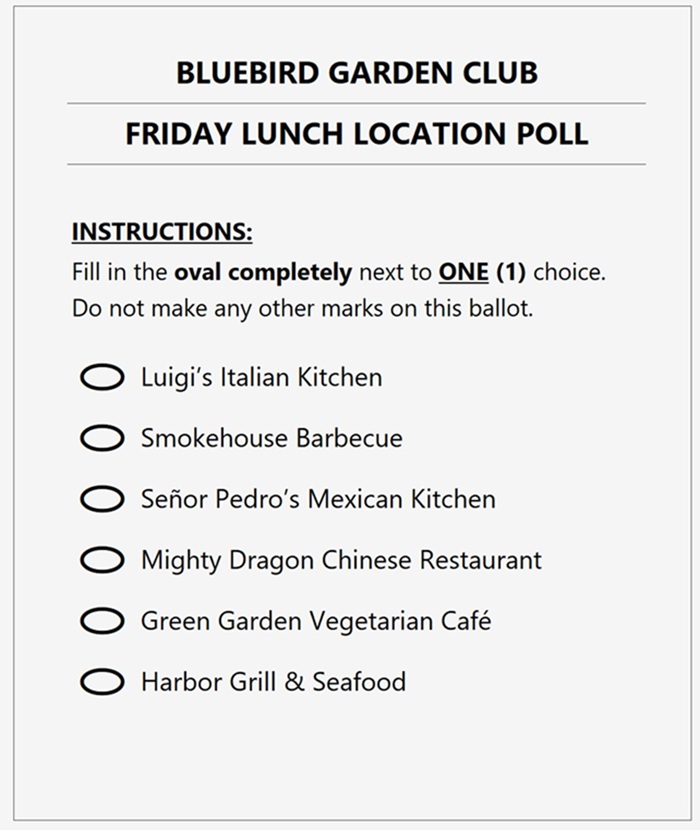 Consider a simple example. A garden club is deciding where to go for a Friday lunch, with six options. They are a friendly club and hope to find a consensus location where all members will be happy. They decide to use a simple pick-one ballot, as used in many democratic elections, that looks like this:
The format is familiar and easy to understand. At the same time, it captures only a single preference from each member. It does not show whether a member has acceptable alternatives, or whether there are options they would prefer to avoid.
The group could go with the option that receives the most votes, even though that number could be small, or hold additional rounds (runoff elections), narrowing the choices each time.
Alternatively, they could look for ways to capture more than a single preference. A ballot could allow members to select multiple acceptable options. Or it could allow them to rank their top choices. Different ranked choice voting ballot designs can affect how preferences are expressed, and in some cases, how results are determined.
Ranking Choices
Members can express their preferences by ranking their choices in order. This can be done in a simple written list:
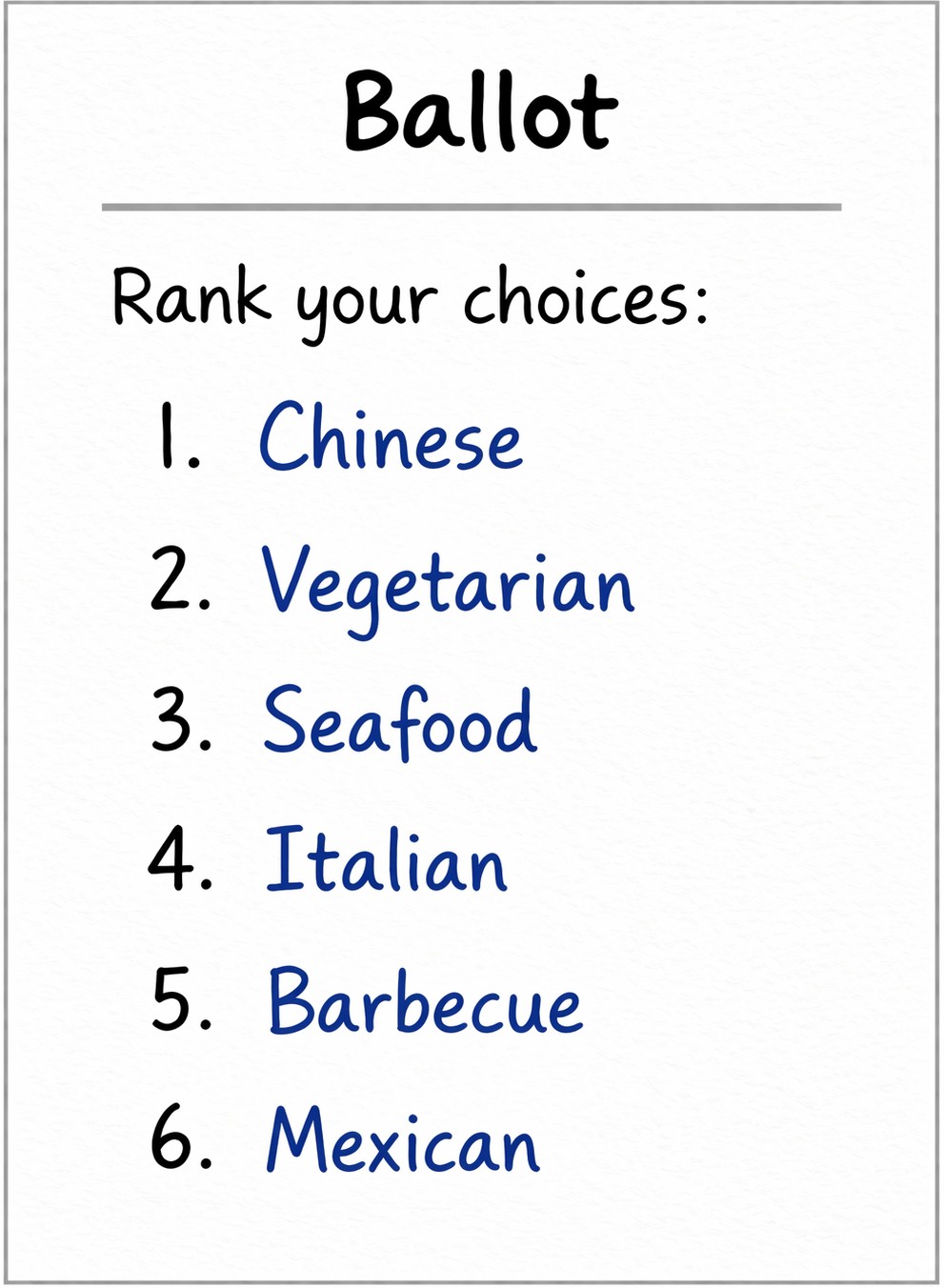
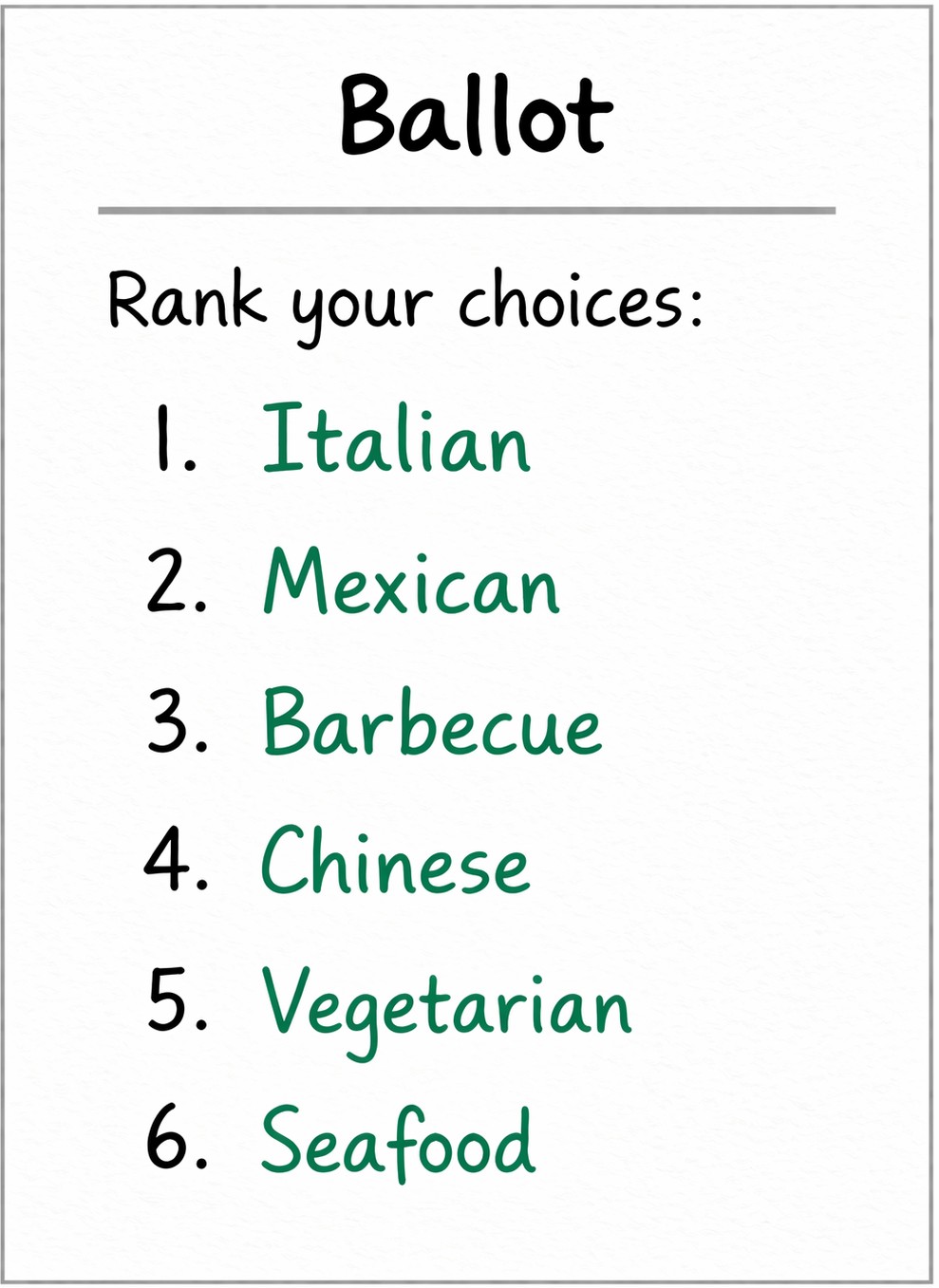
In many elections, this is done using a structured ballot, which records a full ranking of the choices.
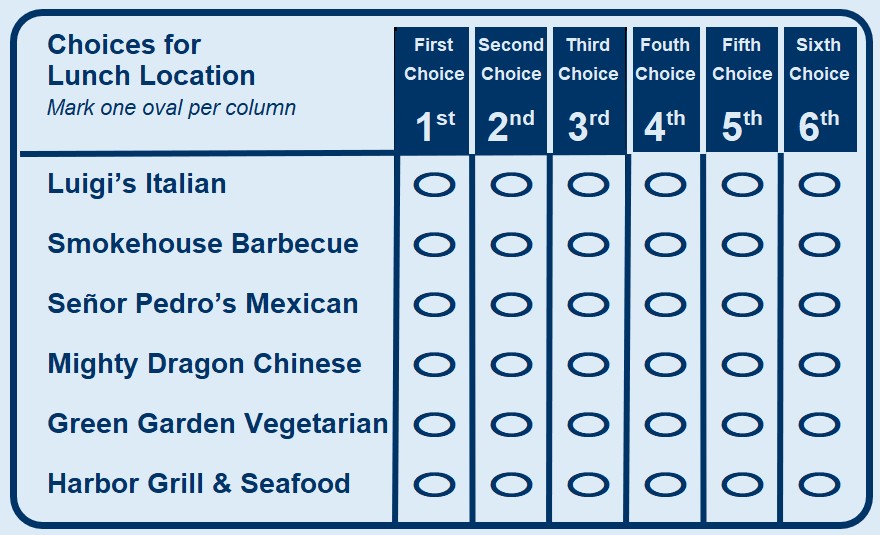
Instead of expanding across columns, some ballots ask voters to assign numbers to indicate their preferences, capturing the same idea in a different layout.
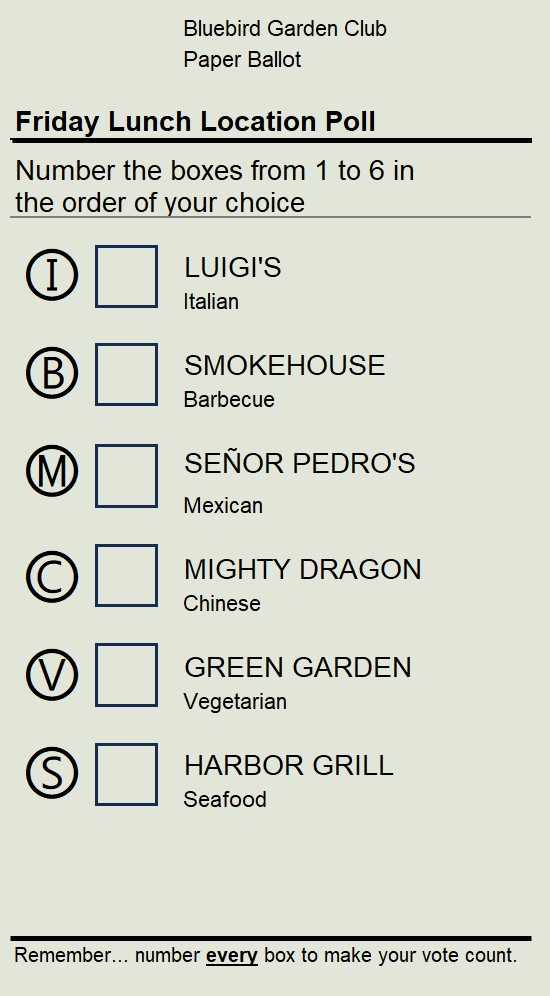
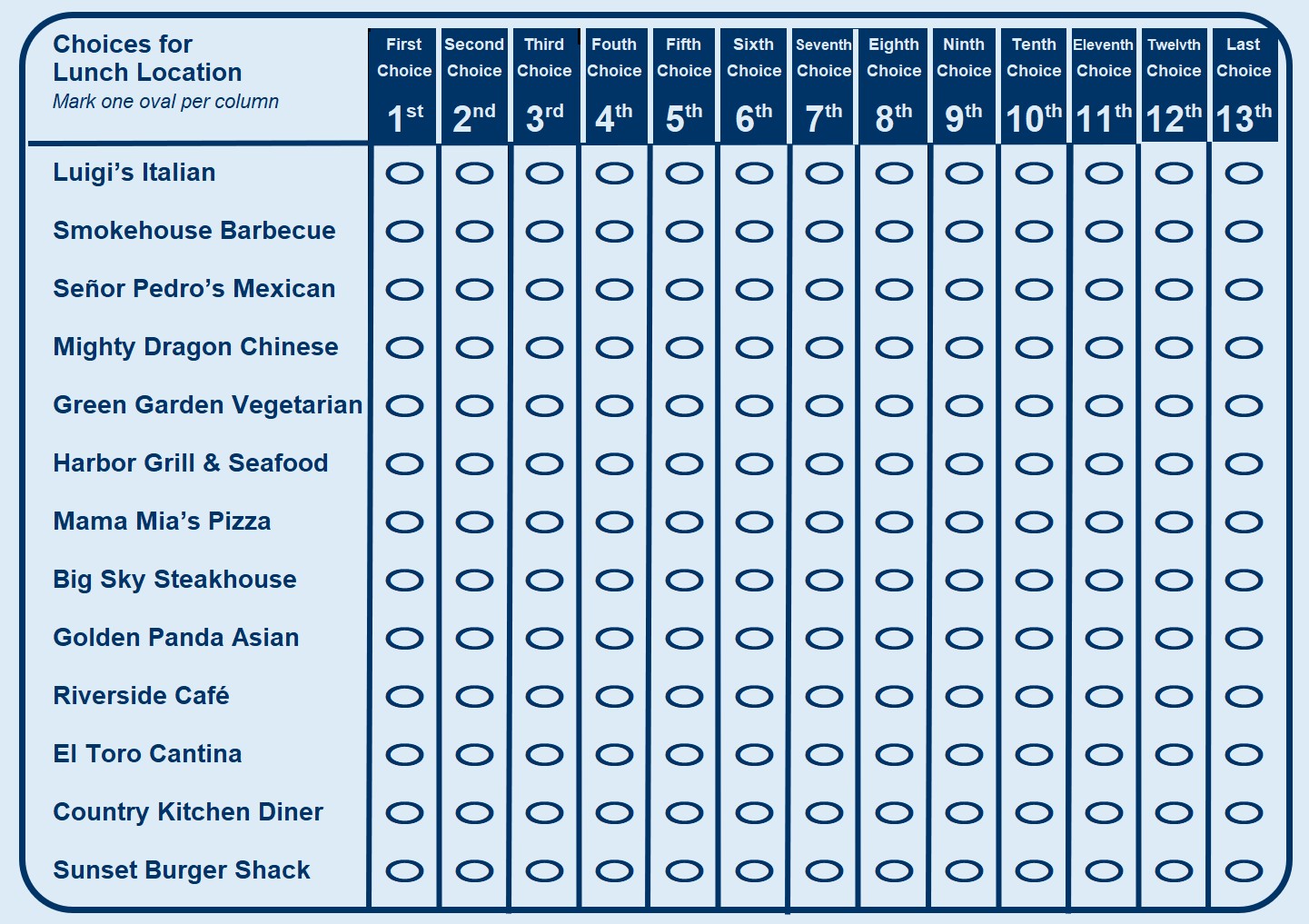
As the number of options increases, the ballot can become larger and more difficult to complete. For example, if there were 13 lunch choices, and voters were expected to give all of them individual rankings, the ballots may start to look ridiculous:
To keep the ballot more manageable, some elections limit the number of choices that can be ranked. For example, a ballot might allow only a first, second, and third choice:
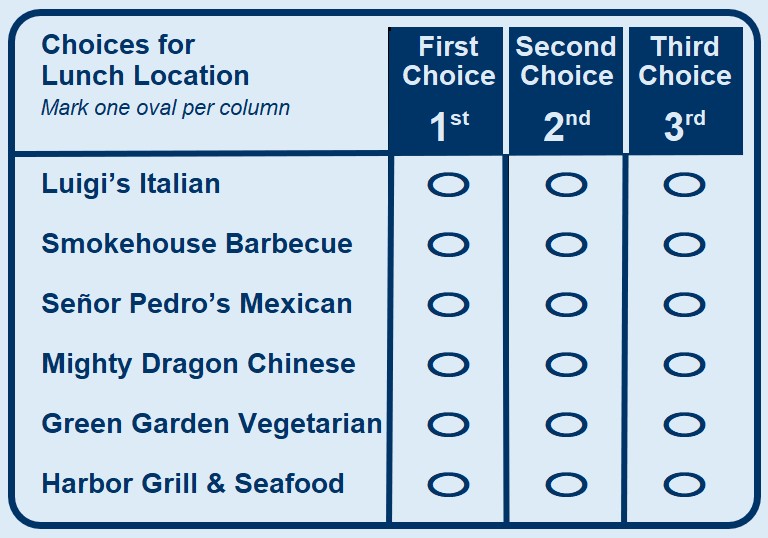
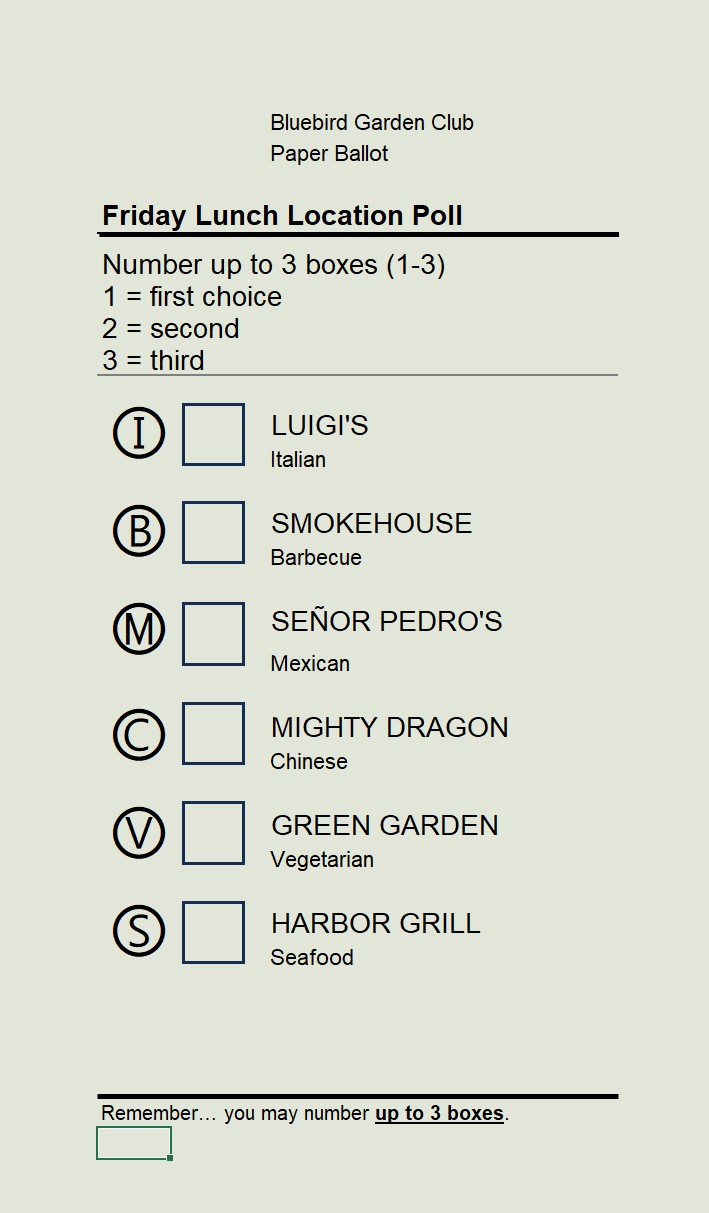
This still provides more information than a single selection while keeping the ballot relatively simple for voters to fill out.
Indifference Between Choices
Most ranked choice ballots require voters to rank candidates in a strict order, without allowing equal preferences. This leads to another criticism of ranked choice voting: voters may be asked to rank all of the candidates on a long list, even when they are only familiar with some and indifferent to the rest. A voter may have a clear first choice, and possibly a second or third choice, but no strong opinion about the remaining options.
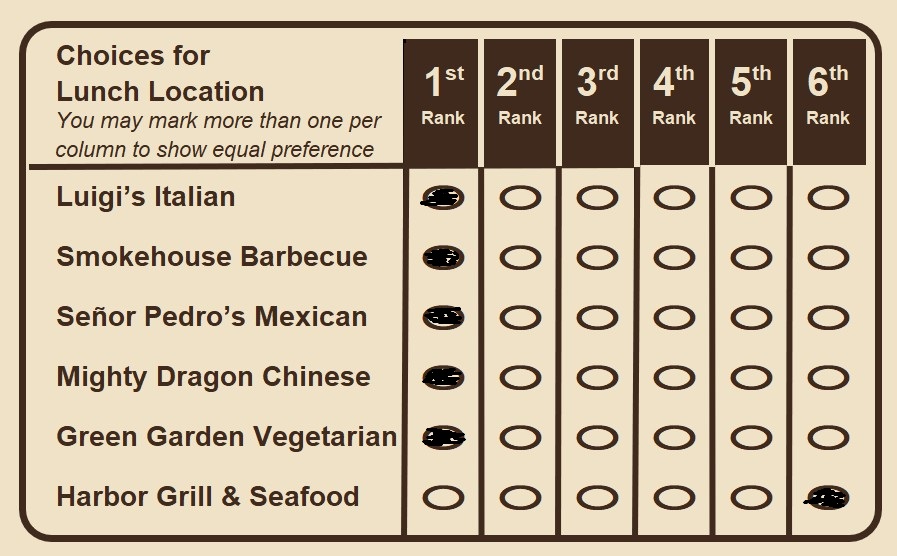
A member who selects only one option may not be disengaged. They may simply be indifferent to all of the remaining options. For example, suppose a member of the garden club strongly prefers the Chinese restaurant, but is indifferent to all of the remaining options. She might express that preference in one of the following ways:
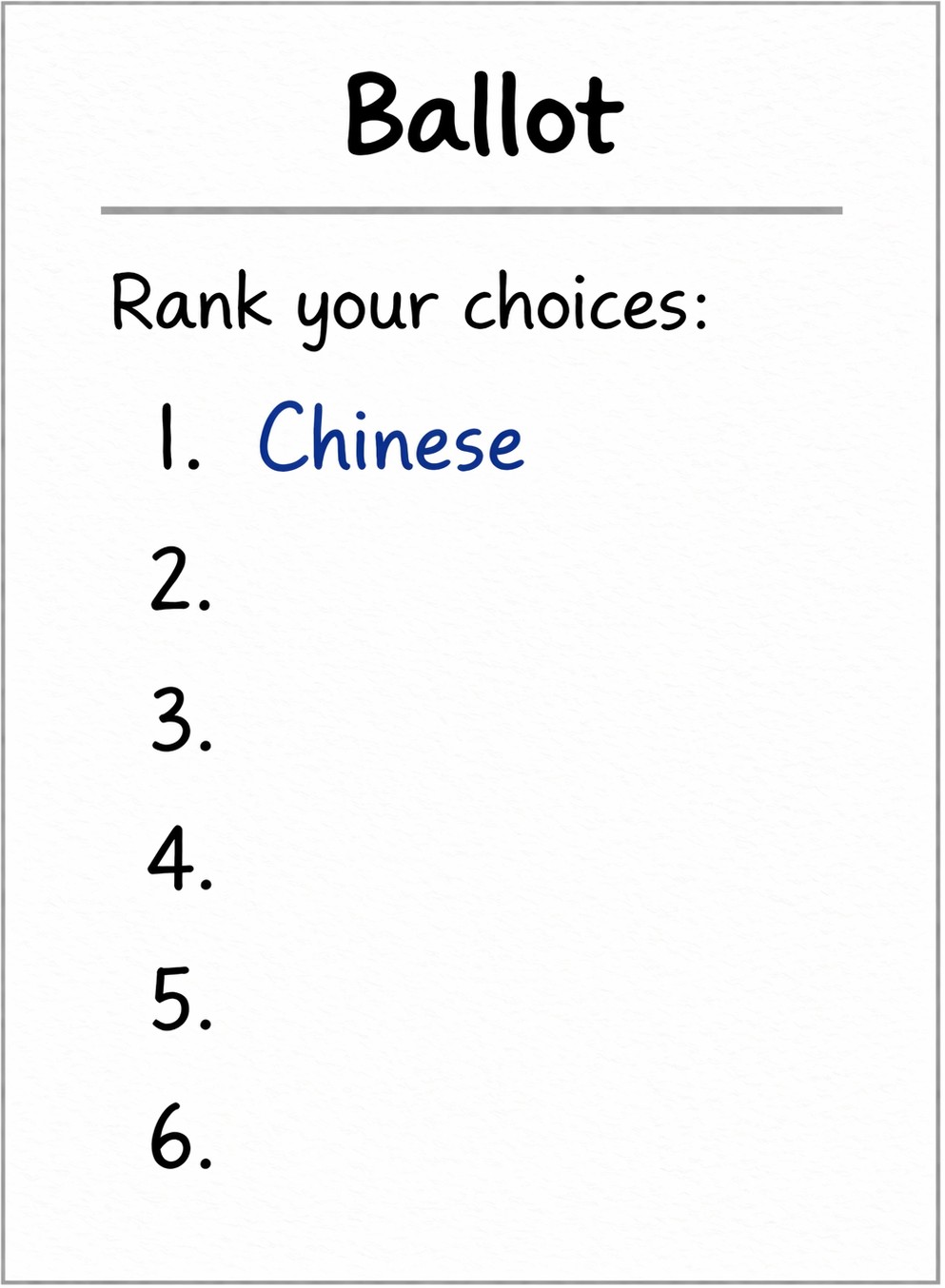
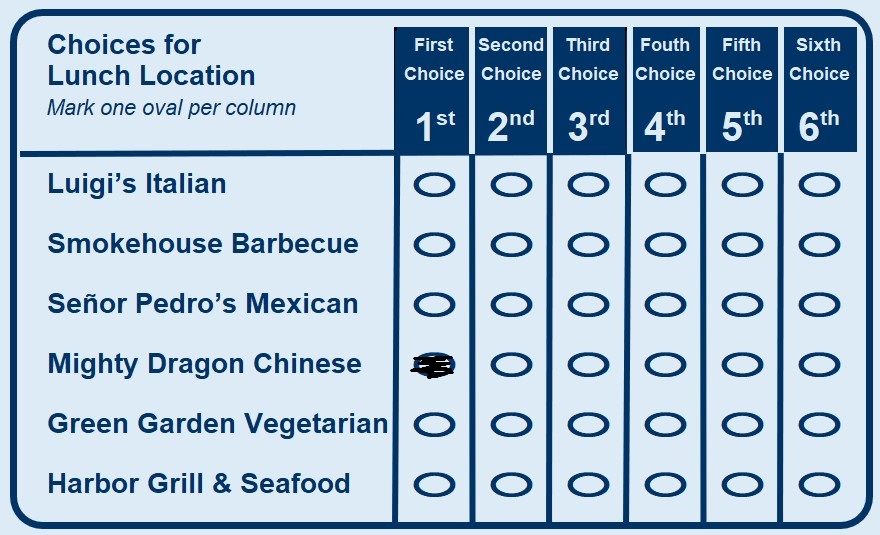
Another member may like all of the options equally, except the seafood restaurant. That member might want to fill out the ballot like this:
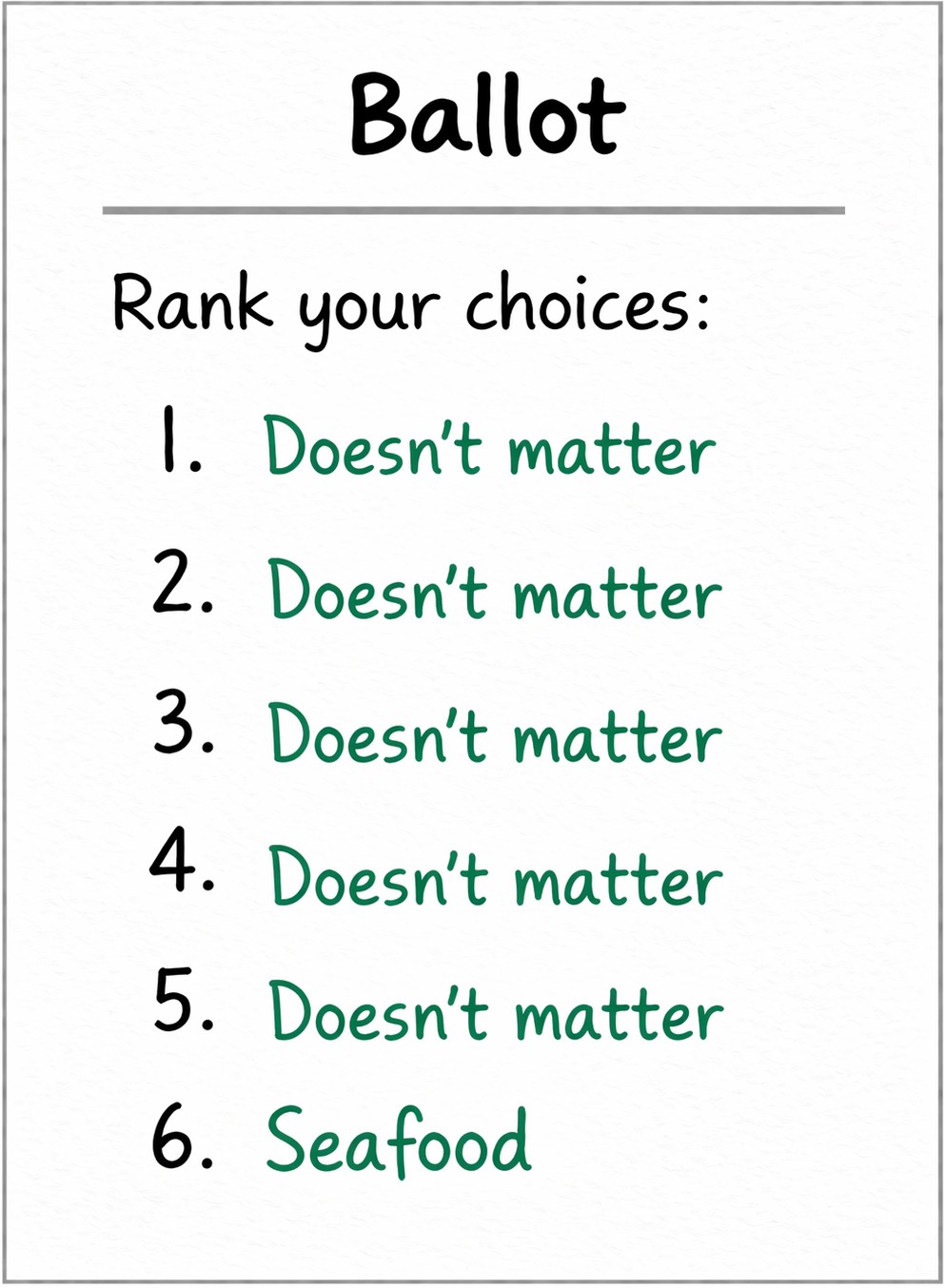
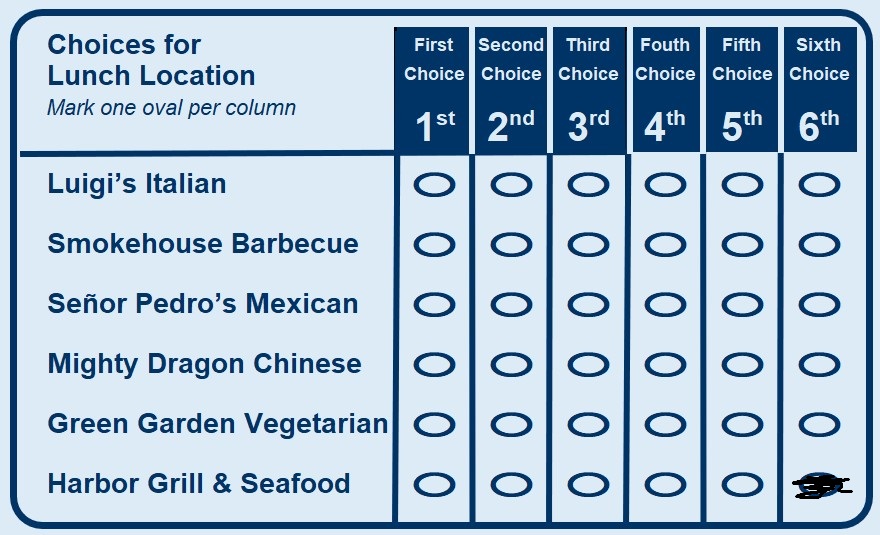
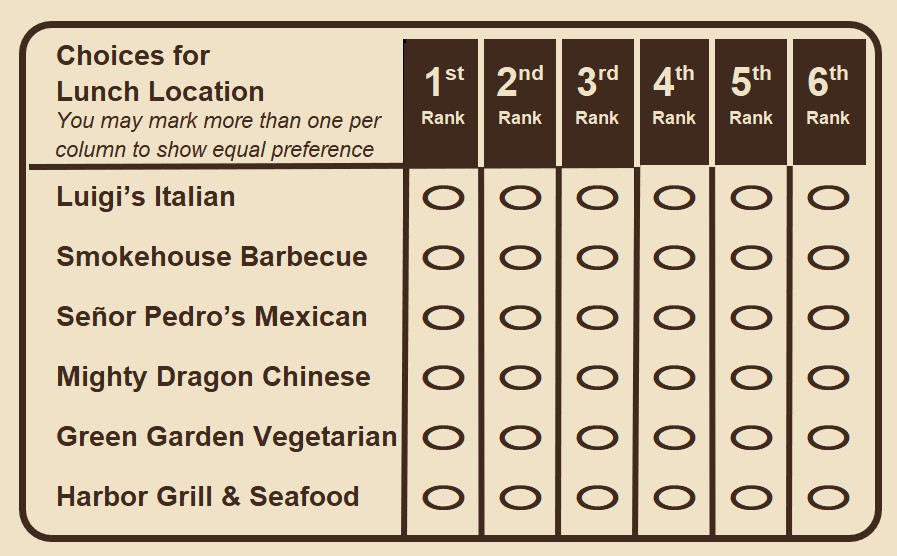
These are different ways of expressing the same idea: that a voter does not have a preference among certain options. Voters may also be indifferent between options at different points on the ballot, not just at the top or bottom. A voter may have a clear top choice and bottom choice, but no preference among the remaining choices. Some ballot designs allow voters to express this more directly. Most ranked choice ballots used in public elections do not allow this, but it illustrates another way preferences could be expressed without forcing the voter to rank every option on the ballot. For example, a ballot could allow voters to mark multiple choices at the same rank:
A voter with a single strong preference could mark one option first, and group the rest together:
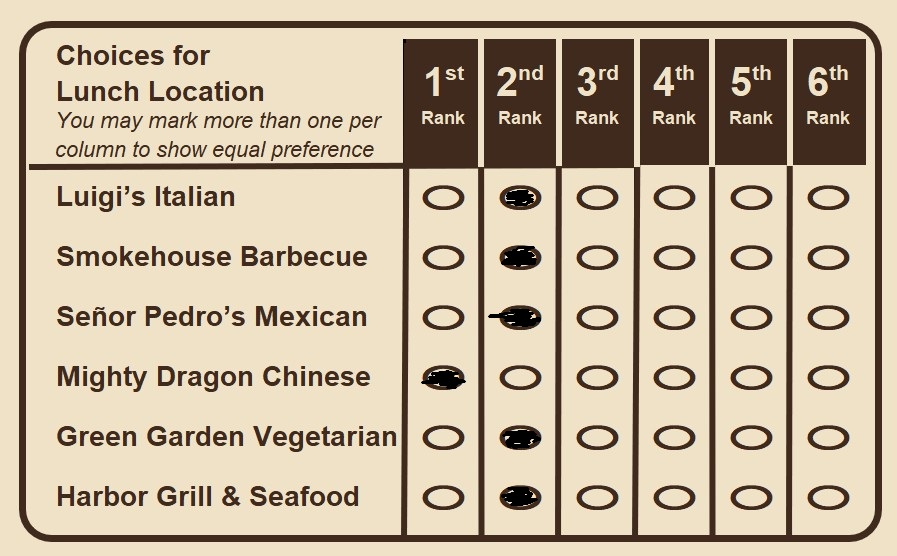
A voter who only wants to avoid one option could group the acceptable choices together and rank the least preferred option last:
A voter with more structured preferences might group options at different levels:
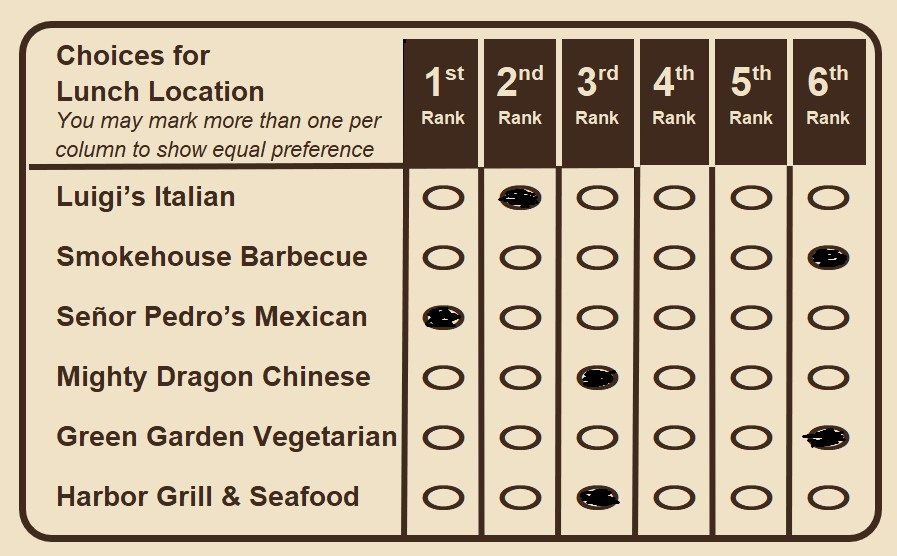
As the grid example shows, when a voter is indifferent between options, there may be multiple ways to fill out a ballot that represent the same underlying preference. Not all ballots allow voters to express indifference, and even when they do, they may not capture it clearly.
Other Ways Voters Fill Out Ballots
In practice, voters do not always follow the instructions on the ballot. For example, a voter who strongly prefers one option might mark that same choice across every rank:
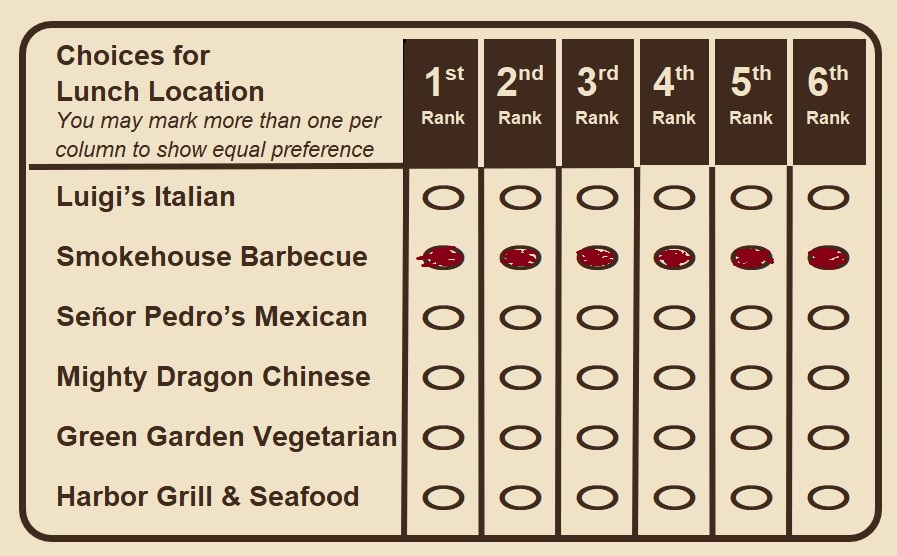
A voter may do this believing it strengthens their preference. This reflects a legitimate voter intent. While a ballot like this may appear to give multiple votes to the same choice, a well-designed voting system would not give this ballot any more weight than a ballot that only marks a first choice.
Score Ballots
Other systems ask voters to assign scores to each choice. While ranked ballots are typically organized from most favored to least favored (first choice, second choice, third choice), score ballots are often organized from lowest score to highest score (worst to best), as shown below:
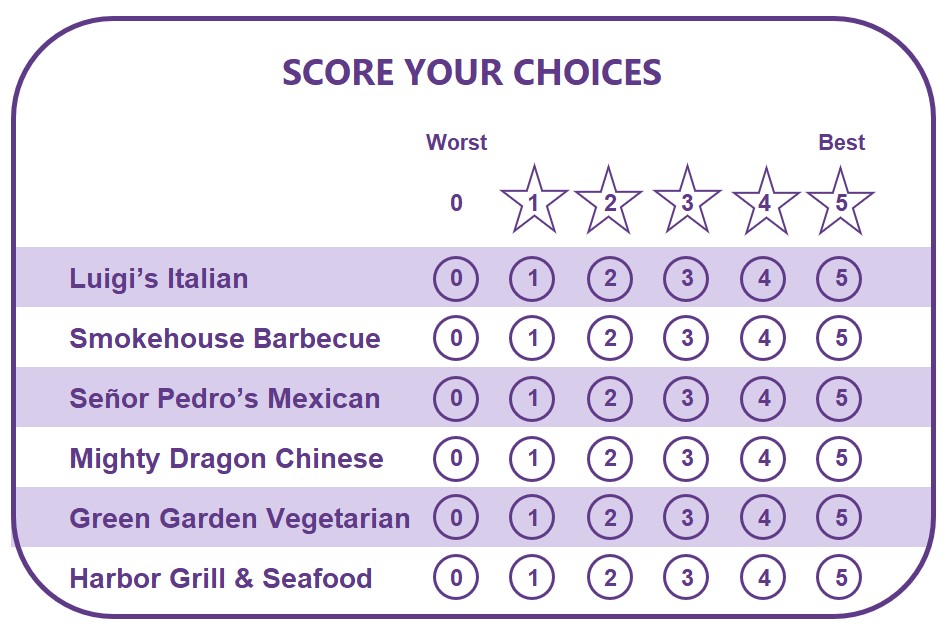
This illustrates another challenge in ballot design. No matter how much thought is put into the layout, voters may naturally think about their preferences in the opposite order from the way the ballot is designed. To help reduce confusion, score ballots often include numbers within each oval, begin with a score of 0 to avoid confusion with first place, and include labels across the top showing "Worst" and "Best." Whether the ballot is ranked left to right or scored right to left, voters who misunderstand the instructions may unintentionally communicate preferences opposite to their actual intent.
Pairwise Ballots
Pairwise ballots represent another way of collecting a voter's order of preference. To resolve the potential confusion of ranking left to right or right to left, pairwise ballots ask voters to compare candidates in a series of head-to-head contests. There are currently proposals in several states to use 3-candidate pairwise ballots that look similar to the following:
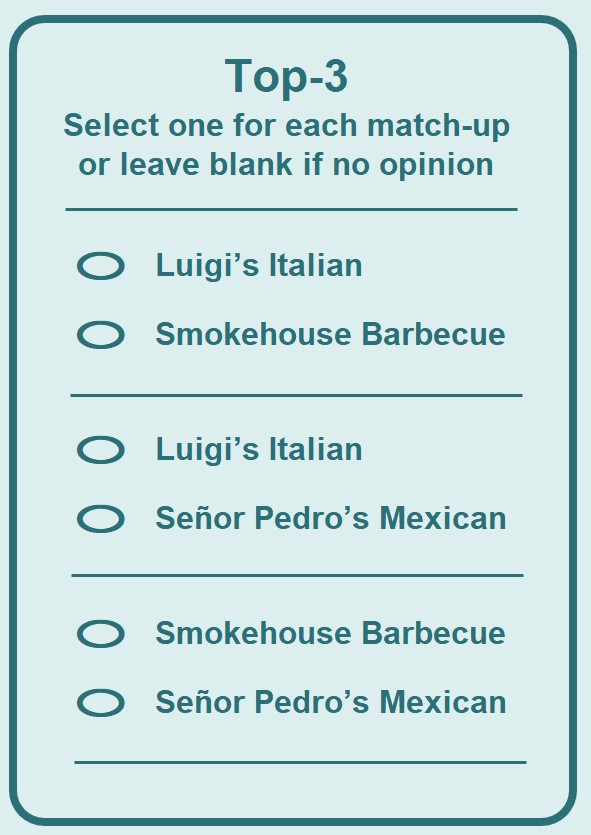
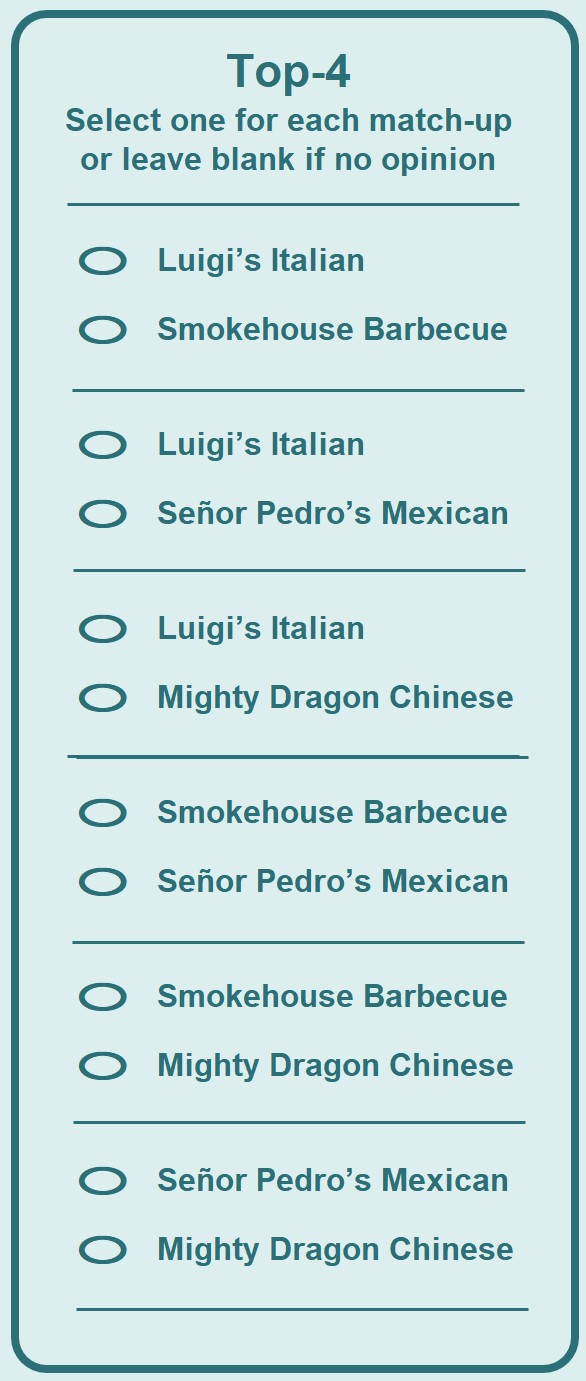
While these ballots allow for indifference, they do not necessarily fill in the blanks left by the voter. For example, if a voter indicates A>B and B>C, but leaves A vs C blank, the currently proposed system does not automatically assume a preference of A>C. In fact, this style of ballot actually allows the voter to indicate C>A, expressing a cyclical preference of A>B>C>A. Pairwise ballots work particularly well with three candidates because there are only three matchups. However, the number of matchups grows rapidly as candidates are added. For example, a 4-candidate pairwise ballot requires six separate comparisons, and may look like:
Ranked choice ballots can have a wide variety of designs. Some voters may have no difficulty adapting to the majority of these designs, while others may find certain designs unfamiliar or difficult to interpret.
There may not be a single ballot design that is universally acceptable to all voters. If you have seen other ballot formats, or have ideas about how ranked choice ballots could be improved, please feel free to share them in the comments.
Comments
This site does not manage comment accounts. Comment data is handled by a third-party discussion service.